Pnyx: The Assembly Hill of Ancient Athens
Site at a Glance
- Popularity
- Very High
- Country
- Greece
- Primary era
- Classical
- Eras represented
- Classical
- Civilizations
- Ancient Greek, Kingdom of Macedon, Roman
- Site type
- Civic
On this page19 sections
History
The Pnyx is a rocky hill in central Athens, Greece, that became the official meeting place of the Athenian citizen assembly in the early fifth century BCE. After reforms by Cleisthenes, an Athenian political reformer whose measures helped establish democracy, the assembly first met in the Agora, the city’s civic and commercial center, before moving to the hill.
Assembly and democratic government
The assembly met at the Pnyx about once every nine days to decide matters affecting the city-state. The meeting place was associated with the equal right of male citizens to speak in public debate, although only a relatively small number spoke. Citizens over 50 had the right to speak first. A citizen proposing a measure could face prosecution if it was judged unlawful or harmful to Athens. The politically active citizen body is estimated to have represented about one-fifth of the city’s adult population.
Speakers at the Pnyx included the statesmen Themistocles, Aristides, Pericles, and Alcibiades, as well as the orators and politicians Demosthenes and Aeschines. Demosthenes argued against Philip II, the king of Macedon.
Athenian democracy was suspended in 411 BCE and again in 404 BCE during the Peloponnesian War, a conflict between Athens, Sparta, and their allies. After the oligarchic Thirty Tyrants seized power in 404 BCE, democrats regained control in 403 BCE and assembly meetings resumed. Athens lost its independence following the Macedonian victory over a Greek coalition at Chaeronea in 338 BCE, but continued to govern its internal affairs democratically until Demetrius of Phaleron’s coup in 322 BCE. Democratic forms continued after his fall.
Later use and archaeological investigation
Assembly meetings had shifted to the Theater of Dionysus on the Acropolis’ south slope by the first century BCE at the latest. Assemblies dealing with naval affairs also met at Piraeus, Athens’ port, and on the nearby hill of Mounichia. In the Hellenistic era, which followed Alexander the Great’s conquests, and during Roman rule in Greece, the Pnyx became a cemetery. Part of the hill was also used for a sanctuary of Zeus Hypsistos. The name Pnyx is commonly understood to refer to stones packed closely together. It may have arisen in a later building phase as a description of the site’s appearance.
The hill was proposed as the assembly’s location in 1765. George, Earl of Aberdeen, excavated near the speaker’s platform in 1803. Ernst Curtius investigated the hill in 1862 and interpreted it as a sanctuary of Zeus Hypsistos, while John M. Crow undertook further work in 1882–1883. Excavations by the Greek Archaeological Society beginning in 1910 confirmed the assembly-site identification. Large investigations from 1930 to 1937, led by Homer A. Thompson with K. Kourouniotes and later Robert Scranton, clarified the site’s development and building phases.
In modern times, Greek revolutionary leader Theodoros Kolokotronis also addressed an audience from the hill. During the Second World War, antiquities from Athens’ museums were hidden in the Pnyx spring to protect them from the occupying Nazi forces.
Remains
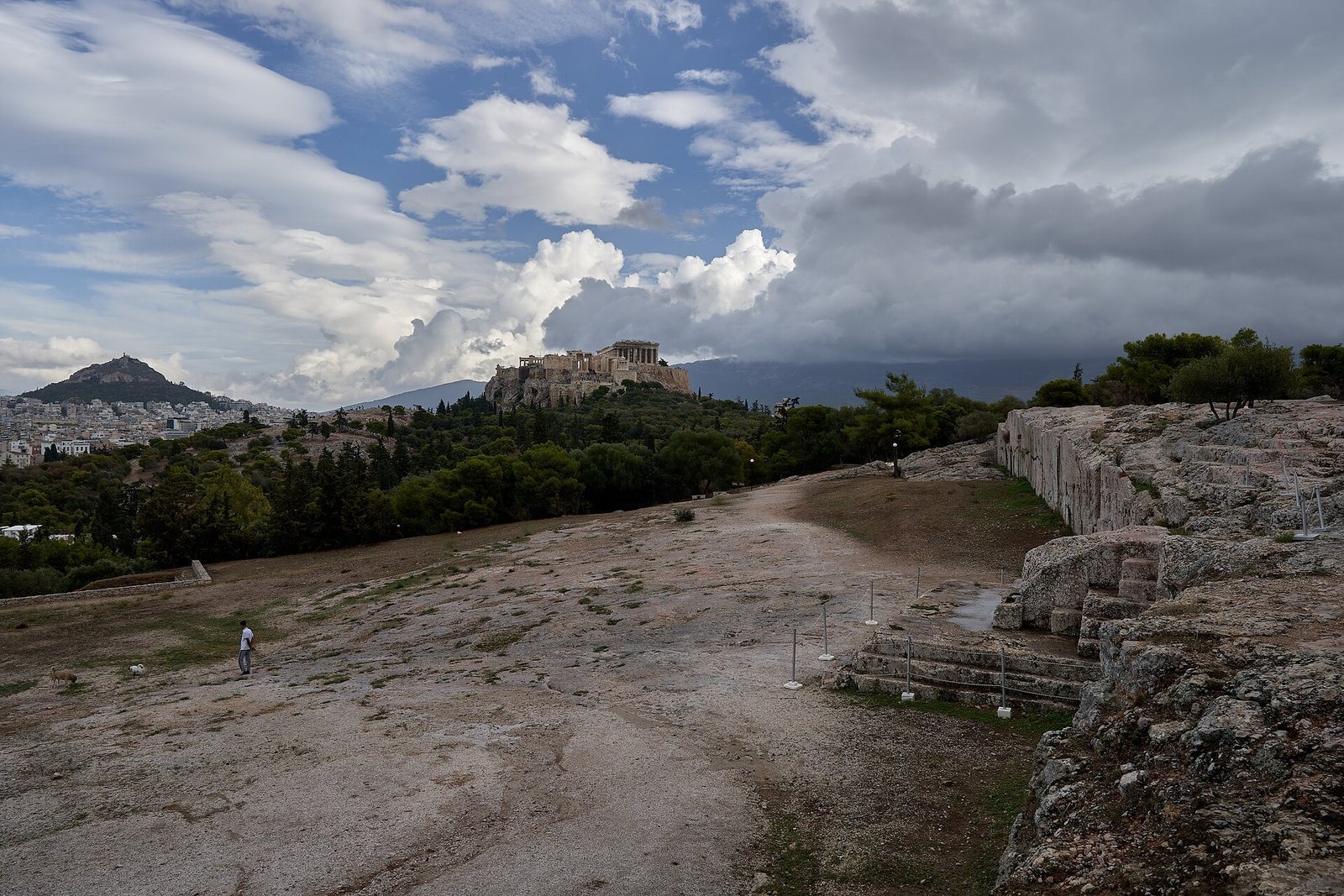
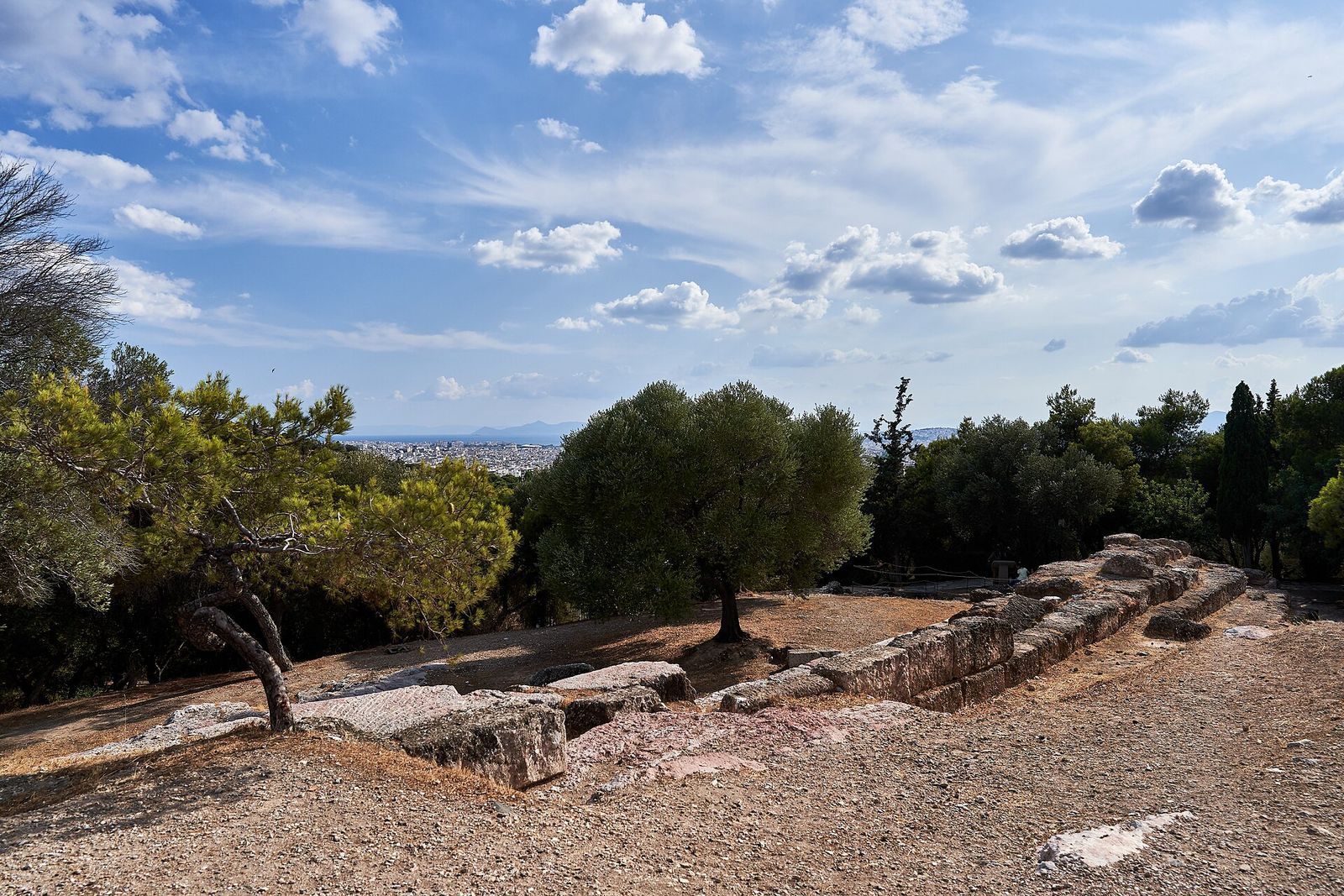
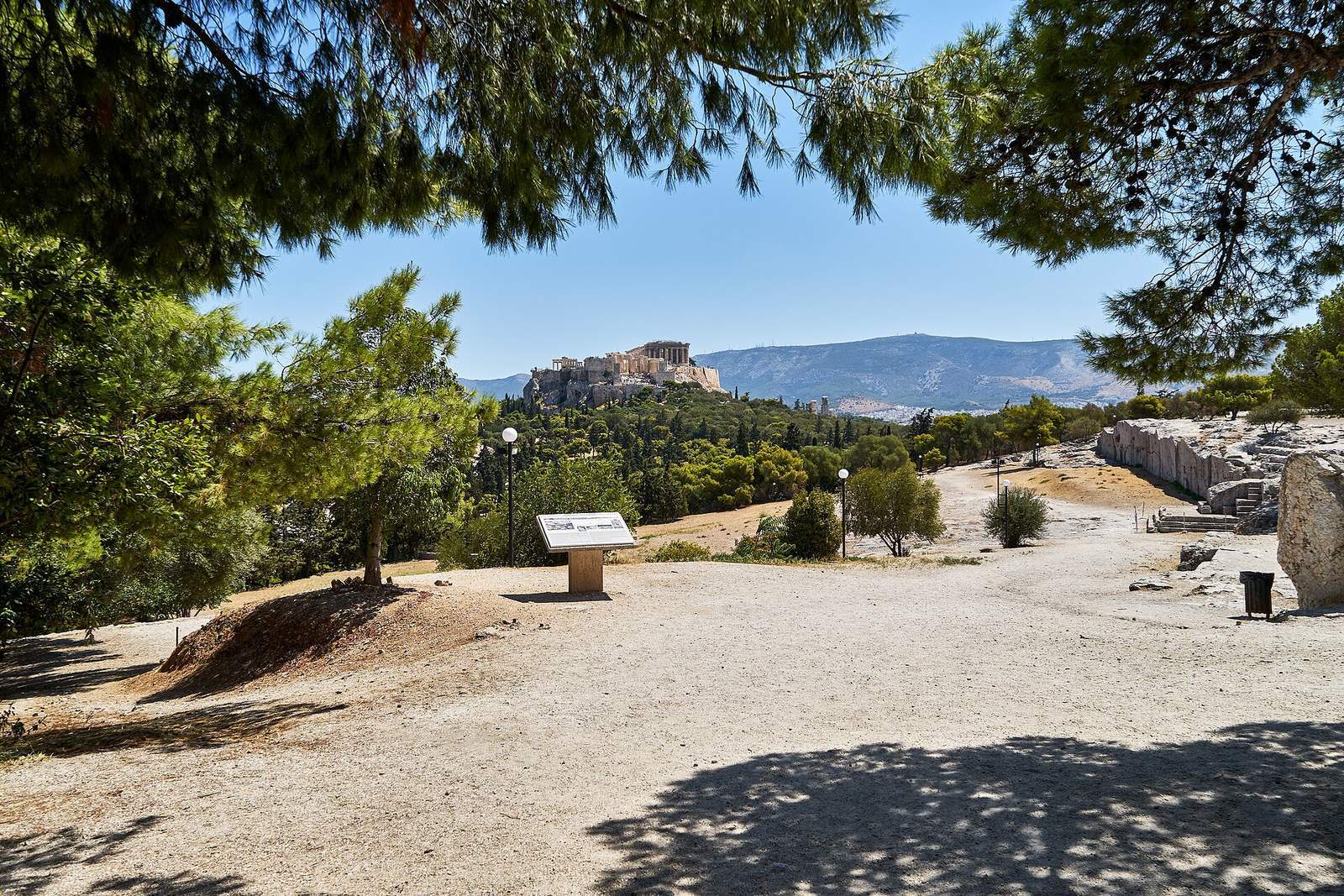
The archaeological area occupies a rocky ridge running north to south, about half a kilometre west of the Acropolis. The Hill of the Nymphs lies to its north and the Hill of the Muses, also called Philopappos, to its south; parkland surrounds the remains. The assembly complex developed through three main building phases. Its surviving parts include cuttings in the rock, sections of retaining walls, stairways, and the remains of the speaker’s platform. A fifth-century BCE marble inscription supports the identification of the site as the assembly place. Wooden seats were provided for the 500 members of the Council, which prepared the assembly’s agenda and managed the city’s daily affairs; the rest of the audience apparently stood. The bare-rock area in front of the platform has been estimated to have held about 6,000 men.
The assembly complex
Pnyx I
The first phase, built in the early fifth century BCE, placed the speaker’s platform on the northern or northeastern side of the hill. Listeners gathered on the natural slope above it, facing the Agora and the city. A straight retaining wall stood behind the platform. Rock cuttings and a boundary stone found away from its original position are among the surviving traces. The capacity of this arrangement is uncertain, with estimates ranging from about 5,000 to 13,000 people.
Pnyx II
Built around 404–403 BCE, the second phase reversed the auditorium’s orientation. The speaker’s platform stood at the uphill, southwestern end, while a stepped terrace for listeners descended southwest toward it. Part of the terrace wall survives, along with two stairways cut into the rock that led up from the direction of the Agora. Each stairway was about 3.9 metres wide. This arrangement could accommodate roughly 5,000–6,000 people. The reorientation took place during the rule of the Thirty Tyrants. Plutarch later linked it to the view that Athenian naval power was essential to democracy; another proposed explanation is that the new arrangement sheltered the assembly from strong northeasterly winds.
Pnyx III
The third phase, built around 345–335 BCE, enlarged and rebuilt the meeting place. Its paved, stepped auditorium was partly cut into the natural rock and sloped southwest toward the speaker’s platform. A semicircular retaining wall supported it from the north and northeast. The platform and the auditorium’s southern section were quarried from bedrock, with quarrying traces still visible on the eastern rock face. The platform itself was cut into the rock, with steps carved on both sides. Its estimated capacity is about 13,500, though proposals as high as 20,000 remain disputed.
Defensive walls
The Themistoclean Wall
The Themistoclean Wall, an ancient defensive wall of Athens named for the statesman Themistocles, crossed the hill immediately southwest of the assembly area.
Later defensive wall
A separate defensive wall was built in the fourth century BCE and rebuilt about a century later. Constructed with nearly solid masonry and large cut-stone blocks, it was about two metres thick and had seven towers spaced roughly 40 metres apart. Its course ran from a northern tower south of the Melitides Gate to the western end of the summit, where it joined the Diateichisma, a cross-wall within Athens’ fortifications. Buttresses strengthened the connecting walls.
Planned public buildings
Covered colonnaded halls
Two covered colonnaded halls were planned on the southwestern side of the meeting place, one east and one west of the altar. Begun around 330–326 BCE, they were intended to shelter people attending the assembly from bad weather, but were never completed. Their unfinished state may be connected with construction of the Diateichisma around 325–307 BCE.
Altar of Zeus Agoraios
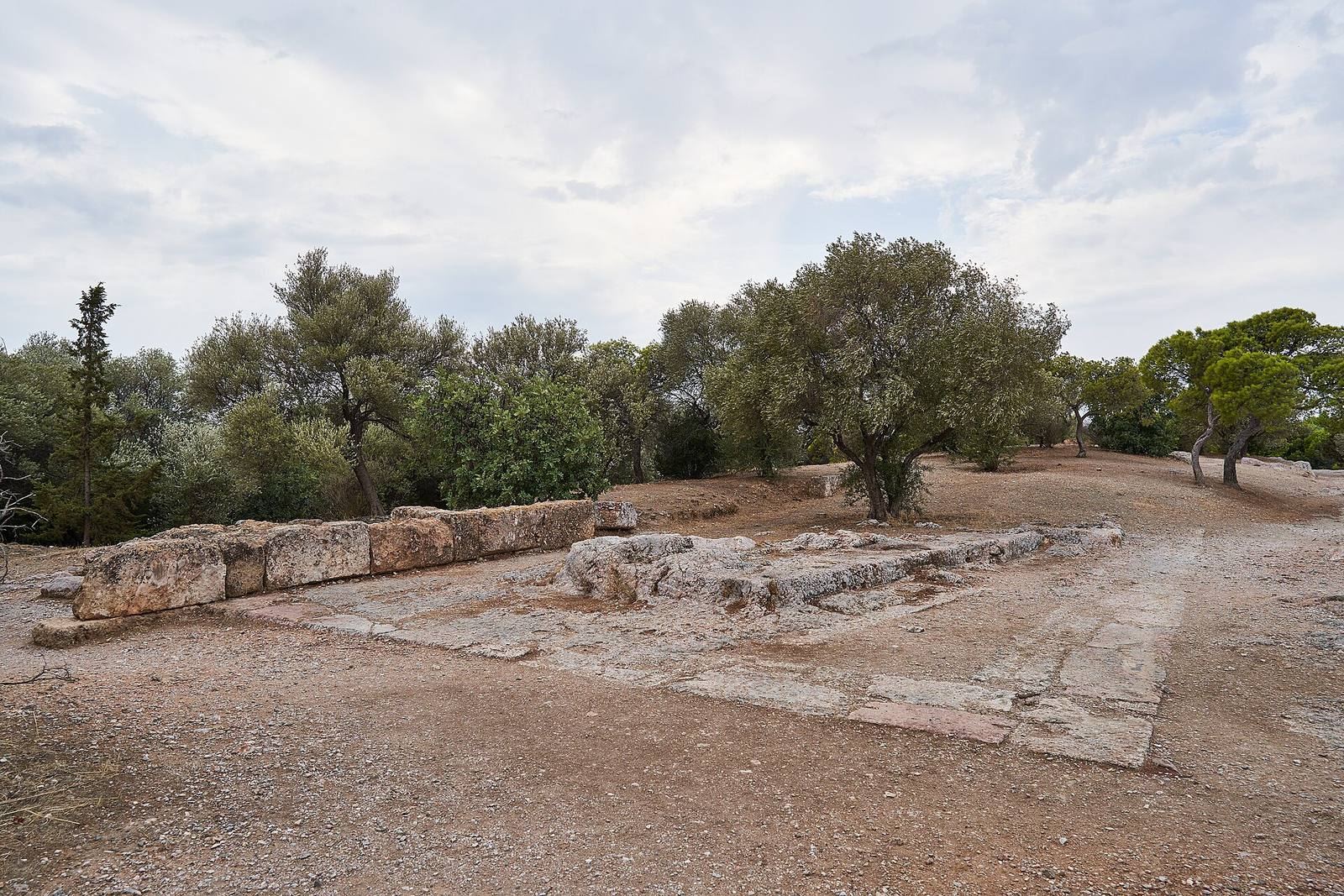
The altar of Zeus Agoraios, a name associating the god with the Agora, originally stood southwest of the speaker’s platform and was built at about the same time as the halls. During the reign of Augustus, Rome’s first emperor, it was moved to the Agora after the Pnyx had lost its political importance. A large rectangular cutting in the bedrock marks its former position.
Planned entrance colonnade
A rock cutting measuring about 19 by 13 metres lies between the planned halls. It is identified as the foundation area for a monumental entrance colonnade, begun alongside the halls and altar but left unfinished.
Sanctuaries, water, and astronomy
Sanctuary of Zeus Hypsistos
The sanctuary of Zeus Hypsistos stood immediately east of the speaker’s platform, to the audience’s left when facing it. Its remains include part of a floor, a staircase, and 58 niches cut into the rock for offerings. Many surviving offerings represent parts of the human body, including eyes and breasts, pointing to a healing role. Short inscriptions invoke Zeus as Hypsistos, meaning “Most High.” The pattern of dedications suggests informal worship, and many dedicants were women or people of modest social standing.
Sanctuary of Pan and the spring
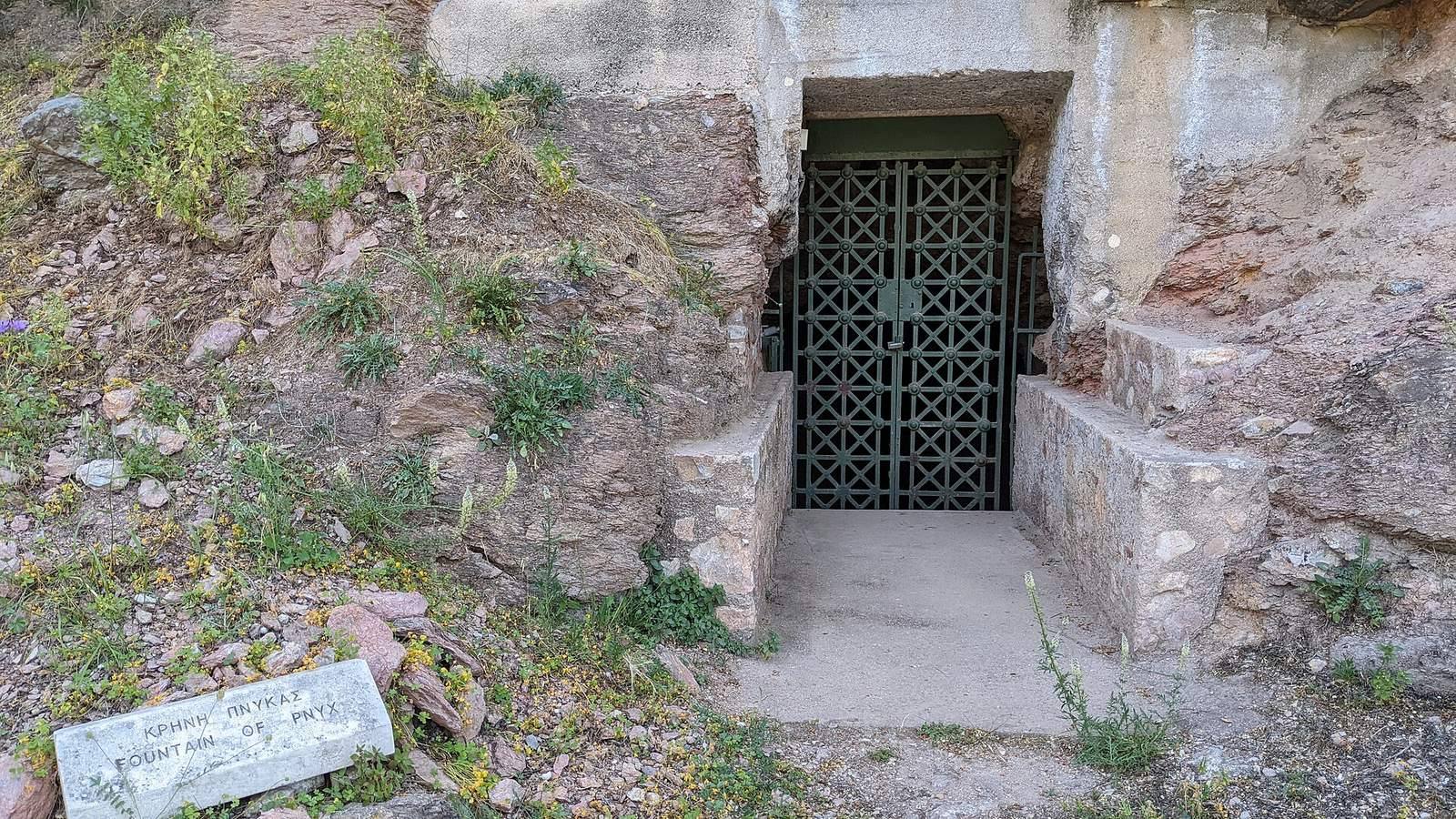
A cave-like sanctuary of Pan, a Greek deity associated with the wild and pastoral life, was also located on the hill. A relief found there shows Pan with a nymph, a female nature deity, and a dog. Below the sanctuary, the Pnyx spring is a water reservoir cut into the rock around the sixth century BCE.
Heliotropion
The foundations of a heliotropion, a tower for observing the Sun, Moon, and stars, survive at the site. The square tower measured about 4 by 4 metres. Its two diagonals were aligned north–south and east–west; the latter crossed the Pnyx along the line of sunrise at the equinoxes. The astronomer Meton used his observations to establish a 19-year cycle that reconciled lunar months with the solar year. In 432 BCE, that cycle was incorporated into the Attic calendar.