Pietramogolana Castle: A Medieval Fortress Guarding Italy’s Taro Valley


Site at a Glance
- Rating
- 4.3
- Popularity
- Very Low
- Country
- Italy
- Primary era
- Medieval
- Eras represented
- Medieval
- Civilizations
- Holy Roman Empire, Lombard
- Site type
- Military
- Remains
- Castle
On this page9 sections
History
Pietramogolana Castle is a medieval hilltop fortress in Italy, beside the settlement of Pietramogolana and above the Taro River. Its first fortification was probably built in the seventh century to guard the Taro Valley. The place, then known as Petra Mugulana, stood along the boundary between territories associated with Parma and Piacenza and was first recorded in a diploma issued by the Lombard king Pertarito on 23 October 674. The Lombards were a Germanic dynasty that ruled much of Italy during the early medieval period.
Early lords and episcopal authority
Pietramogolana’s strategic position made it a long-standing object of competition among the leading families of the region. At the beginning of the eleventh century, the fortress belonged to Count Plato Platoni. When he died in 1022, he left it to his fifth son, Begarolo.
In 1035, Holy Roman Emperor Conrad II granted the bishop of Parma, Ugo, authority over the territory of Parma, including Pietramogolana. The Holy Roman Empire was a political entity that included territories in central Europe and northern Italy, and its emperors could confirm territorial rights and feudal possessions. The authority of the bishopric, a diocese governed by a bishop, was exercised through the canons of Parma Cathedral and was later confirmed by other emperors.
In 1210, Emperor Otto IV granted full authority over the area to Bishop Obizzo Fieschi. Obizzo reinforced the castles controlled by the bishopric in the Parma region, with particular attention to Pietramogolana. A dispute over the extent of Parma’s authority followed in the next decade. In 1219, Emperor Frederick II confirmed Parma’s ancient rights, including full authority over its territory. The chief magistrate of Cremona, Negro Mariani, interpreted this as confirmation of the city’s complete independence from episcopal rule, while Obizzo Fieschi appealed to Pope Honorius III.
In 1220, the pope restored the diocese’s authority over the territories it had previously governed, including Pietramogolana. The settlement between Parma and the bishop was ratified in 1221. Obizzo then assigned the castle to the Platoni counts in exchange for 50 imperial pounds. In 1240, Marquis Oberto II Pallavicino seized the fortress, and Frederick II formally granted it to him in 1249. The Platoni brothers Rangone, Uberto, Alberto, and Rodolfo took possession in 1260. Gianquirico Sanvitale recovered the castle for the diocese of Parma in 1295 and received its formal grant from Bishop Obizzo Sanvitale.
Fourteenth-century rivalries
The castle continued to pass among powerful families and political authorities. In 1327, Emperor Louis the Bavarian confirmed the privileges of Marquis Manfredino Pallavicino’s family, including those connected with Pietramogolana. In 1355, Bernabò Visconti, lord of Milan, confirmed the formal grant of the fief to Giberto Sanvitale, Gianquirico’s heir. The Visconti were the ruling dynasty of Milan during this period. In 1361, the Platoni sold their one-third share of the Pietramogolana fief to Count Giberto.
The Pallavicino family later seized the castle by force and destroyed it in 1391. Marquis Niccolò Pallavicino received formal investiture, the granting or confirmation of a fief, from King Wenceslaus of Luxembourg in 1395. The fortress was rebuilt in 1404.
Wars, confiscations, and episcopal recovery
The rebuilt fortress was immediately drawn into further conflict. In 1404, Pier Maria I de’ Rossi attacked and captured Pietramogolana and nearby territories, including Berceto. Giacomo Terzi took the castle from him in 1408, but the Rossi recovered it the following year after a legal judgment. In 1412, Bishop Bernardo Zambernelli of Parma challenged the Rossi and appealed to the Roman Rota, a high ecclesiastical tribunal of the Catholic Church.
The diocese recovered the fortress in 1423 and assigned it to the brothers Manfredo and Bartolomeo Pallavicino. Five years later, troops of Filippo Maria Visconti, duke of Milan, attacked the nearby castle of Pellegrino under the command of Niccolò Piccinino and captured Marquis Manfredo Pallavicino. Torture forced him to confess to conspiring against the duke. Visconti condemned him to death and confiscated his possessions, including Pietramogolana, which he assigned to Piccinino.
Bishop Delfino della Pergola recovered the fief in 1450. In 1460, Bishop Agostino, serving as an apostolic commissioner of Pope Pius II, enlarged and strengthened the castle. He later assigned Pietramogolana to Count Stefano Sanvitale. The Rossi attacked and captured the fortress again in 1551, but returned it to the Sanvitale family in 1552.
Decline and modern ownership
After the sixteenth-century conflicts, the castle lost its strategic role and entered a slow decline as the Sanvitale family showed little interest in maintaining it. In 1627, the fief passed to the ducal treasury of Parma and was assigned to Count Cornelio Palmia. His heirs retained it until 1739, when the family ended with the death of the last count, Luigi Palmia. Pietramogolana was then reincorporated into the Duchy of Parma and Piacenza.
By the end of the nineteenth century, the castle had been reduced to a heap of ruins, and families from the settlement purchased it. In 2012, its numerous owners donated the ruins to the Municipality of Berceto. The municipality commissioned architect Roberto Bruni to prepare a project for recovery and rebuilding, but work had not begun because sufficient funds were unavailable.
Remains
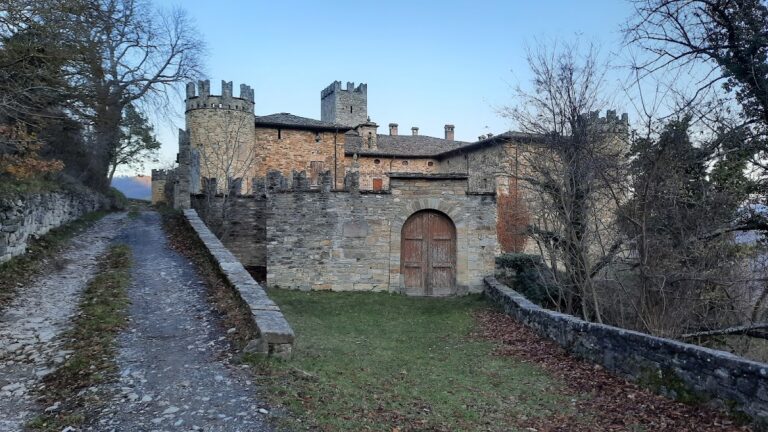
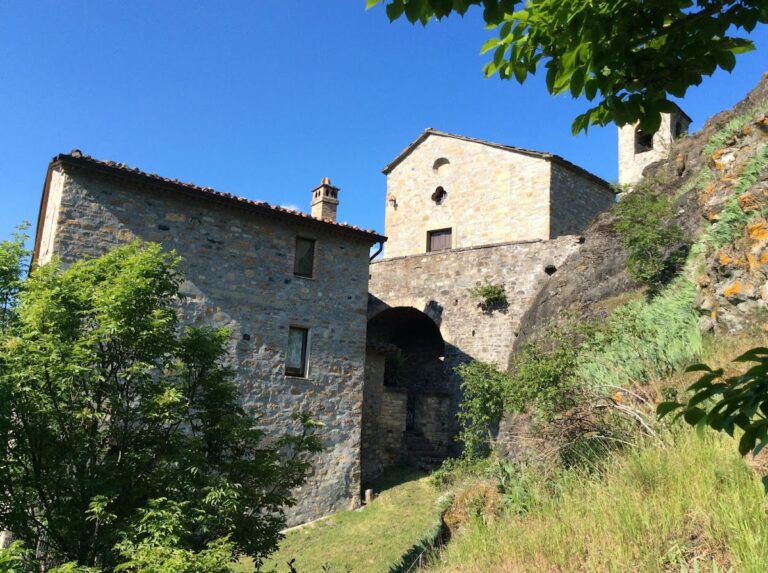
Pietramogolana Castle occupies a steep rocky spur beside Pietramogolana, overlooking the Taro River. The medieval fortress was built of stone using rubble masonry. Only limited traces of the complex survive, including parts of its keep and the lower remains of the main building. The original access path collapsed, making the ruins difficult to reach.
Fortified structures
Square keep
The keep, the castle’s principal fortified tower, had a square plan. At ground level, three sides of its perimeter wall remain. These surviving sections identify the tower’s basic shape and preserve part of the structure that formed the central defensive element of the fortress.
Main building
Lower down the spur, toward the settlement, a few traces of the main building survive. They indicate the basic plan and arrangement of the medieval complex. Together with the remains of the keep and the surviving stonework, these fragments define the limited but readable outline of the former fortress, which is now in a ruinous condition.
Nearby sites