Rocca di Rusino: A Medieval Castle Overlooking the Enza Valley


Site at a Glance
- Rating
- 3.9
- Popularity
- Very Low
- Country
- Italy
- Primary era
- Medieval
- Eras represented
- Medieval
- Civilizations
- Holy Roman Empire
- Site type
- Military
- Remains
- Castle
On this page6 sections
History
Rocca di Rusino, also known as Rocca di Belvedere, Castello di Rusino, and Castello di Moragnano, is a medieval castle in Italy between the settlements of Rusino and Moragnano, in Tizzano Val Parma. Most historians date its construction to the first years of the fifteenth century, when Ottobuono de’ Terzi, a military commander and lord of Tizzano, commissioned it as a fortified garrison controlling the Enza Valley.
Origins and Terzi Control
An earlier origin around 1100 has been proposed, linking the fortification to the noble Da Moragnano family, vassals of the Obertenghi, a powerful aristocratic family that held extensive lands and feudal rights in northern Italy. This early date and attribution remain unsubstantiated. The better-supported account places the castle’s creation in the period of Ottobuono de’ Terzi’s rule.
The site entered the wider politics of the Terzi family in 1364, when Niccolò and Giberto Terzi swore allegiance to Bernabò Visconti, the Milanese ruler, for the castles of Tizzano and Belvedere. On 19 August 1387, Emperor Wenceslaus of Luxembourg confirmed the family’s investitures, including these principal castles and territories obtained through earlier imperial grants.
Fifteenth-Century Conflicts
After Ottobuono de’ Terzi was killed in 1409, the marquis Odoardo Pallavicino occupied the castle on behalf of Niccolò III d’Este, ruler of Ferrara. In 1441, after Parma had been transferred in exchange for Reggio Emilia, Filippo Maria Visconti, duke of Milan, regranted the Belvedere fief to the counts Guido and Giberto Terzi.
Parma briefly governed itself independently from Milan in 1447 and 1448. During that interval, the city placed the territory of Rusino, Moragnano, Vezzano, Groppizioso, Lalatta, Treviglio, and Musiara under the direct administration of Antonio Caviceo, a chief municipal official known as a podestà.
Late in 1448, after Parma’s municipality destroyed Castellaro Castle, Jacopo Vallisneri attacked and captured Rocca di Rusino. He surrendered it voluntarily to Alessandro Sforza in 1450, after Sforza had reconquered Parma. That same year, Duke Francesco Sforza of Milan elevated the fief to a county and returned it to the Terzi family. Their investiture was confirmed in 1459.
The castle continued to face military threats. Count Roberto Sanseverino d’Aragona besieged it in 1479 but withdrew without taking it. In 1518, the Reggio-born bandit Domenico Amorotto likewise attacked the stronghold and failed to capture it.
Loss of Military Function and Later History
During the War of Parma in 1551, Camillo Rossi attacked and seized the fortification. Afterward, Rocca di Rusino ceased to serve its defensive purpose. The castellan and guards moved to Moragnano, while the county became part of the Rossi family’s domains.
In 1666, the indebted marquis Scipione I de’ Rossi transferred his Apennine fortresses, including Belvedere, to the Ducal Chamber of Parma. Duke Ferdinand of Bourbon later granted the Belvedere fief to Count Giuseppe Camuti in 1774. Camuti exchanged it in 1790 for lands at Ronchetti di San Secondo with Count Pietro Andrea Leggiadri Gallani, who retained his rights until Napoleonic decrees abolished them in the former Duchy of Parma and Piacenza in 1805.
By the beginning of the twentieth century, the castle had declined to a ruined tower and associated remains. The surviving structure was reinforced, unstable sections were removed, and accumulated debris was cleared from the interior.
Remains
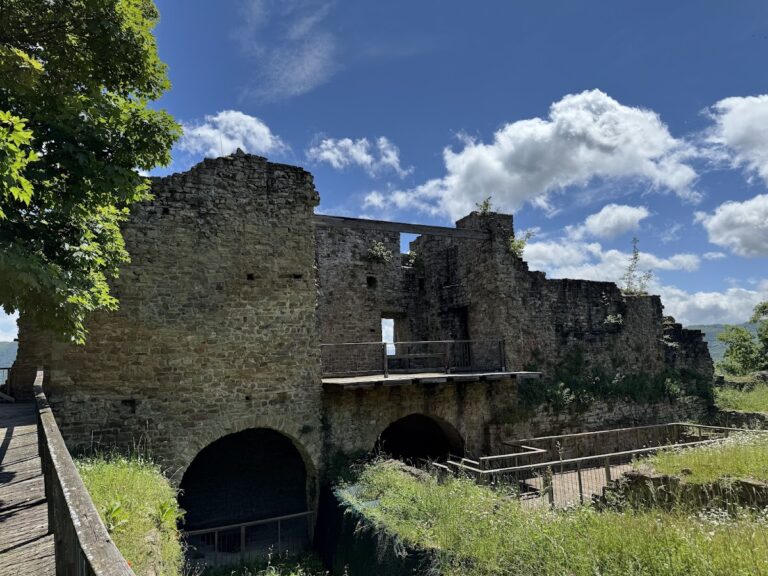
The remains stand at approximately 1,013 metres above sea level between Rusino and Moragnano. The former castle survives as a massive stone tower on a square plan, reduced at the top to a truncated form and accompanied by other ruins. Its defensive character is visible in the small loopholes and in the narrow entrance, which has a round arch and was closed by a gate.
Surviving Tower
The tower was partly restored at the beginning of the twentieth century. Sections threatened with collapse were removed, the structure was reinforced, and the interior spaces were emptied of accumulated debris. These interventions shaped the surviving remains while preserving the principal stone mass and its medieval defensive features.