Pierre-aux-Fées, Reignier: A Prehistoric Dolmen in France
Site at a Glance
- Popularity
- Medium
- Country
- France
- Primary era
- Bronze Age
- Eras represented
- Bronze Age
- Civilizations
- Unclassified
- Site type
- Civic
- Remains
- Megalithic Monument
On this page7 sections
History
Pierre-aux-Fées, Reignier, is a prehistoric dolmen in France, a structure formed by upright stones carrying a large capstone. It is generally dated to 3200–2800 BCE, although the small quantity of archaeological material and the possibility that its capstone came from an earlier, larger monument make the date uncertain.
Early records and investigations
The monument was first described in 1819 as an altar attributed to Druids, religious specialists of ancient Celtic societies. Burdallet published its earliest known illustration in 1834. In 1843, the landowner probed the chamber. J.-D. Blavignac drew a preliminary plan in 1847, and P. Vionnet identified the structure as a dolmen in 1872 and took its earliest known photographs.
Louis Revon excavated west of the monument in 1878 and published a detailed description and plan. Fessi, Mayor, and Olivier carried out further work in 1879.
Protection, later study, and traditions
France designated the dolmen a historic monument on 10 June 1910. The ground around it was lowered by 0.30–0.60 m, possibly after the designation and perhaps to make the structure more visible. A three-dimensional laser survey was carried out in 2007.
Local stories offer imaginative accounts of the stones. In one, the poor but brave knight Aymon de Bellecombe loved Alice, daughter of the Baron du Châtelet. The baron required Aymon to bring four large stones from the Rocailles plain before sunrise for a wedding feast, and fairies helped him assemble the stone table in time. Another tradition says that fairies caught in a storm made a temporary shelter from stones on the plain.
Remains
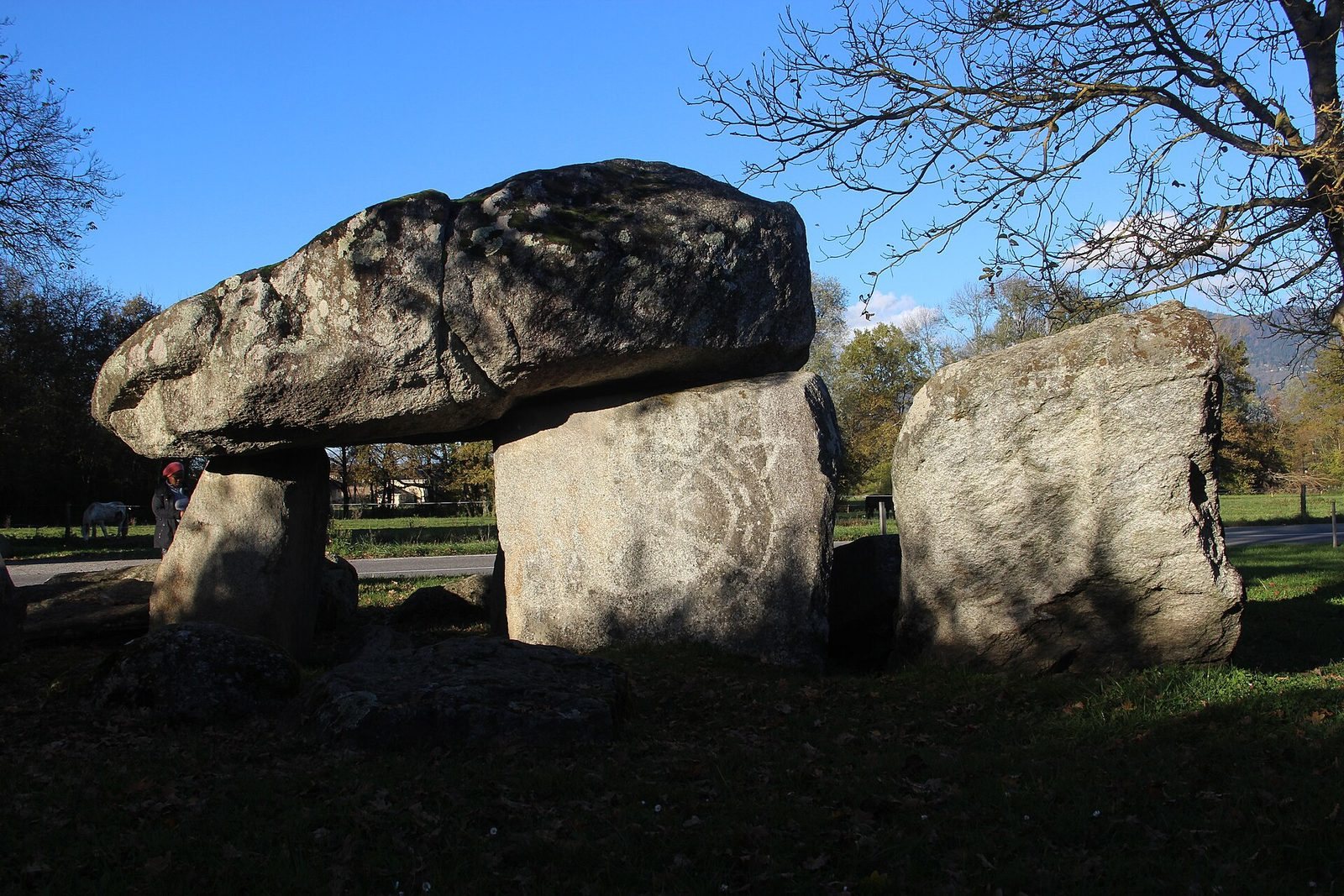
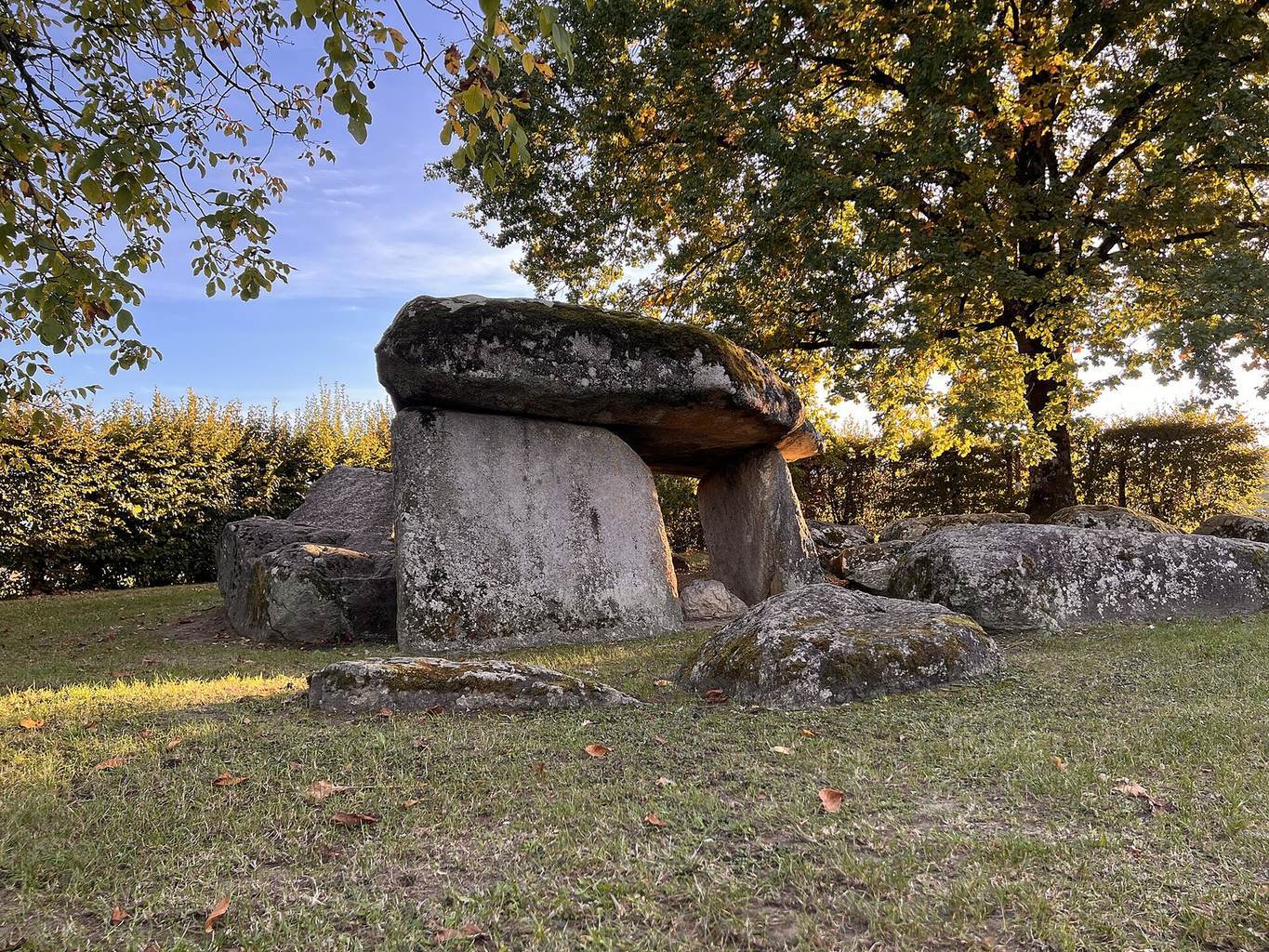
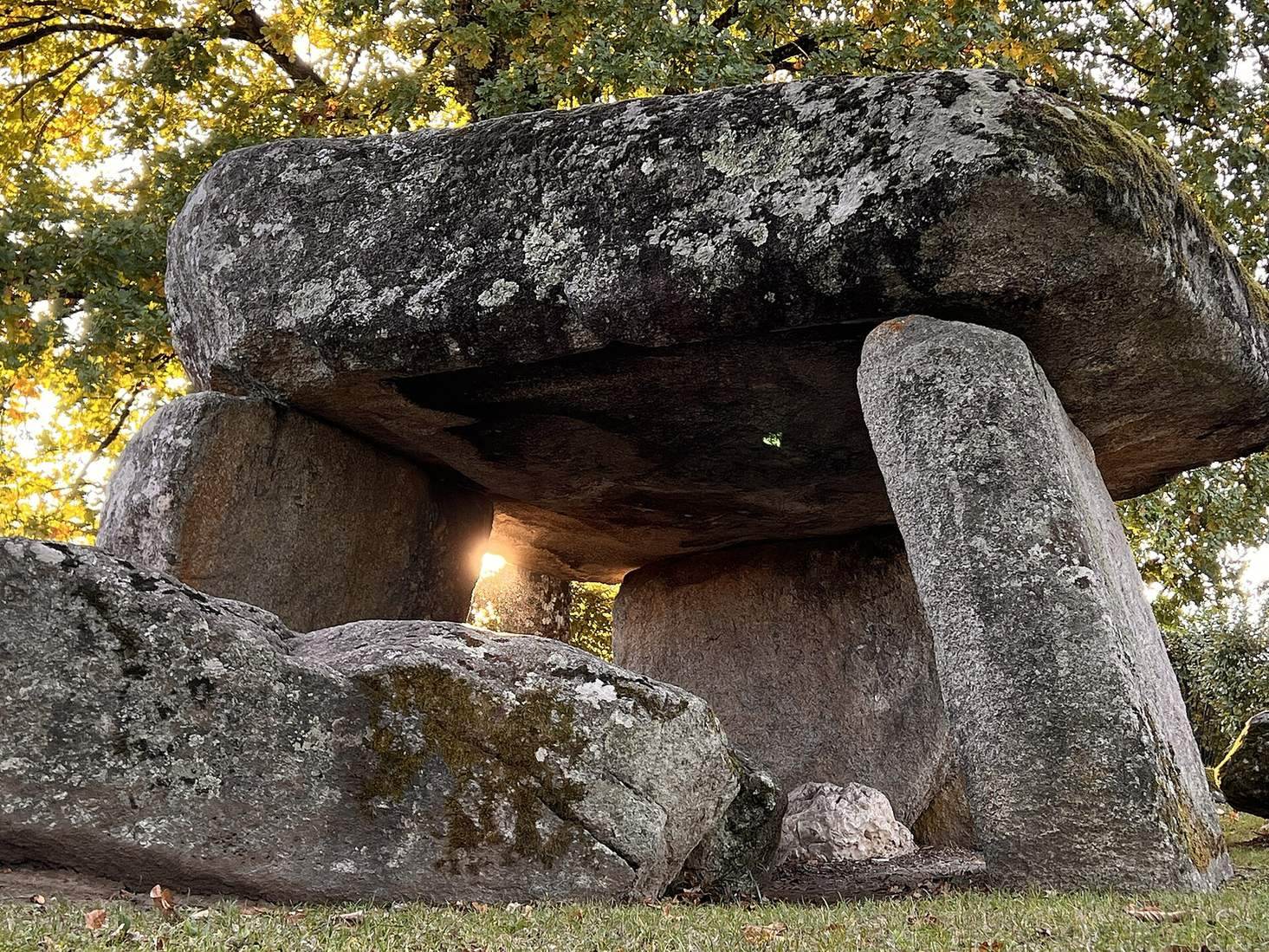
The elongated dolmen stands on the Rocailles plain, a glacial moraine landscape scattered with large boulders, near the hamlet of Saint-Ange. It is oriented east and consists of a large capstone resting on three upright stones, with other slabs and blocks around the chamber.
Capstone and supports
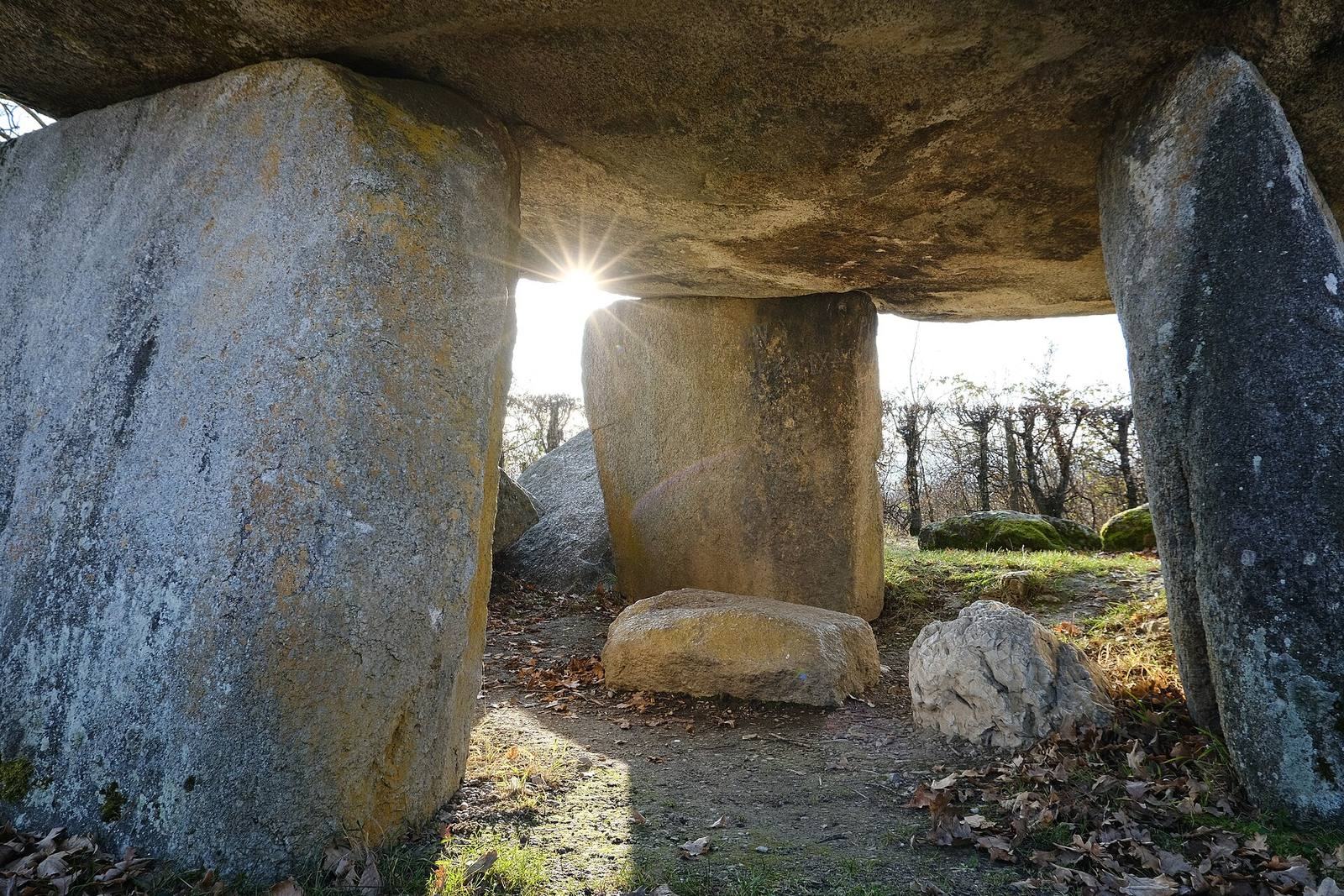
The Mont Blanc granite capstone measures 4.90 m long, 4.30 m wide, and up to 1.20 m thick. Its estimated volume is 15.04 cubic metres and its estimated mass just under 40 tonnes. The underside was flattened and pecked with channels 0.30–0.50 m wide and up to 5 cm deep, arranged in a trapezoidal pattern. The three upright granite supports are each about 2 m wide. The western one is 1.60 m high; the northern and southern ones are 1.85 m high. Their thicknesses range from 0.35 to 0.85 m, and each has a straight, reshaped side edge. The inner faces of the north and south supports have vertical pecked channels beneath those in the capstone. The northern support has an additional channel. The supports’ upper edges do not align precisely with the capstone channels, prompting the suggestion that they were shaped for a larger monument and later reused.
Surrounding stones
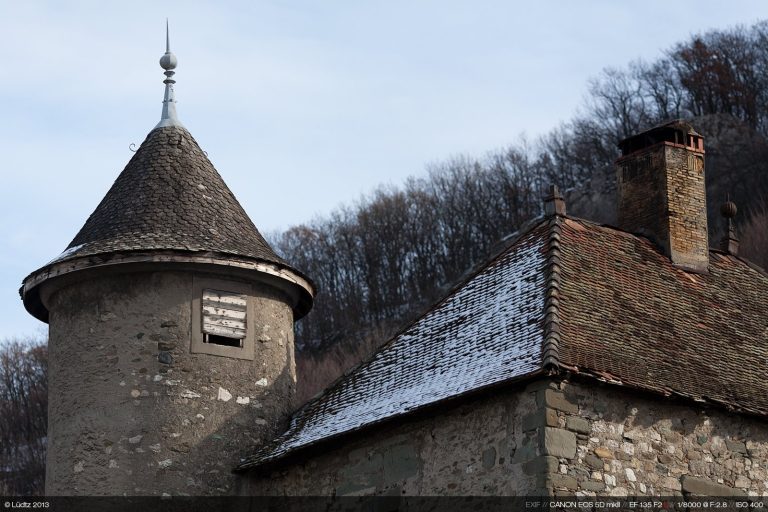
A small, four-sided block lies flat in the centre of the chamber. Two elongated Mont Blanc granite slabs lie to the east. Each has one irregularly curved face and one flatter face, forms attributed to natural splitting of the rock rather than deliberate shaping. They may have served as projecting arms, a form also found at some dolmens in the Jura and Valais. Other massive slabs lie to the west, south, and north. The southern and northern groups appear aligned east–west and east-southeast to west-northwest, respectively, and may have formed a stone facing. An oval pecked mark on one southern slab may depict a polished axe. Other scattered stones may have provided an approach to the monument. Earlier descriptions also say that part of the dolmen was covered by mound remains.
Excavated finds
Animal bones found during the 1843 chamber probe were identified as sheep and cattle. In 1879, Fessi, Mayor, and Olivier recovered four teeth and a cattle toe bone. These remains are now held in the collections of the Museum of Geneva.