Piercebridge Roman Fort: A Roman Military Crossing on Dere Street


Site at a Glance
- Rating
- 4.3
- Popularity
- Low
- Country
- United Kingdom
- Primary era
- Classical
- Eras represented
- Classical
- Civilizations
- Roman
- Site type
- Military
- Remains
- Fort
On this page15 sections
History
Piercebridge Roman Fort is a Roman military site in the United Kingdom, at Piercebridge in County Durham. Roman activity began around AD 70, and the site later developed beside Dere Street, the major Roman military and commercial road running north from York through northern Britain. Its position beside the River Tees enabled the Roman authorities to control both the road crossing and the major bridge over the river.
Early Roman activity and the fort
The earliest Roman presence may have been connected with a ford or ferry that needed protection from the Brigantes, a large Iron Age people whose territory covered much of northern Britain during the Roman conquest and occupation. A military installation beside Dere Street appeared in the late second century AD. The fortifications visible on the north side of the river were built around AD 260 to 270, during the later Roman period.
Piercebridge was the southernmost of four Roman forts along Dere Street in present-day County Durham. The others stood at Binchester, Lanchester, and Ebchester. Another fort beside a bridge was established farther south at Greta Bridge on the River Greta. Piercebridge therefore formed part of a wider chain of military installations associated with the road and its river crossings.
Late Roman occupation
The fort was maintained from approximately AD 290 to 350. After this period, the population became concentrated mainly within the fort, indicating a change in the organization of settlement and occupation. Roman use continued until at least the early fifth century. The site may have remained inhabited into the sixth century, although its final abandonment is also placed in the early fifth century.
The Roman name of Piercebridge remains uncertain. Morbium has been proposed because it appears in the fourth-century Notitia Dignitatum, a late Roman administrative list of imperial offices and military commands. An older identification with Magis is now generally rejected, while Bremesio, mentioned in a mid-first-century Vindolanda tablet, has also been suggested. None of these names is secure.
The settlement around the fort
A civilian settlement, or vicus, occupied Tofts Field east of the fort from the first century AD until the early fifth century. Such settlements housed traders, craftspeople, families, and service providers connected with a military garrison. The community probably supplied goods and services to the fort, and its inhabitants appear to have traded by river from the late first century. Its population declined after the fortifications were built.
A Roman villa south of the river at Holme House began as a native roundhouse and was associated with the vicus. Another related civilian settlement stood at Cliffe, in Richmondshire, on the opposite side of the river crossing. The garrison bath house was outside the fort in the customary Roman arrangement. It was still standing in the thirteenth century, when St Mary’s Chapel was built to incorporate part of it.
Investigation and later reuse
Excavations took place in 1938 and 1939, followed by a longer campaign from 1969 to 1981 directed by Dennis Harding and Peter R. Scott. David Mason reassessed the site in 2006, and the excavation archive is held at the Bowes Museum. In 2009, the archaeological television programme Time Team investigated Piercebridge and established that early bridge timbers in the riverbed were Roman. The investigation also identified a track of Dere Street leading to the bridge and dating to the reign of Domitian, Roman emperor from AD 81 to 96.
Hella Eckardt and Philippa Walton spent more than twenty years cataloging and interpreting thousands of Roman artefacts recovered from the River Tees near the fort. In the nineteenth century, carved Roman stones from Piercebridge were reused in St Mary’s Church at Gainford. The 1855 church building contains worked stones from the fort area. Piercebridge Roman Fort is a scheduled ancient monument, a legally protected archaeological site in the United Kingdom. Much of the approximately 11-acre site, around 45,000 square metres, lies beneath later buildings, while the north and west earthworks survived beyond the boundaries of the modern village.
Remains
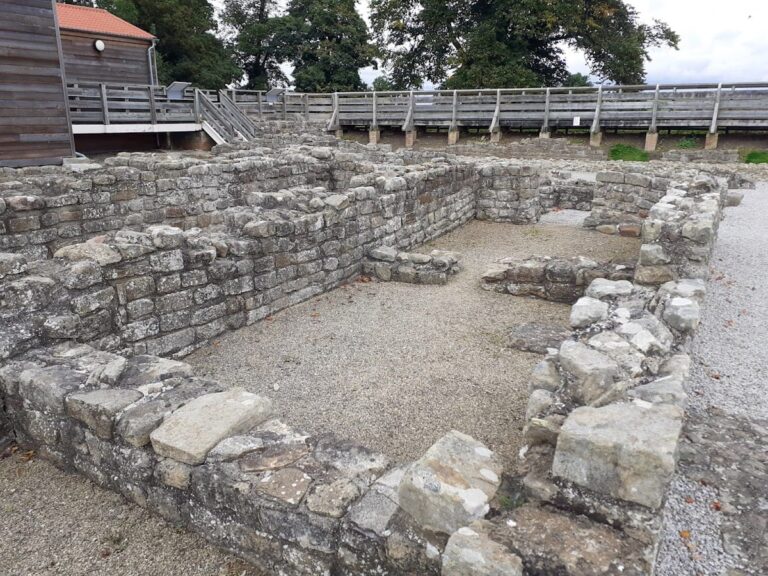
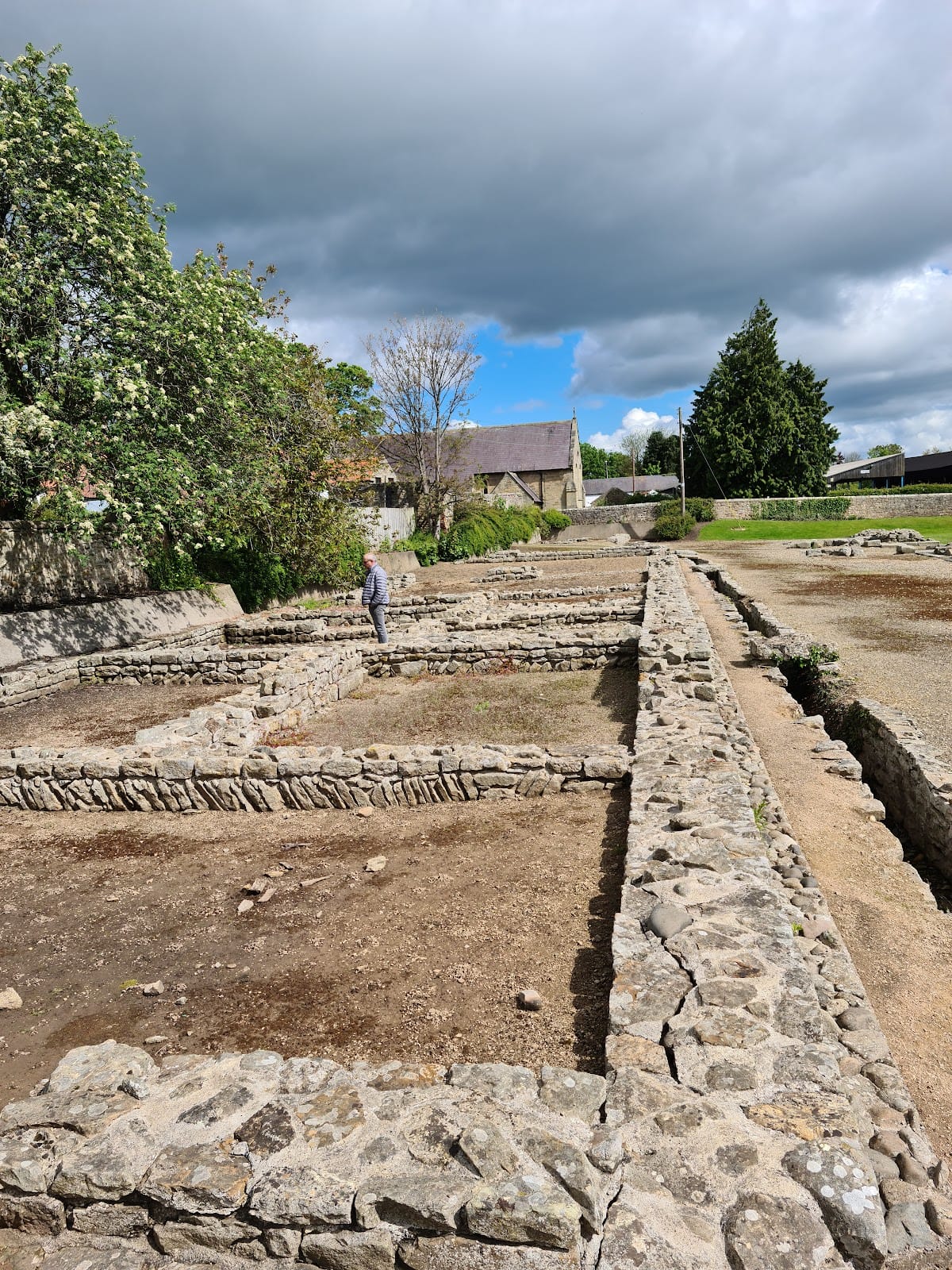
The surviving site follows the standard Roman fort plan, with a rectangular enclosure, corner towers, and four gates. Defensive walls surrounded internal buildings that included barracks, workshops, granaries, a headquarters building, and separate accommodation for the commanding officer. Visible remains are concentrated in the eastern part of the site, while earthworks also survive along the north and west sides.
Fortifications and internal layout
Eastern gate and defensive works
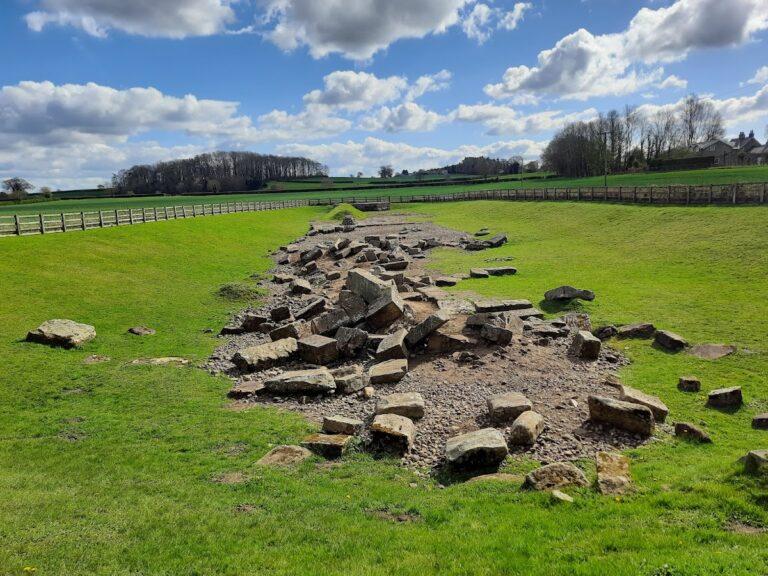
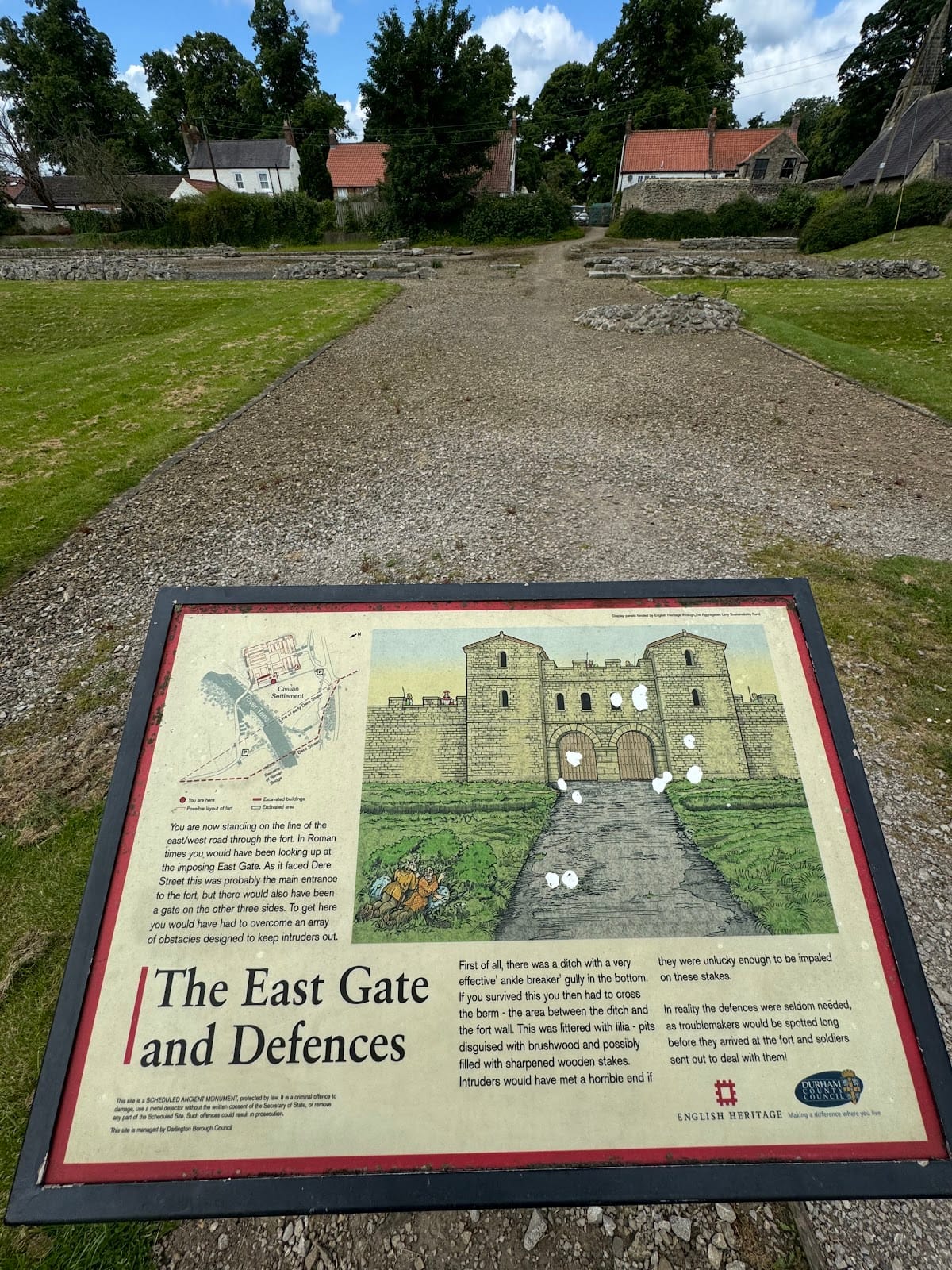
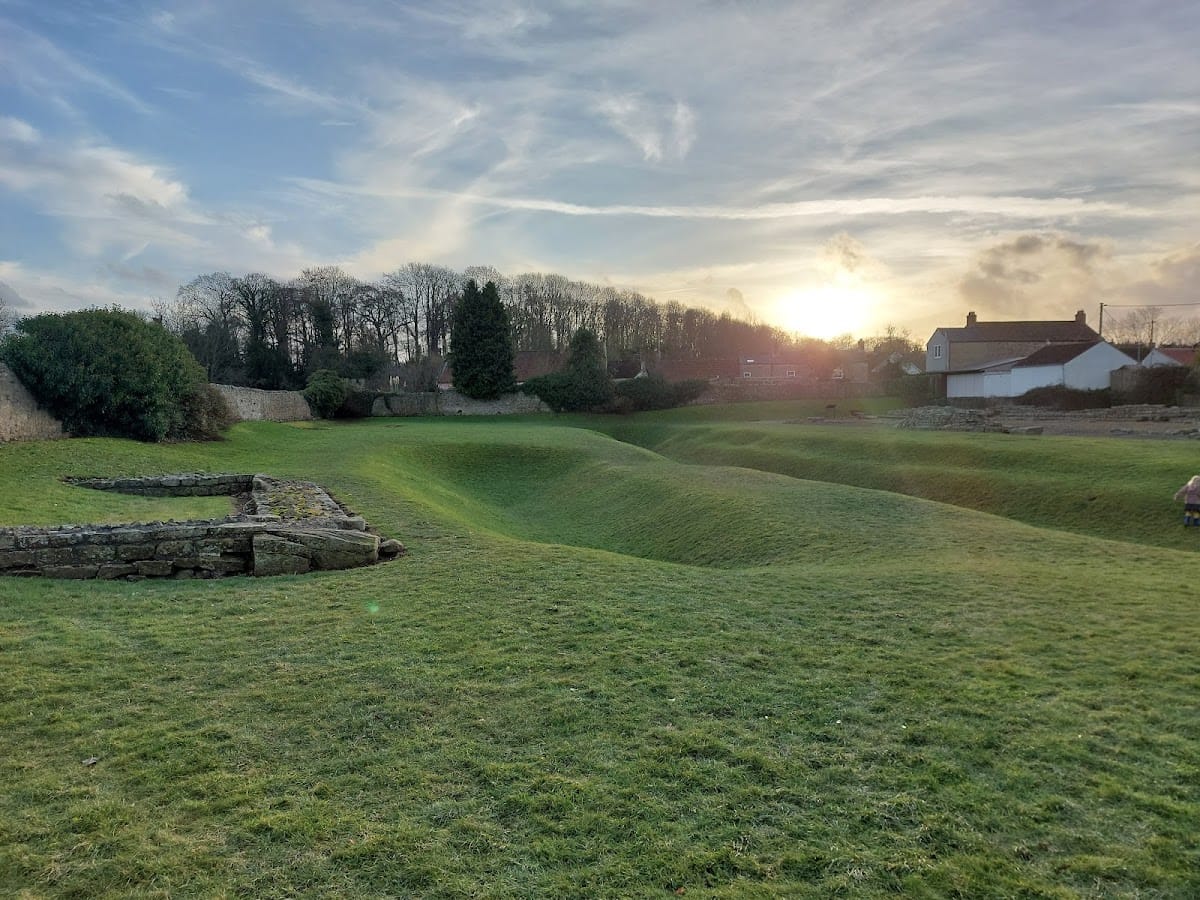
The eastern area preserves sections of the east gate, defensive walls, a courtyard building, and an internal road. Part of the eastern elevation has been conserved for permanent public display. Between the wall and the outer ditch were rectangular defence pits, now covered by lawn. The defences also included obstacle pits and roughly square concealed man-traps, probably covered with undergrowth and fitted with large pointed wooden stakes.
Western and southern gateways
The 1938 excavation uncovered a guard chamber on each side of the western gateway and exposed the outer-rampart wall near the north-west corner. The following year’s excavation revealed part of the southern outer wall. Together, these remains clarify the arrangement of the fort’s gateways and perimeter.
Roads and the commanding officer’s house
A road ran outside the fort wall and had a drain or culvert that still survives. Beyond this outer road stood the substantial house of the commanding officer, built on river pebbles. It had a private bath house to the north of the site, on private property.
Buildings and river crossing
Third-century building
An excavation in 1973 revealed a rectangular third-century building containing a hypocaust, a Roman underfloor-heating system in which hot air circulated beneath raised floors.
Bath house and medieval chapel
A Roman bath house stood at the south-east corner of the fort site. A wall with a rounded arched doorway, possibly part of the bath house, remained visible after the medieval chapel incorporated part of the structure. The bath house is a Grade II* listed building, a structure of particular importance above the usual level of special interest, as well as a scheduled ancient monument.
Bridge remains
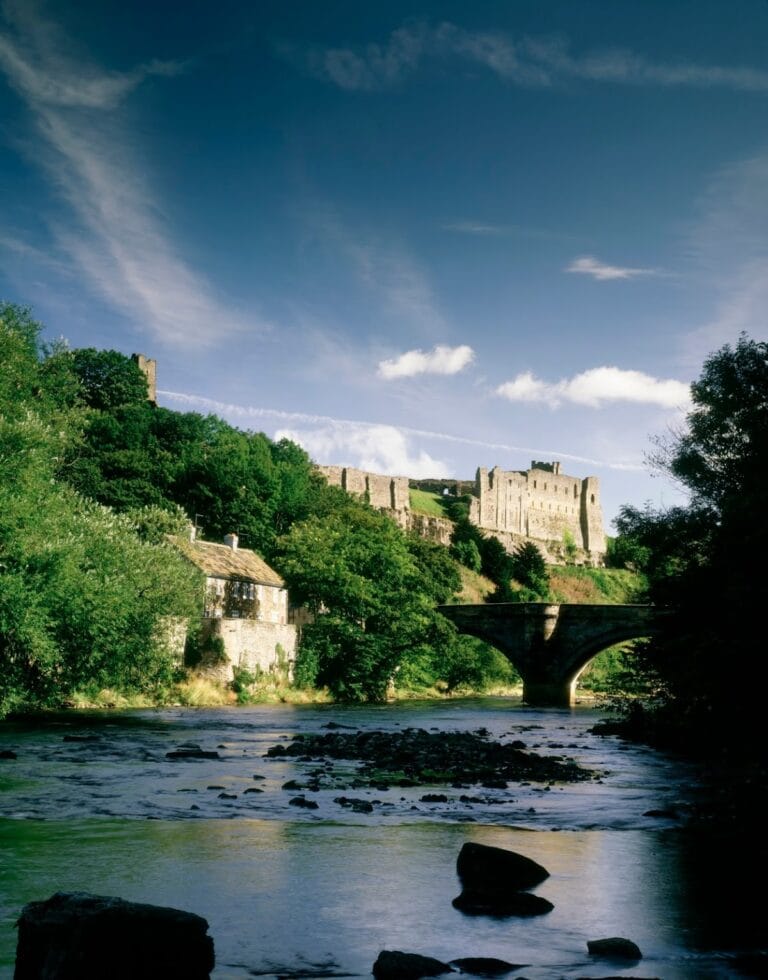
Remains that may represent the Roman bridge carrying Dere Street across the River Tees are visible on the south side of the river at Cliffe, Richmondshire. Their interpretation remains uncertain. Edward Wooler, an antiquarian investigator of Roman remains, found a large worked Roman stone around 1910 and believed it belonged to the original bridge. A 2005 conservation-area appraisal identified a south abutment and four piers, while Raymond Selkirk argued that the remains might instead be a dam and spillway.
Artefacts and ritual evidence
Archaeological remains associated with Piercebridge include kilns, Roman pottery, a metalworking installation, a carved stone altar, and burials containing gravestones and a lead coffin. Inscriptions from the site attest to members of Legio II Augusta, Legio VI Victrix, and Legio XXII Primigenia, large permanent formations of the Roman imperial army. Other finds from the fort and the River Tees include Roman inscriptions, a small lead goat, a hairpin, early fourth-century Roman coins, and a bronze figure of a ploughman with oxen, now in the British Museum.
The inscriptions and carved altar provide evidence for worship of Jupiter and Mars, Roman deities associated respectively with the state and sky, and with war and military protection. Some artefacts from Piercebridge are displayed at the Bowes Museum, while worked Roman stones from the site remain incorporated into the 1855 church at Gainford.