Peyre-Brune: A Final Neolithic Burial Dolmen in France
Site at a Glance
- Popularity
- Very Low
- Country
- France
- Primary era
- Stone Age
- Eras represented
- Stone Age
- Civilizations
- Unclassified
- Site type
- Burial
- Remains
- Tomb
On this page7 sections
History
Final Neolithic burial and later use
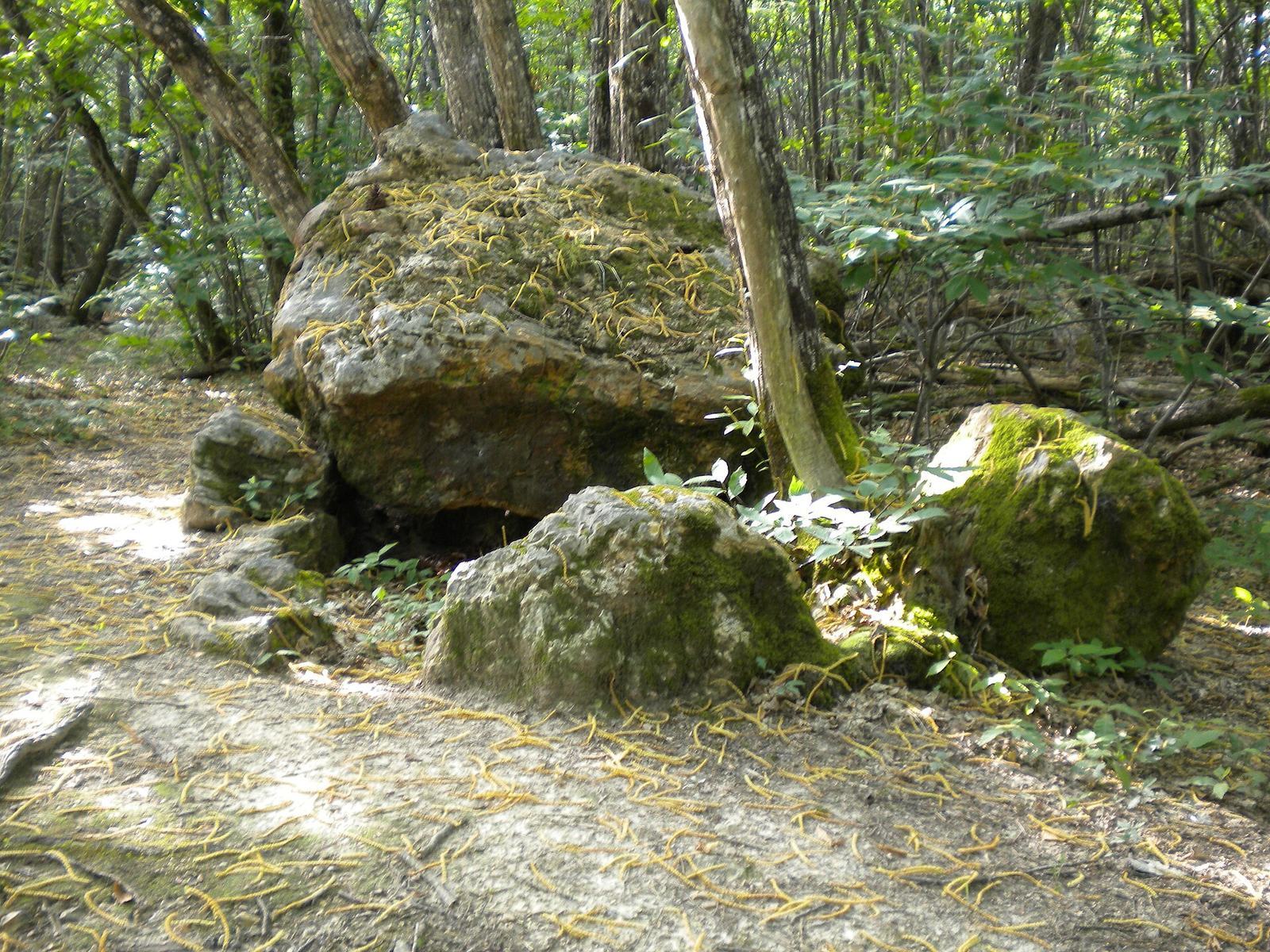
Peyre-Brune is a Final Neolithic dolmen, a tomb formed from large stones, near Saint-Aquilin in France. Finds from its burial chamber are attributed to the Artenac culture, a prehistoric culture of western France. This makes the monument one of the region’s rare megalithic tombs that can be assigned to a particular archaeological culture.
The tomb was reused during La Tène III, a late phase of the La Tène culture, an Iron Age tradition in Europe. Local tradition tells of a chief killed in battle and buried at the place where the dolmen was later built. His wife, said to be a fairy, supposedly sent six attendants to carry stones there and cursed anyone who disturbed his grave.
Recording and protection
F. Jouannet first recorded Peyre-Brune in 1828. L. Drouyn and A. de Gourgues later mentioned it, and the Archaeological Society of Périgord excavated the monument in 1874. Édouard Galy prepared the first complete description in the excavation report. In 1889, France designated Peyre-Brune a protected historic site under the Monument historique system.
Remains
Setting and stone structure
The dolmen stands in woodland on a ridge about 200 metres above sea level, near Saint-Aquilin and roughly 1.5 kilometres west of Seyssac hamlet. Its rectangular burial chamber measures about 2.70 metres long and 1.90 metres wide, with its long axis running northwest to southeast. Seven supporting stones, each around 0.80 metres high and 0.65 metres wide, hold the structure. The cover slab measures about 2.75 by 2 metres and is 0.75 metres thick. It has slipped from its supports and tilts southeast; the heavy stone was transported at least 500 metres. The dolmen is in poor condition and sweet chestnut trees increasingly overgrow it.
Geological setting and building stone
The monument rests on sands of the Boisbreteau Formation, a named rock unit of the Upper Eocene. Its blocks come from the Beau-Repos Formation, a middle Eocene rock unit also known as Sidérolithique. This source sandstone is hard, fine-grained, orange-brown, and rich in iron and silica. It now occurs irregularly over Campanian deposits, rocks of the Late Cretaceous. After those deposits formed, the basin emerged and developed karst, terrain shaped by the dissolution of rock. Continental sediments of the Cuisian, an early Eocene stage, filled depressions; later Lutetian sands, from the middle Eocene, recrystallized and hardened through silica.
Excavated finds
The excavation recovered plant ash, oak charcoal, stone fragments, and a range of grave goods. These included a black flint axe, knives, broken scrapers, an awl, sharp-edged flint arrowheads, and three pendants made from sandstone, flint, and shell. Grey pottery sherds were also found. Analysis indicated that the deceased had not been cremated. Some of the grave goods are now held by the Musée d’Art et d’Archéologie du Périgord in Périgueux.