Pescina Cathedral: A Late-Renaissance Cathedral Basilica in Italy


Site at a Glance
- Rating
- 4.5
- Popularity
- Very Low
- Country
- Italy
- Primary era
- Early Modern
- Eras represented
- Medieval, Early Modern, Modern
- Civilizations
- Italian, Kingdom of Naples, Spanish
- Site type
- Religious
- Remains
- Cathedral
On this page12 sections
History
Pescina Cathedral, formally the Cathedral Basilica of Santa Maria delle Grazie, is a Roman Catholic church in Pescina, Italy, built chiefly between 1579 and 1596 in a late-Renaissance style with late-Gothic elements. Dedicated to the Madonna delle Grazie, it belongs to the Diocese of Avezzano and preserves the institutional history of the historic Diocese of Marsi.
From the Diocese of Marsi to Pescina
The cathedral institution at Pescina began in the early sixteenth century, when the episcopal seat of the ancient Diocese of Marsi moved from Santa Sabina in San Benedetto dei Marsi. During the transition, the church of Santa Maria del Popolo served as the cathedral. That church had already been mentioned in a bull issued by Pope Lucius III in 1181.
Under Bishop Matteo Colli, construction of a new cathedral dedicated to Santa Maria delle Grazie took place from 1579 to 1596. Donations from the baronial families of the County of Celano financed the work. The church was consecrated on 6 August 1606 and formally received the title of cathedral in 1613.
Later development and diocesan change
The building was enlarged and enriched during later centuries. Its final major construction phase was the erection of the dome between 1863 and 1865. These successive interventions gave the church an interior combining Renaissance and Baroque work with earlier medieval elements.
On 16 January 1924, the episcopal seat moved to Avezzano. Pescina Cathedral then became a co-cathedral, meaning that it shared the title of the diocese with another cathedral. In 2016, it was elevated to basilica status within the Diocese of Avezzano.
Berardo and the Marsi bishops
Berardo, Bishop of Marsi, died on 3 November 1130 and was first buried in the cathedral of Santa Sabina. His relics were transferred to Santa Maria del Popolo in 1361, before the diocesan seat moved to Pescina, and were definitively brought to Santa Maria delle Grazie in 1631. Venerated as a saint, Berardo is regarded as the patron of Pescina.
Earthquake, war damage, and restoration
The 1915 Marsica earthquake severely damaged the cathedral. Reconstruction followed in 1930, but bombing during the Second World War caused further damage. The building was restored and reconsecrated on 30 April 1961.
Remains
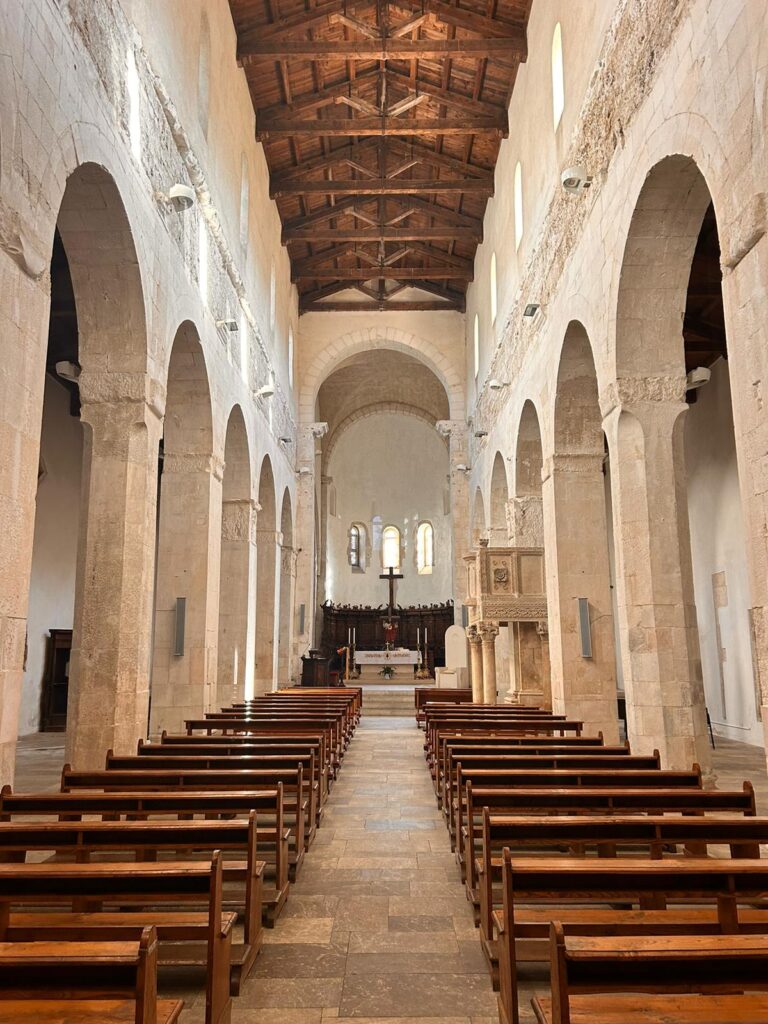
The cathedral presents a late-Renaissance structure enriched by late-Gothic, Renaissance, and Baroque features. Its facade, bell tower, and three-nave interior form the principal surviving architectural elements, while medieval frescoes remain among the church’s older decorative features.
Facade and bell tower
Portico and entrance portals
A stone cornice divides the facade horizontally into two principal sections. The lower section forms a portico, or entrance atrium, with five arches. Within it are three Renaissance entrance portals.
Windows and bell tower
The upper facade contains two rows of windows. The lower row has five windows and the upper row has four, with a small late-Gothic rose window at the centre. A large three-storey bell tower with a clock stands on the right side of the facade. It contains an ancient bell dedicated to Berardo of Marsi.
Interior spaces and furnishings
Naves and main altar
Inside, pillars divide the church into three naves, each ending at an altar. The main altar stands within a semicircular apse and is covered by a ciborium, an architectural canopy supported by columns. The apse also contains a fourteenth-century wooden statue of Santa Maria del Popolo.
Chapels and episcopal memorials
The cathedral includes a sacristy, the Chapel of the Blessed Sacrament, and the Chapel of Saint Berardo. The latter contains Berardo’s relics, the tombs of several bishops of the Marsi, and a commemorative tablet naming bishops and bearing the Latin inscription Hic quiescunt Marsorum pastores, meaning “Here rest the shepherds of the Marsi.”
Nearby sites