Evdir Han: A Seljuk Caravanserai in Türkiye


Site at a Glance
- Rating
- 4.3
- Popularity
- Low
- Country
- Turkey
- Primary era
- Medieval
- Eras represented
- Medieval
- Civilizations
- Seljuk
- Site type
- Economic
- Remains
- Caravanserai
On this page7 sections
History
Evdir Han is a Seljuk caravanserai in Türkiye, located near Antalya on the historic road to Konya, the capital of the Sultanate of Rum, the medieval Seljuk state that ruled much of Anatolia. Built during the reign of Sultan Izz Ad-Din Kai Kaus I between 1211 and 1220, it served a route where travelers, merchants, animals, and goods could rest under protection.
The Antalya to Konya route
The road developed after Kai Chosrau I conquered Antalya for the Seljuks of Rum in 1207. The Seljuk authorities then established a series of caravan stations between Antalya and Konya. Evdir Han stood north of Antalya as the first caravanserai on this route, while Kırkgöz Han lay about 15 kilometers farther north.
Its considerable size and richly ornamented entrance have led to the interpretation that Evdir Han was one of the six so-called Sultan Hans, caravanserais commissioned directly by the ruler. On that interpretation, it would be the oldest surviving example in this group.
Patronage and later history
A construction inscription reported in 1931 identified Sultan Izz Ad-Din Kai Kaus I as the patron of the caravanserai. Rudolf Meyer Riefstahl, a German-American specialist in Islamic art who studied Seljuk architecture in Anatolia during the 1920s, had found the inscription in the school of the nearby village of Yeşilbayırköy. The inscription is now lost.
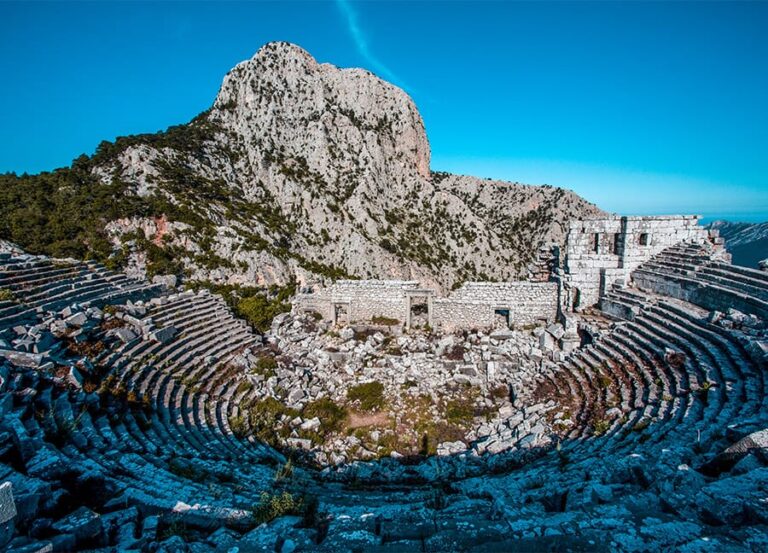
Evdir Han is now heavily ruined, although restoration work took place during the 2010s. The ruins stand in the Döşemealtı district near Düzlerçamı, approximately 20 kilometers northwest of Antalya. About 10 kilometers west, the mountain massif historically known as Solymos rises under its modern name, Güllük Dağı, near the ancient city of Termessos.
Remains
Courtyard and vaulted cells
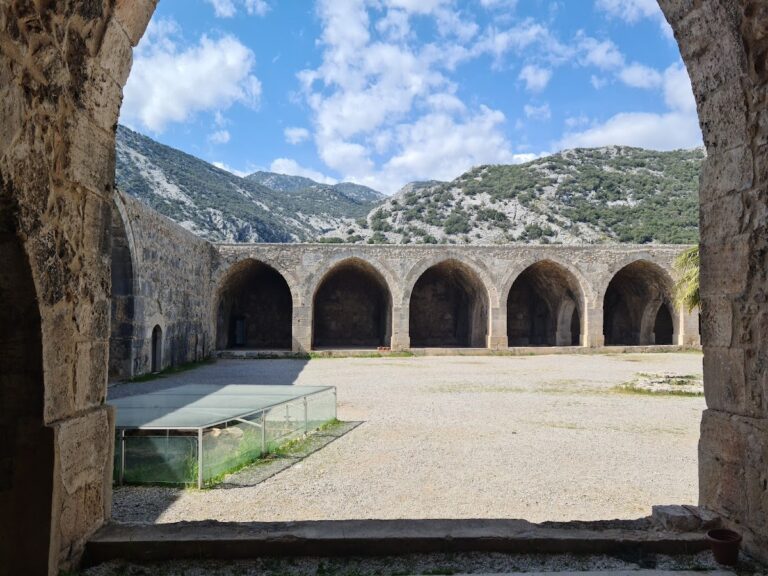
Evdir Han measures approximately 45.3 by 78.8 meters and follows the open-courtyard type of Seljuk han. Open cells surround a central courtyard, with no enclosed covered section. A continuous arcade, resembling a cloister and formed by uniform slightly pointed arches, runs around all four sides in front of the cells.
Fourteen cells line both the northwest and southeast sides. The eighth cell on each side is slightly larger and takes the form of an iwan, a vaulted space open toward the courtyard. Each cell has a slightly pointed barrel vault opening onto the central space. The northeast and southwest sides each contain 11 corresponding rooms, while the central room on the southwest side forms the entrance passage. Two enclosed rooms stand beside this passage.
The vaulted cells on the northwest and southeast sides remain standing, whereas little survives of the northeast side. The exterior walls are made from carefully dressed stone, and some blocks carry masons’ marks. An eastern iwan may have served as a mosque, although no mihrab, the prayer niche indicating the direction of Mecca, has been found. A bath has not been located.
The monumental portal
The entrance faces southwest toward Güllük Dağı and projects outward from the main wall. It is constructed from white limestone and carries an elaborate pattern of interlaced bands, triangles, and stars. The inner sides contain two niches, above which are two muqarnas pediments, three-dimensional tiered decorations made from small recessed or projecting cells, together with a band of interlaced openwork carving.
A substantial muqarnas pediment crowns the gateway and is decorated with palmettes. The upper cornice is missing and probably held the lost construction inscription. The portal’s elaborate ornament, together with the building’s scale, supports the possible identification of Evdir Han as a Sultan Han.
Archaeological surroundings
Remains of an ancient settlement occur around Düzlerçamı, although its precise identity and date remain undetermined. Sarcophagi are visible near Evdir Han. The setting also lies within sight of the mountain massif associated historically with Solymos and with the ancient city of Termessos.