Penthes Castle: A Historic Manor Estate in Switzerland
Site at a Glance
- Popularity
- Medium
- Country
- Switzerland
- Primary era
- Modern
- Eras represented
- Medieval, Early Modern, Modern
- Civilizations
- French, Holy Roman Empire, Swiss
- Site type
- Domestic
- Remains
- Manor House
On this page12 sections
History
Penthes Castle is a historic manor-house estate in Switzerland, first recorded in 1358 and later transformed from a fortified house into a country-house residence. Its history reflects successive changes in ownership and rebuilding before the estate became the property of the State of Geneva.
Medieval estate and family succession
The estate belonged to the Visency lords of the Pays de Gex, a historical region adjoining the Geneva area. Knight Guillaume de Visencier was among its owners. The fortified house later passed into the hands of the de Saconnay family.
In 1650, Etiennaz de Saconnay married Jean-Antoine de Charrière, lord of Penthaz. The estate took the name Penthaz after him, and its spelling later changed to Penthes in keeping with regional pronunciation. Jean-François de Charrière inherited the property in 1658.
From fortified house to country residence
Marc Roset acquired the fortified house on 16 April 1690. After his business ventures failed, his daughters Clermonde and Michée depended on support from the Geneva Hospital, the predecessor of Geneva’s General Hospice, a public welfare institution. When Michée died in 1761, the institution took the family’s property to recover advances amounting to at least 20,000 florins. It then sold the estate to Alexandre de Sales.
De Sales demolished the fortified house and built a country-house-style residence. The estate became part of the new commune of Pregny in 1790. Under the Second Treaty of Paris, signed on 20 November 1815, Pregny was transferred to the Swiss Confederation on 4 July 1816 and joined the Republic and Canton of Geneva on 10 October that year.
Family ownership and rebuilding
The estate passed to de Sales’s second daughter, Jeanne-Louise, who sold it to the English nobleman Robert Pigott. After Pigott’s death, his widow, Marguerite Henriette de Bontems, left the property to her nephew Charles Henri de Bontems. Charles substantially altered the residence. When he died in 1842, his niece Elisa inherited it; she married Maurice Sarasin in 1844. In 1870, Sarasin rebuilt the part of the house facing the lake while retaining some of the older structure.
Public ownership and changing uses
In 1901, Sarasin’s son Albert took possession and leased the residence for several years to Pensionnat Beaupré, a girls’ boarding school. His son Paul later succeeded him, and Paul’s daughter Clermonde inherited the estate in 1940. Geneva industrialist Louis Birkigt bought the castle in 1950 and undertook major modernization. The State of Geneva acquired it from the Birkigt family in 1972.
In 1978, the State granted the Foundation for the History of the Swiss Abroad, which studies Switzerland’s relations with the wider world, usufruct of the castle. This arrangement gave the Foundation the right to use property that remained State-owned. It established a museum and research centre there, and the Museum of the Swiss in the World operated until 2022. The castle and dependencies are classified as cultural property of regional importance. The estate entered Geneva’s protected-property list in 1954 and the canton’s inventory in 1987. In 2001, ICOMOS, the International Council on Monuments and Sites, included it in its Swiss inventory of historic parks and gardens.
The Foundation went bankrupt following the Covid-19 pandemic, and the museum closed in 2022. The Swiss Press Club moved its headquarters to the estate’s west wing in September 2020. The State considered using the castle as a meeting place for Geneva’s international community, but its future assignment and renovation remained under consideration.
Remains
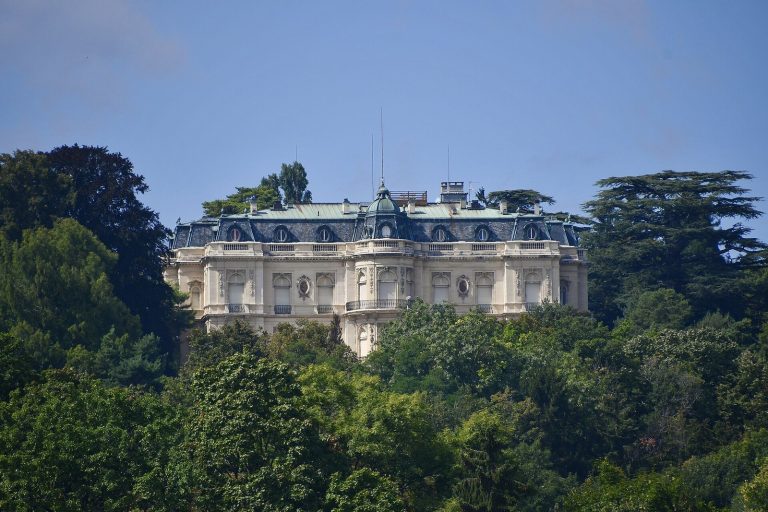
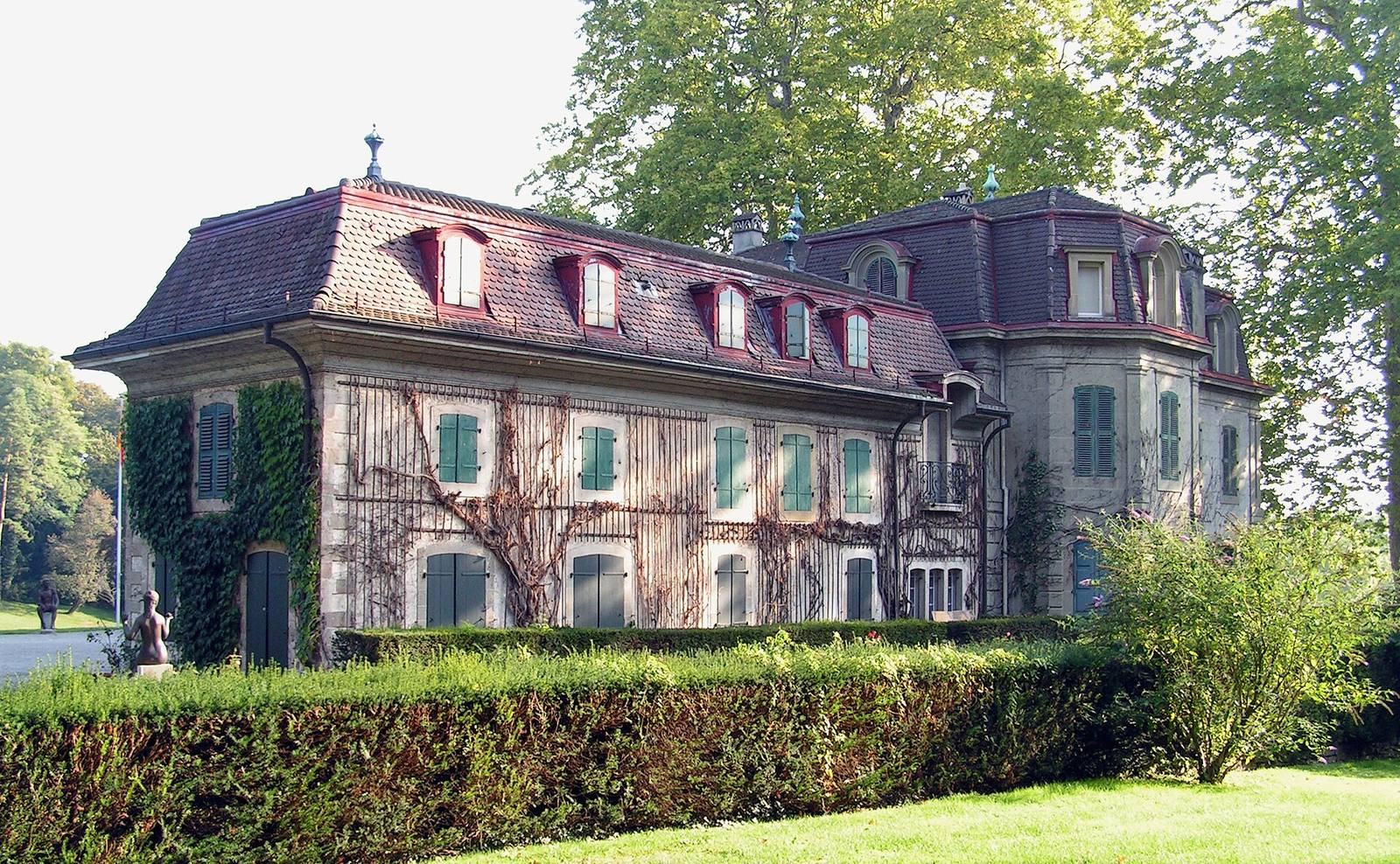
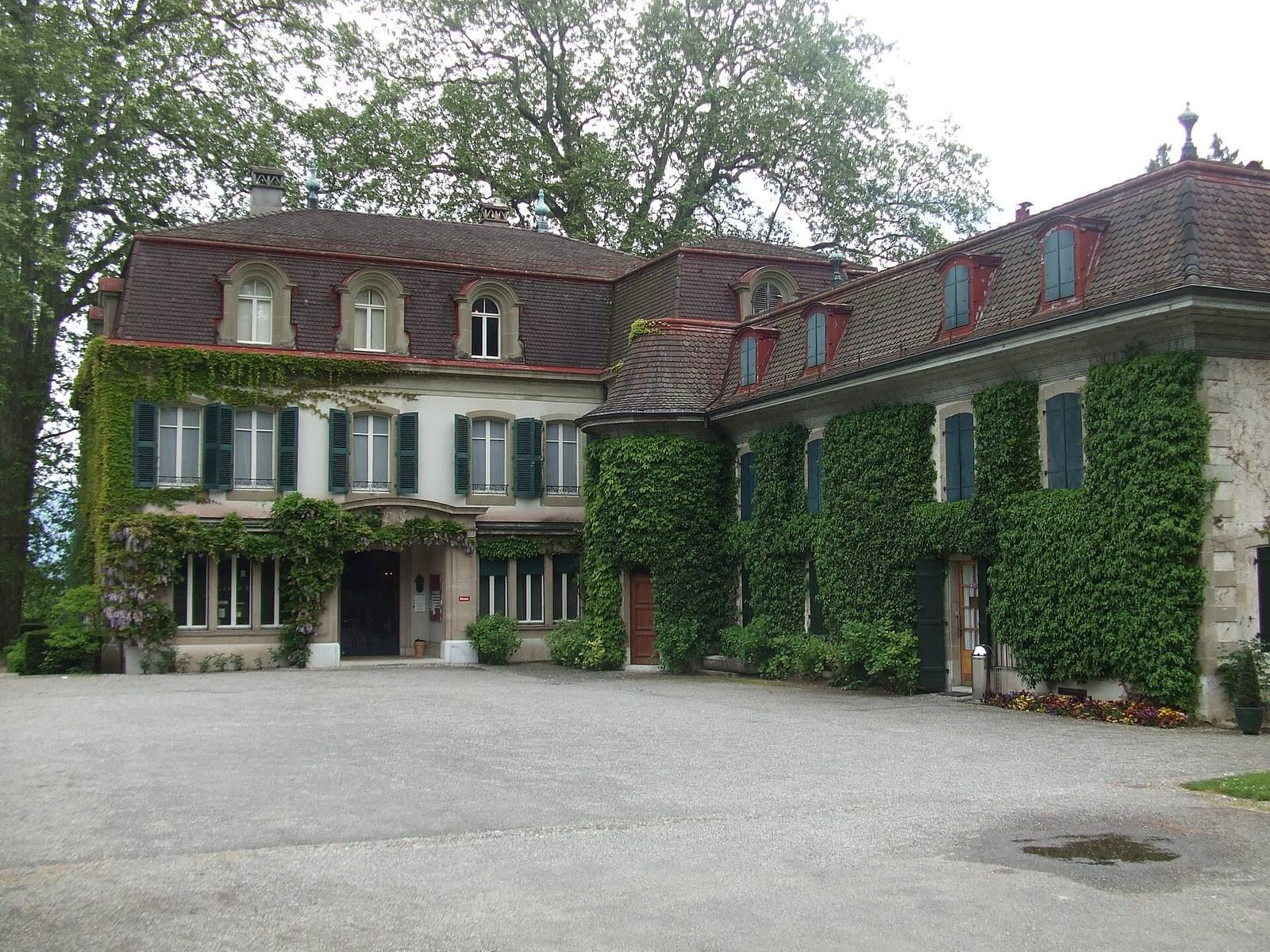
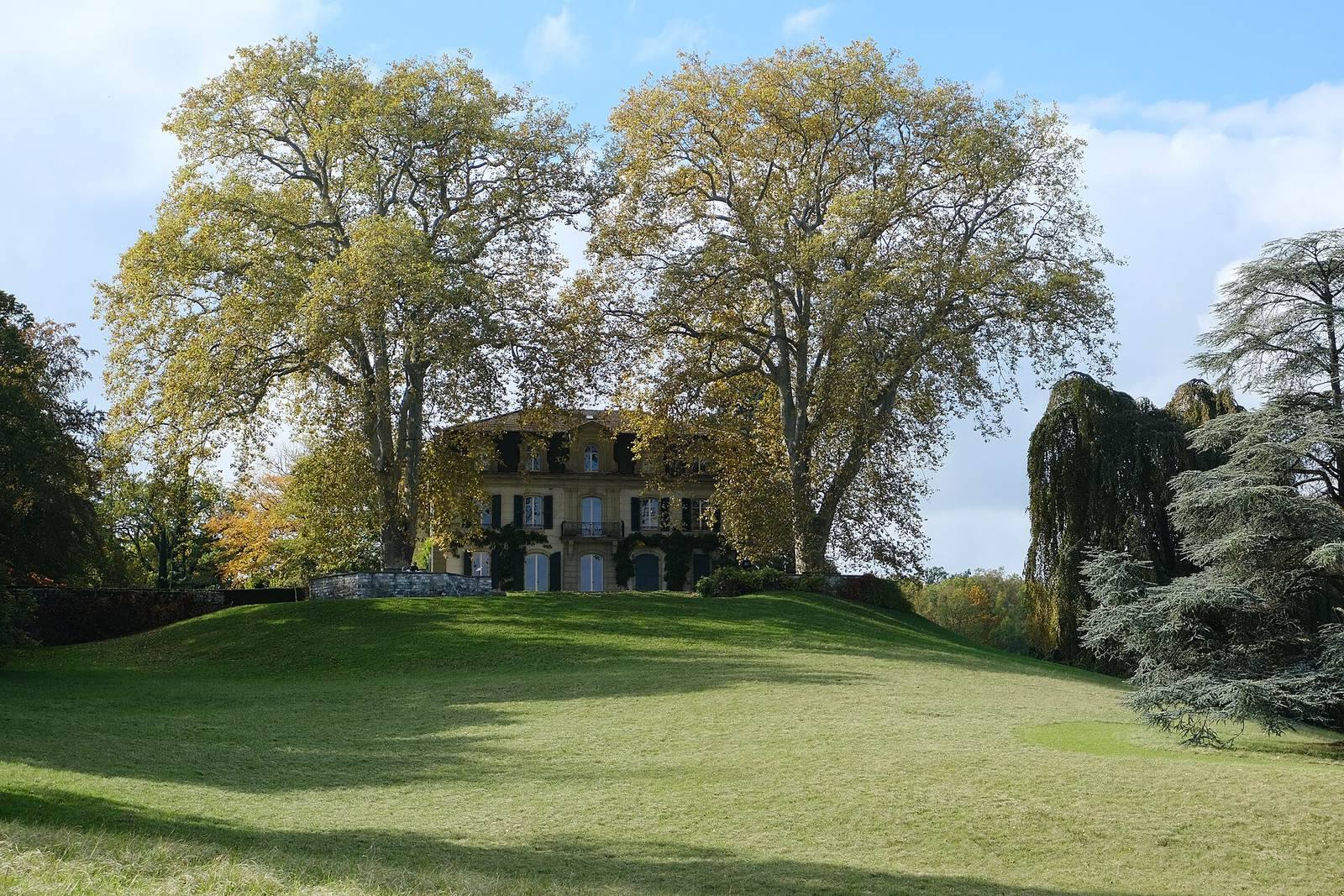
The 90,610-square-metre estate is arranged around a manor house and landscaped garden. The garden covers about nine hectares and slopes gently toward the right bank of Lake Geneva. The castle stands on higher ground, with open views toward the lake and the Alps.
Castle architecture and earlier remains
The fortified house
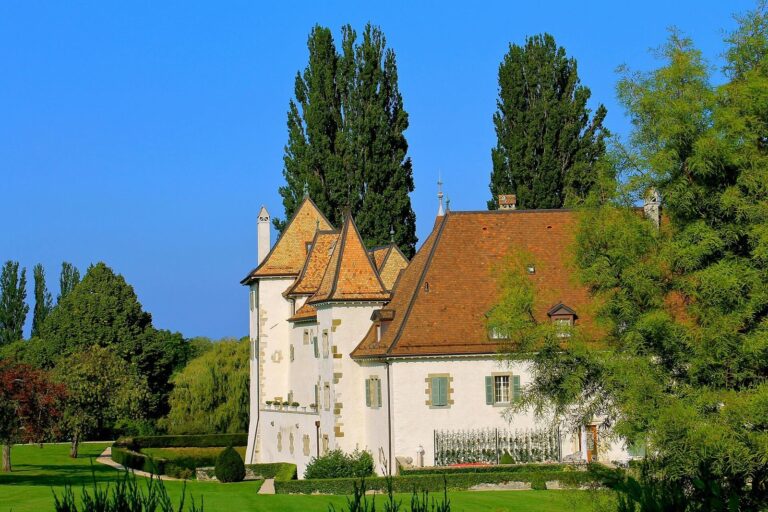
The earlier fortified house was built of stone and had a rectangular footprint about 19 metres long and 9 metres wide, with a circular tower at each corner. Ditches bordered the building, and an enclosed garden plot stood nearby. Two walls from the old house remain beneath two large plane trees on the castle terrace.
The manor house
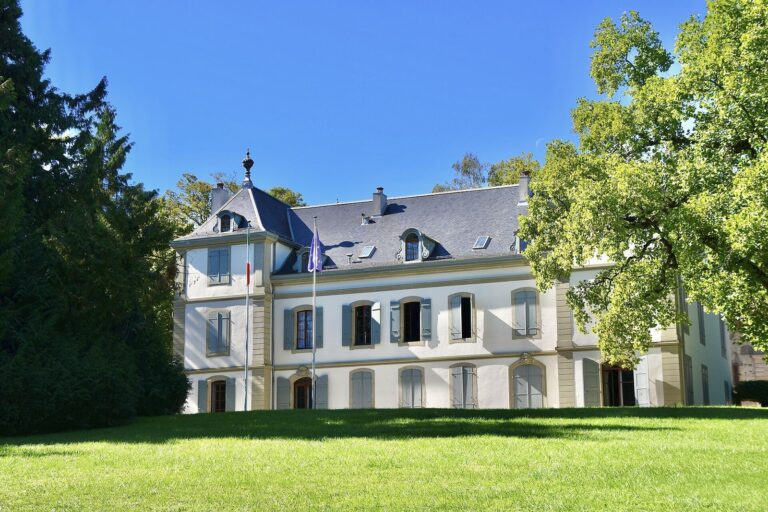
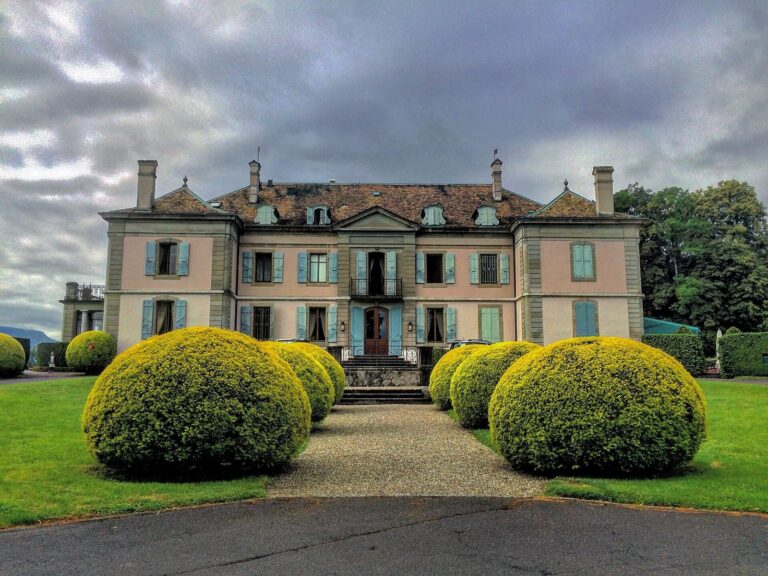
The present residence has an L-shaped plan and a veranda on its south side. Its west wing dates to 1761, while the main building took its present form through the lake-facing reconstruction of 1870, which incorporated part of the older structure. Birkigt’s modernization added central heating and electricity and removed the fireplaces. It also introduced a non-defensive tower resembling a fortified keep in the courtyard and added the initials “LB” to the balcony.
Garden and surviving trees
The City of Geneva’s Conservatory and Botanical Garden maintains the public grounds. An orchard created by Raymond Tripod contains about 60 fruit trees representing roughly 30 old local varieties, now rare and difficult to find. Two large plane trees shade the castle terrace above the surviving walls of the fortified house. A Sequoia wellingtonia planted around 1870 was struck by lightning during a severe storm on 6 October 1993. Its stump was left in place and remains a prominent feature of the estate.
Pavilions and other estate buildings
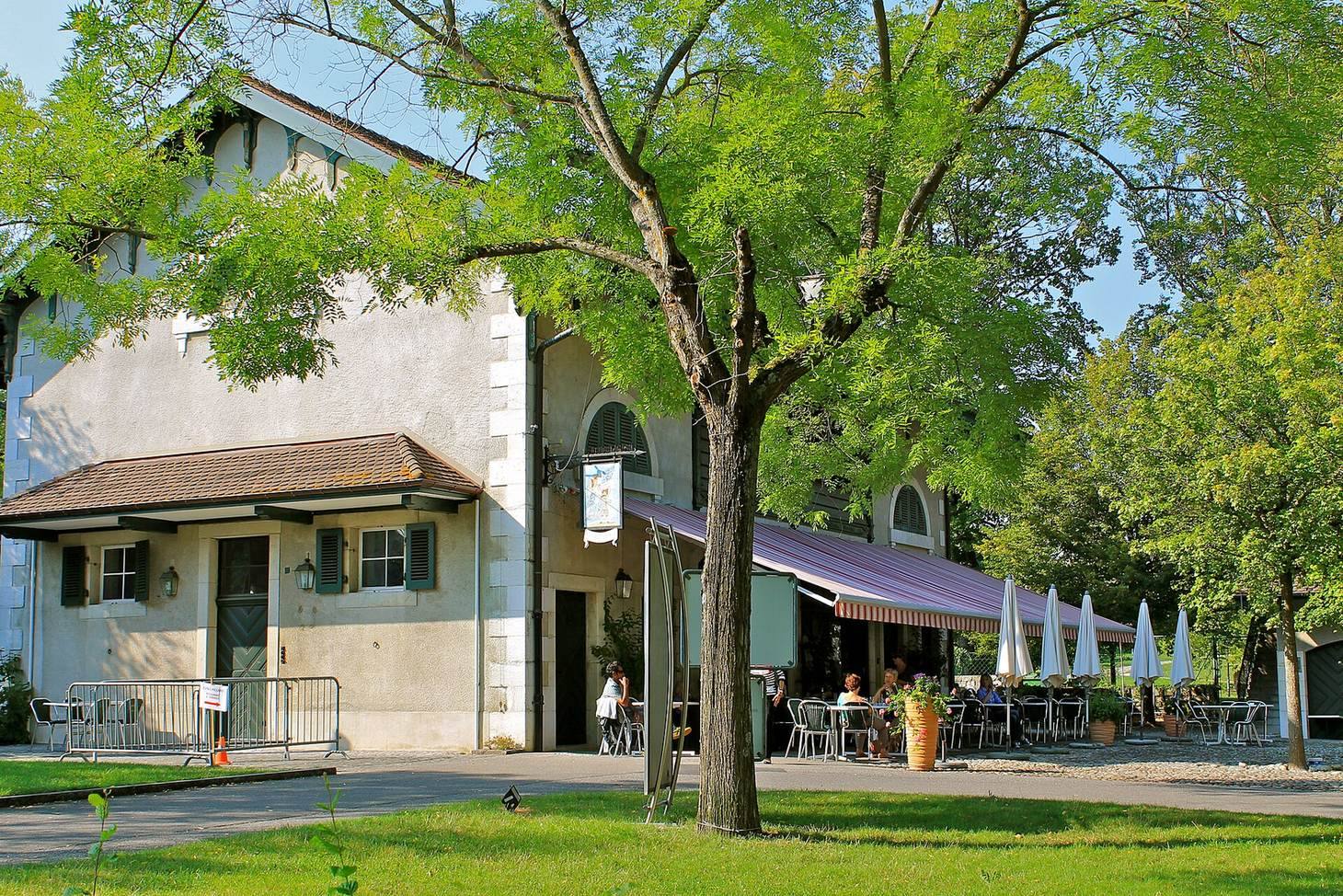
The grounds include the Dufour Pavilion, which houses the Geneva Military Museum; the Besenval Pavilion, used as a restaurant; the Soldati Pavilion, used as a conference room; and the Gallatin Pavilion, used for receptions. A former farm is also part of the estate.
Millénium
The State of Geneva commissioned Millénium, a 5.7-metre-high hourglass that is Europe’s largest, to mark the turn of the millennium. After appearing at several locations, it was featured by the United Nations at Place des Nations in the early 2000s. In 2015, the State entrusted the sculpture to Pregny-Chambésy, which chose Place des Waldstätten in the estate as its location. Millénium commemorates children maimed by antipersonnel mines, mines intended to injure or kill people on foot, and recalls the message that a child somewhere in the world is mutilated by a mine every 20 minutes.