Château de l’Impératrice: A Historic Estate in Switzerland
Site at a Glance
- Popularity
- Medium
- Country
- Switzerland
- Primary era
- Early Modern
- Eras represented
- Early Modern, Modern
- Civilizations
- French
- Site type
- Domestic
- Remains
- Castle
On this page12 sections
History
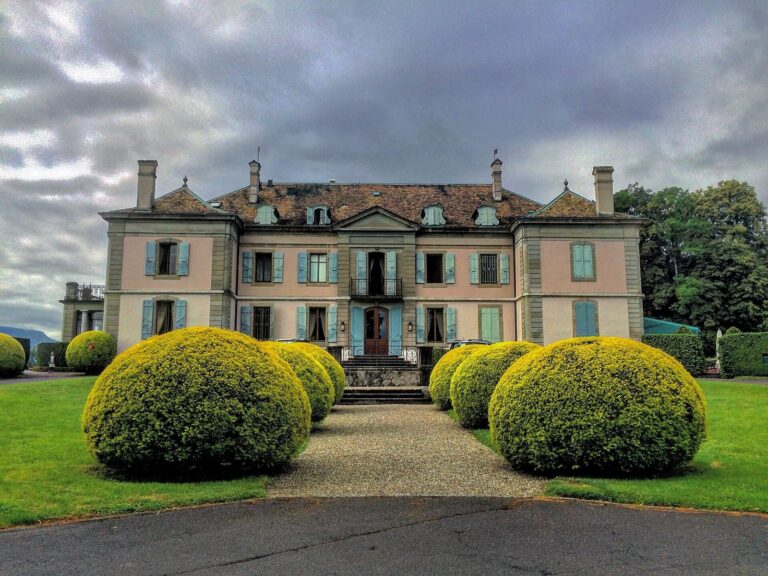
Château de l’Impératrice is a historic château and estate in Pregny village, within the municipality of Pregny-Chambésy, Switzerland. Its history reaches back to the fifteenth century, and its fortified predecessor later served as the headquarters of Genevan political leader Ami Perrin. The estate was enlarged into a château in the early eighteenth century and took its present name after Joséphine de Beauharnais acquired it in 1811.
Fortified estate and Geneva politics
On 5 September 1486, François d’Orly transferred the property to Mathieu Scarron. In 1538, Pierre Scarron exchanged it with Ami Perrin for land at Ruth, while retaining the right to buy it back after ten years for 1,800 gold écus. Perrin was a prominent Genevan political and military figure. He served as captain-general from 1544 to 1555 and as syndic, a senior civic magistrate, in 1545, 1549, and 1553.
In 1555, Calvinists, followers of the Protestant tradition shaped by John Calvin, gained a majority on Geneva’s Council and granted citizenship to French refugees. Perrin and his supporters, known as Perrinists or Libertines, then tried to seize power. After their defeat and the authorities’ repression, Perrin established his headquarters at Pregny-La-Tour. The fortress stood in Bernese territory, outside the Republic of Geneva and beside the Franchises, a boundary zone associated with Geneva’s territory.
After Perrin died in 1561, Scarron exercised his right to repurchase the estate and sold it to Antoine de Saussure. Claude and Jean de Saussure sold it to Pierre Dupuys in 1574, and Marie Vaudenet owned it by 1699.
From fortified house to château
The fortified house was enlarged between 1713 and 1718. Marie Cramer-Vaudenet is thought to have replaced an earlier structure with a château in the early eighteenth century. The earliest known plan of the château, drawn by Genevan engineer and cartographer Micheli-du Crest, dates to 1730. More than five owners held the property between 1740 and 1802.
Henri Melly acquired the château in 1802 and also bought a lakeside parcel at Le Pilon from Isaac Pictet. After Melly’s death in 1808, his widow decided to sell the property.
Joséphine and Hortense
After her divorce from Napoleon I, Joséphine de Beauharnais visited Geneva in 1810 and travelled around Lake Geneva. Impressed by the lake and Mont Blanc, she repeatedly expressed a desire to own a residence on the lake’s right bank. With Napoleon’s permission, her Paris notary arranged the purchase of Pregny-La-Tour. Joséphine acquired the estate on 25 April 1811 for 145,000 francs.
Finding the château too small for her staff and furnishings, Joséphine enlarged and altered it, moving in permanently in July 1812. The estate acquired its present name in her time. Her daughter Hortense inherited it in 1814 and began further improvements. Pregny became part of Geneva on 20 November 1815, and the commune became Swiss on 4 July 1816 following the Second Treaty of Paris, signed on 20 November 1815. Opposed to Hortense settling in territory about to come under its authority, the Geneva government pressed her to leave. She departed on 30 November 1815 and later settled at Arenenberg in Thurgau. Before leaving, she arranged a lease to Francis d’Ivernois; on 22 February 1817, she sold the château to Jean-Louis Moilliet.
Division, protection, and present use
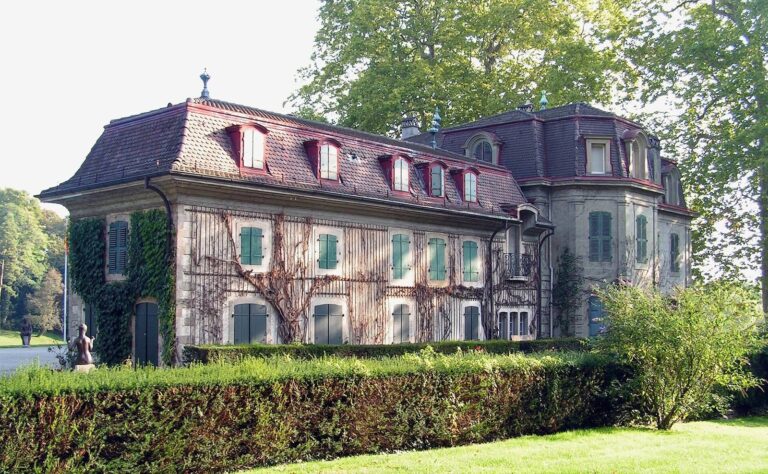
The Moilliet heirs sold the estate in 1853, after which it was divided. Some land formed the La Pelouse estate, while other portions enlarged the estates of Château de Penthes and Château du Reposoir. The château changed hands four times between 1853 and 1983.
On 26 June 1954, Geneva’s State Council placed the château, its outbuildings, and the estate under protection. That year, owner Carlo Rezzonico undertook a complete restoration that gave the château a modern appearance while retaining its historic character; the outbuildings were converted into housing. In 2001, the estate entered the Swiss national ICOMOS inventory of historic parks and gardens. ICOMOS is the International Council on Monuments and Sites, an organization concerned with cultural heritage conservation.
The Commune and City of Geneva acquired the property in 1983, and the grounds became public. The château now houses the Permanent Mission of the Italian Republic to the United Nations.
Remains
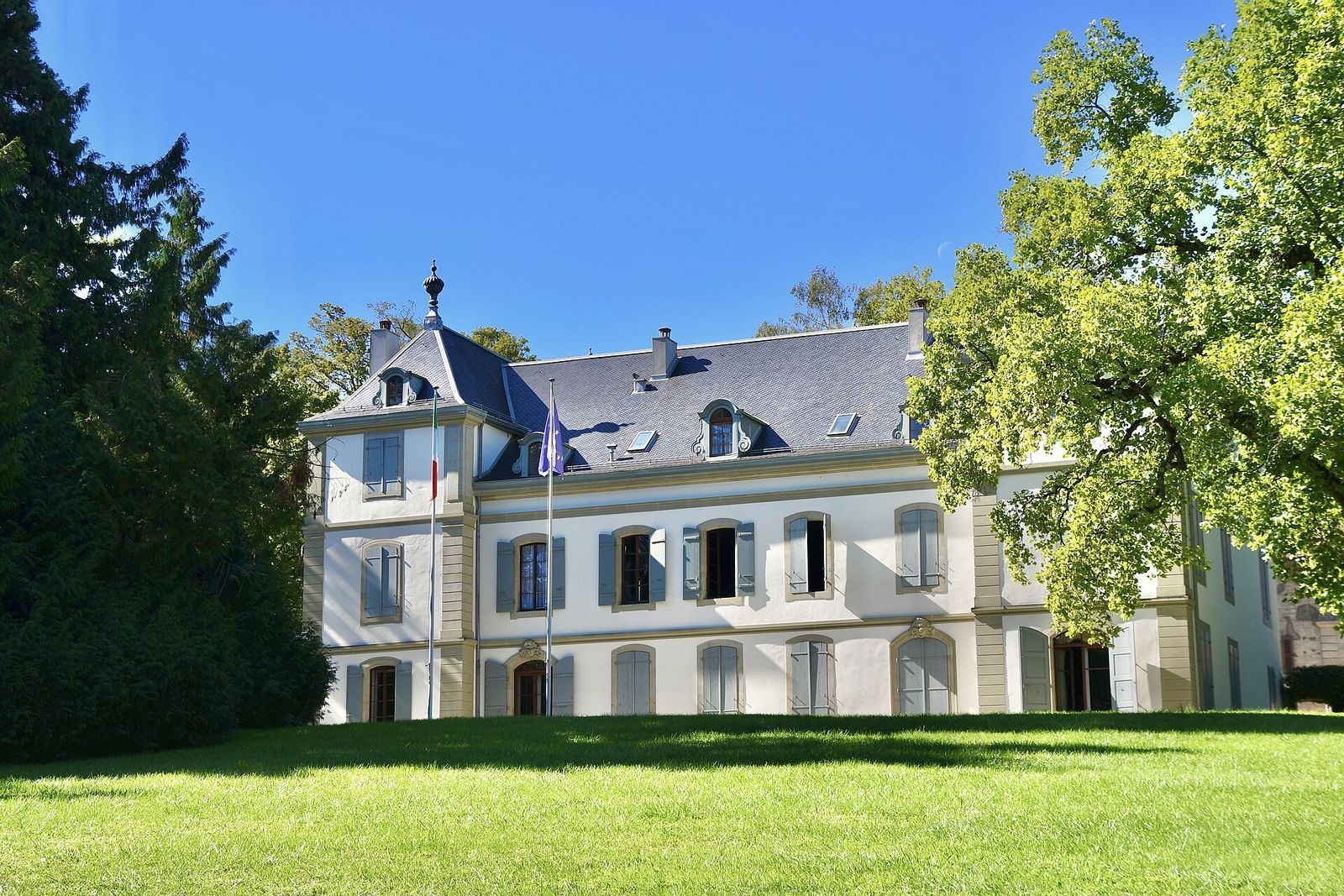
The 29,799-square-metre estate lies between the Château de Penthes grounds and the Terres de Pregny. It includes the château and its outbuildings, along with parkland of meadows and dense woodland. The surviving landscape also includes a lawn sloping from the château toward the railway and a stream that runs from a spring on the estate to Lake Geneva.
Château and furnishings
Fortified house and later château
A deed of 1538 describes the earlier property as a tall house with a barn, a wine press, and defensive walls connecting parts of the fortification. The estate then covered 50 poses, a historical local measure of land area, and stood on the eastern side of the public road from Geneva to Versoix. Later, Alexandre de Sales retained the old manor house while completely remodeling the château’s façades facing the lake and Mont Blanc.
Joséphine’s rooms
In Joséphine’s time, the château had two wings projecting slightly from its main body, and she used only the first storey above ground. A large central salon had Louis XV-style decoration, an eighteenth-century French style, and large seascape paintings on canvas. Other rooms had painted wooden panels above their doors. A smaller salon adjoined the main one, while Joséphine’s bedroom had a heavy canopy. A long vestibule, lit by a row of windows, connected with the other rooms. A harpsichord associated with Joséphine and a round table in Empire style, the early nineteenth-century decorative style linked to Napoleon’s empire, were preserved.
Parkland and water
Terrace, lawn, and trees
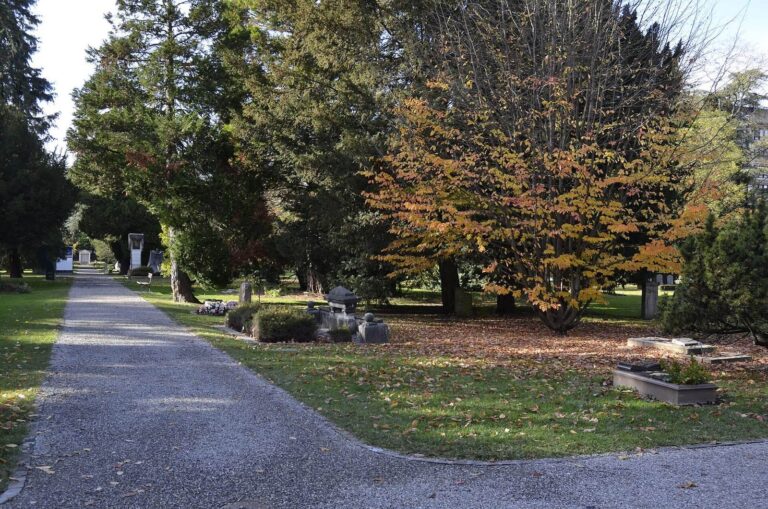
The park combines open meadows with dense woodland and contains trees centuries old. From the château, a lawn descends toward the railway, with century-old trees around it. A tulip tree and a sequoia stand at the upper end of the terrace, while a weeping willow grows farther down. In Joséphine’s time, the park extended to the lake. The terrace looked across lawns toward Lake Geneva and the nearby mountains; Geneva could be seen against the Salève.
Spring and stream
A spring within the estate feeds the Ruisseau de l’Impératrice. The stream runs for about 1,000 metres before reaching Lake Geneva.