Pennsylvania Castle: A Gothic Revival Mansion on the Isle of Portland


Site at a Glance
- Rating
- 4.8
- Popularity
- Very Low
- Country
- United Kingdom
- Primary era
- Early Modern
- External website
- Open
- Eras represented
- Early Modern, Modern
- Civilizations
- British
- Site type
- Domestic
- Remains
- Castle
On this page7 sections
History
Pennsylvania Castle is a Gothic Revival mansion in the United Kingdom, built between 1797 and 1800 for John Penn on the Isle of Portland in Dorset. James Wyatt, a leading English architect associated with Gothic Revival design, created the house for Penn, Governor of Portland and grandson of William Penn, the English Quaker who founded Pennsylvania, the North American colony later incorporated into the United States.
Creation of the marine mansion
John Penn discovered the site during a journey with King George III, the British monarch from 1760 to 1820, and chose it for a residence overlooking Church Ope Cove. The mansion was officially opened in 1800 by Princess Elizabeth, King George III’s daughter. Its creation established the house as a private residence closely connected with Portland’s governing family and the royal circle.
A few years later, Penn commissioned a bath below the castle gardens at a time when sea bathing was becoming popular. The structure stood on common land, whose use was subject to the authority of Portland’s Court Leet, a local manorial court with administrative and legal powers. When the court demanded rent, Penn refused to pay, and the bath was abandoned.
Literary and wartime associations
Pennsylvania Castle entered local literary history when Thomas Hardy used the name “Sylvania Castle” for it in his 1892 novel The Well-Beloved. During the Second World War, Winston Churchill, Britain’s wartime prime minister, met at the castle with Dwight D. Eisenhower, the senior Allied commander in Europe, and Charles de Gaulle, leader of Free France. Their meeting concerned final plans for the Normandy landings, the Allied amphibious invasion of German-occupied Normandy on 6 June 1944.
Change of use and protection
In 1950, the private residence became the Pennsylvania Castle Hotel, which continued operating into the 1990s. It later returned to use as a private house and was subsequently made available as a holiday residence for weddings, private functions, corporate functions, and other events. Pennsylvania Castle is a Grade II listed building. The adjacent gatehouse and lodges also have Grade II listing, although they are separately owned.
Remains
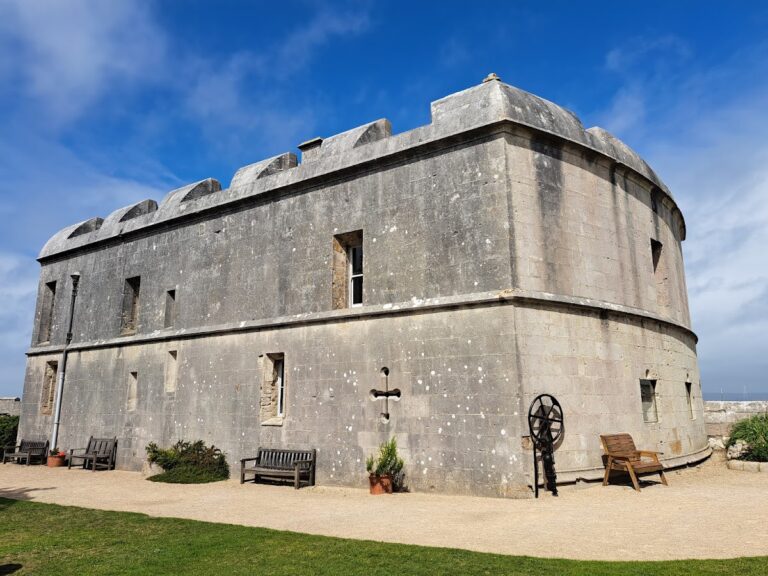
Pennsylvania Castle stands at Wakeham on the Isle of Portland, overlooking Church Ope Cove. Built in Portland stone, the house originally formed a rectangular block and was extended during the twentieth century. Its Gothic Revival character is expressed through projecting corner turrets, embattled parapets with alternating raised sections and openings, and a circular tower.
The mansion
The surviving mansion combines the original rectangular stone block with its later twentieth-century extensions. The corner turrets project from the main building, while the embattled parapets give the roofline a fortified appearance. A circular tower forms another prominent element of the design, and the house remains the principal architectural feature of the site.
The abandoned bath
Below the castle gardens is the bath commissioned by John Penn for sea bathing. It occupied common land and was later abandoned following the dispute over rent. The bath remains associated with the gardens as a separate feature from the main Portland stone mansion.
Nearby sites