Pedra de les Orenetes: A Prehistoric Rock-Art Site in Catalonia
Site at a Glance
- Popularity
- Very Low
- Country
- Spain
- Primary era
- Stone Age
- Eras represented
- Stone Age, Bronze Age
- Civilizations
- Unclassified
- Site type
- Civic
- Remains
- Rock Art
On this page6 sections
History
Dating and possible use
Pedra de les Orenetes is a prehistoric rock-art site in La Roca del Vallès, Barcelona, Spain. Archaeological classification places it in the Chalcolithic, or Copper Age, around 2200–1800 BCE, a period generally associated with copper use alongside stone tools. The dates of the paintings themselves remain uncertain. Anthropomorphic figures have been assigned to a span between the Mesolithic and Neolithic, while other motifs have been placed in the Late Neolithic or Bronze Age.
The paintings are thought likely to date from the period when megaliths along the Céllecs route were built. The site’s original purpose is unknown; it may have served as a ritual center or a meeting place.
Discovery and recognition
Catalan archaeologist Josep Estrada i Garriga discovered the 32 paintings in 1946. From 1987 to 1989, the Archaeological Service of the Government of Catalonia’s Department of Culture documented them as part of the Corpus of Rock Paintings of Catalonia project.
The rock art forms part of the UNESCO World Heritage property “Rock Art of the Mediterranean Basin on the Iberian Peninsula,” inscribed in 1998. The site is also designated a Cultural Asset of National Interest in the archaeological-zone category.
Remains
Granite shelter
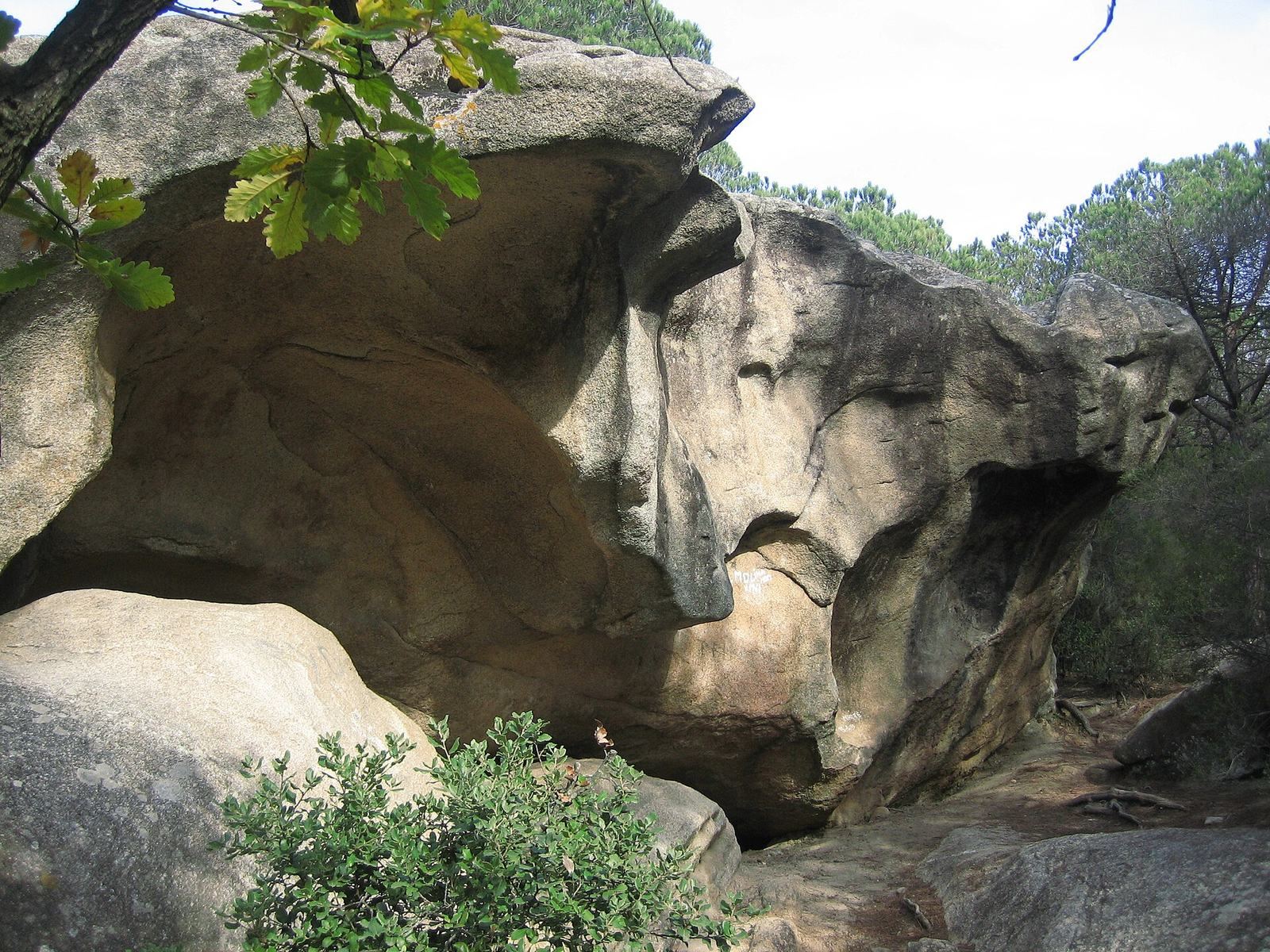
In the Céllecs sector of Litoral Range Park, the site centers on a granite block about 8 metres wide, 3 metres long, and 3 metres high. The rock forms a small shelter with smaller cavities adjoining it. Erosion pits and cracks mark its surface.
Painted imagery
The 32 paintings are classified as Levantine or schematic rock art. Levantine art is generally more naturalistic, while schematic art reduces forms to simplified shapes. The images include human and anthropomorphic figures, among them female figures, and four-legged animals including two deer. Other motifs are snake-like and branching forms, crosses, curved shapes, dots, and lines, some difficult to interpret. Red and black are the most prominent colors, and a central figure appears above undulating forms. Weathering and vandalism have left the paintings almost vanished. They are identified as the only rock paintings on granite in Catalonia.