Paris Observatory: France’s Historic Astronomical Institution
Site at a Glance
- Popularity
- Very High
- Country
- France
- Primary era
- Early Modern
- Eras represented
- Early Modern, Modern
- Civilizations
- French
- Site type
- Civic
- Remains
- Observatory
On this page20 sections
History
The Paris Observatory is a French astronomical institution with a site in Meudon, France, and historic headquarters in Paris. Founded under Louis XIV in 1667, it was intended to advance knowledge of the skies and support navigation. Its Paris building was constructed between 1667 and 1672. The observatory is described as the world’s oldest still in operation.
Royal foundation and early research
The observatory was conceived as a complement to the Royal Academy of Sciences, a French learned institution founded in 1666, and as a laboratory and meeting place for its members. Because the site was then outside Paris, astronomers were its principal users. Louis XIV authorized the project and acquired the land in 1667. On June 21 that year, Academy mathematicians marked out the Paris Meridian, the north–south reference line used in French astronomy and mapping, through the planned site.
Claude Perrault designed the building, and Giovanni Domenico Cassini altered the plans after arriving in 1669 to lead the institution. It opened in 1672. The Academy administered the observatory, while its directors retained considerable independence. Cassini and three later members of his family led it through its first 125 years. Jacques Cassini directed it from 1712 to 1756, César-François Cassini de Thury from 1756 to 1784, and Dominique, comte de Cassini, from 1784 to 1793.
Early observations produced a series of discoveries. Iapetus was identified in 1671, Rhea in 1672, and Dione and Tethys in 1684. In 1676, observatory staff concluded that light travels at a finite speed. The institution began publishing the national almanac Connaissance des temps in 1679. Its use of eclipses of Jupiter’s moons also helped navigators calculate longitude.
Revolution and measurement
During the French Revolution, Dominique, comte de Cassini, resigned in September 1793 because of his close ties to the monarchy. An inspection at the observatory in July 1789 had sought weapons and food, and the institution faced a shortage of funds. In 1795 it came under the newly created Bureau of Longitudes, a national body charged with advancing astronomy and overseeing the observatory.
Under the astronomer Jérôme Lalande, the observatory contributed to the standardization of measurement. The standards for the metre and kilogram were kept there until 1889, when the International Bureau of Weights and Measures was established at Sèvres. Regulations issued in 1785 had also established the observatory’s library.
Nineteenth-century expansion
François Arago was appointed in 1834 to supervise observations and daily operations, and directed the observatory from 1843 to 1853. He developed methods for measuring light and other quantities, and made the first daguerreotype of the Sun, an image produced by an early photographic process. In 1846 he prompted the construction of a large equatorial telescope and dome at the Paris site.
Urbain Le Verrier directed the observatory from 1854 to 1870 and again from 1873 to 1877. During his first term he established a meteorological service. His attempts to increase the director’s authority and raise astronomers’ pay brought him into serious conflict with staff. Fourteen astronomers resigned together, and Le Verrier was removed from office. The observatory published the first modern weather maps in 1863.
Amédée Mouchez led the institution from 1878 to 1892 and founded a museum there in 1879. In 1887 he launched the Carte du Ciel, or Map of the Sky, an international photographic effort to chart the stars. It involved 180 observatories, remained unfinished, and was officially abandoned in 1970. Mouchez also unified official time across France using the time of the Paris Meridian.
Twentieth century and the institution today
In 1913, the observatory used the Eiffel Tower as an antenna to exchange sustained radio signals with the U.S. Naval Observatory. The measurements established the difference in longitude between the two institutions. The world’s first speaking clock was inaugurated at the observatory in 1933.
During the German occupation of France, Ernest Esclangon and part of the staff moved to Bordeaux to maintain the time service. Armand Lambert temporarily directed the Paris site, where work continued nearly normally after the armistice of June 1940. German authorities arrested Lambert in 1943 and deported him to Auschwitz; he never returned.
The Meudon site was established in 1876 and placed under the Paris Observatory’s administration in 1926. The Nançay radio-astronomy site joined the institution in 1953. Together, these locations form part of the institution now associated with PSL University. The Paris Observatory received historic-monument classification in 1926 and again in 2009, and was registered in 2009.
Remains
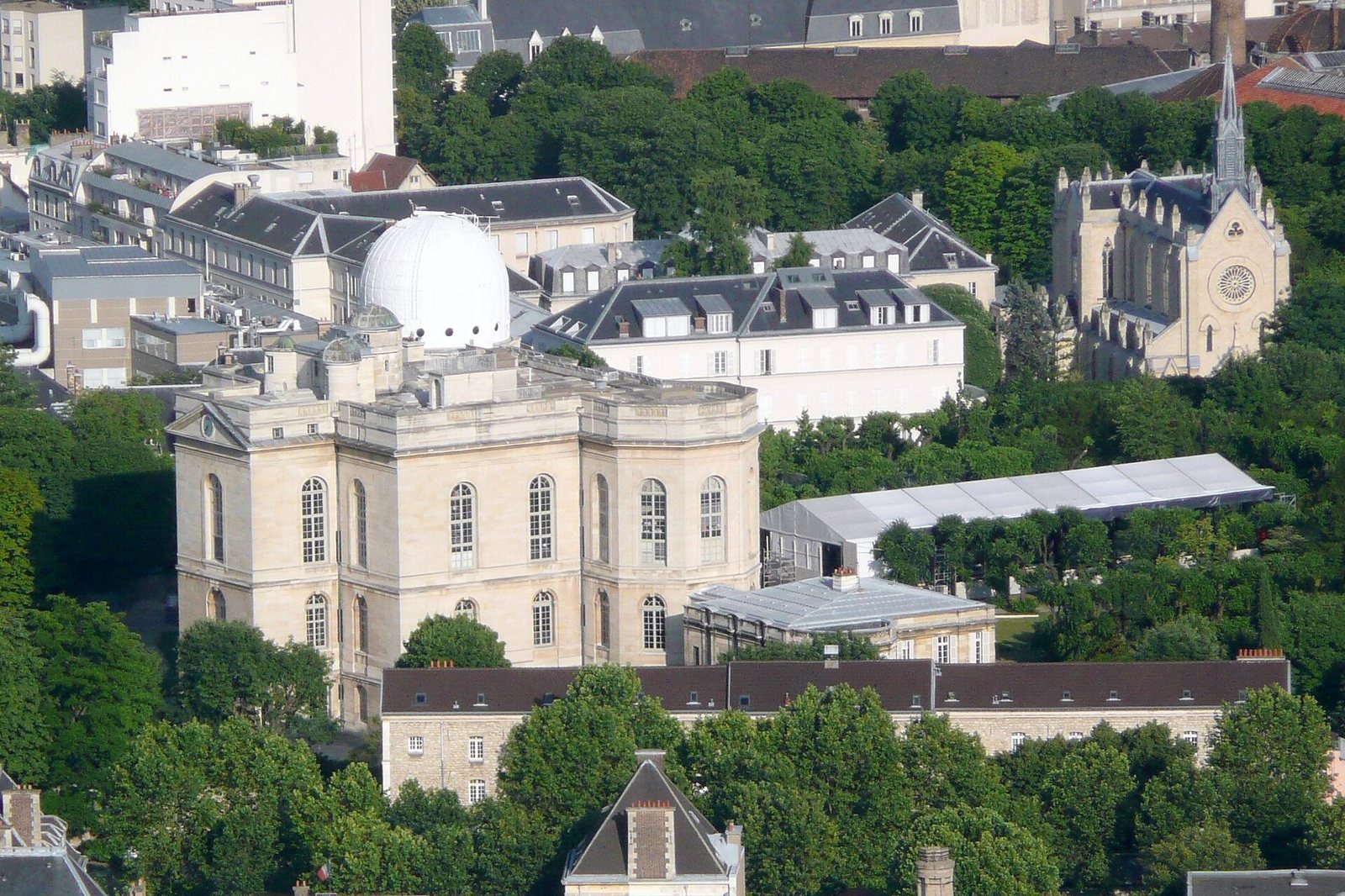
The historic Paris site occupies a 2.5-hectare pentagonal plot above former quarries, some converted into cellars. Its main building is a three-storey, north–south-aligned rectangle, with the Paris Meridian running through its centre. The grounds combine this seventeenth-century structure with later wings, observing domes, garden pavilions, and scientific instruments.
Grounds and principal building
Site and exterior
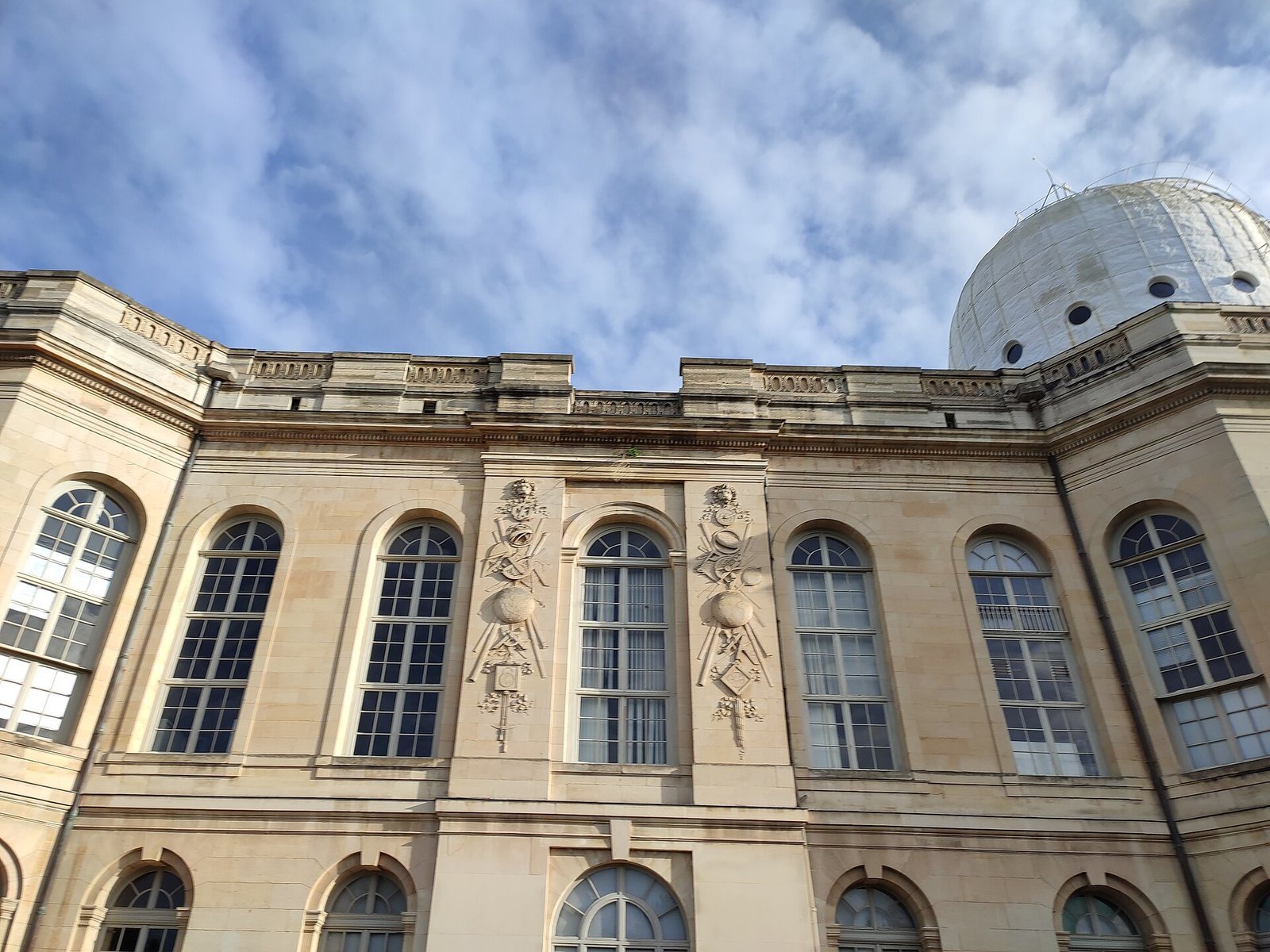
Perrault’s building measures 36 by 50 metres, excluding its cellar levels; Cassini revised the original plans. A square tower projects from the middle of the north face. The south face is flanked by two octagonal pavilions. In each, one side is aligned with sunrise or sunset at a solstice, while another faces the Sun at an equinox. Two stone reliefs by François Temporiti on the otherwise restrained southern façade depict globes and astronomical instruments.
The present northern entrance followed the opening of Avenue de l’Observatoire and the construction of two entrance pavilions after 1811. A single stone staircase links the floors, and the rooms have stone-vaulted ceilings. A vertical shaft runs 55 metres from the roof to the cellars. It was also used to suspend Léon Foucault’s pendulum, an instrument associated with demonstrating Earth’s rotation.
Interior rooms
The ground floor contains the Esclangon Room, with Foucault telescopes and historic machinery from the speaking clock. On the first floor, level with the south terrace, are the Great Gallery, Picard Room, Council Chamber, and library. Wood panelling lines the Great Gallery and Picard Room, which accommodate the museum founded by Mouchez.
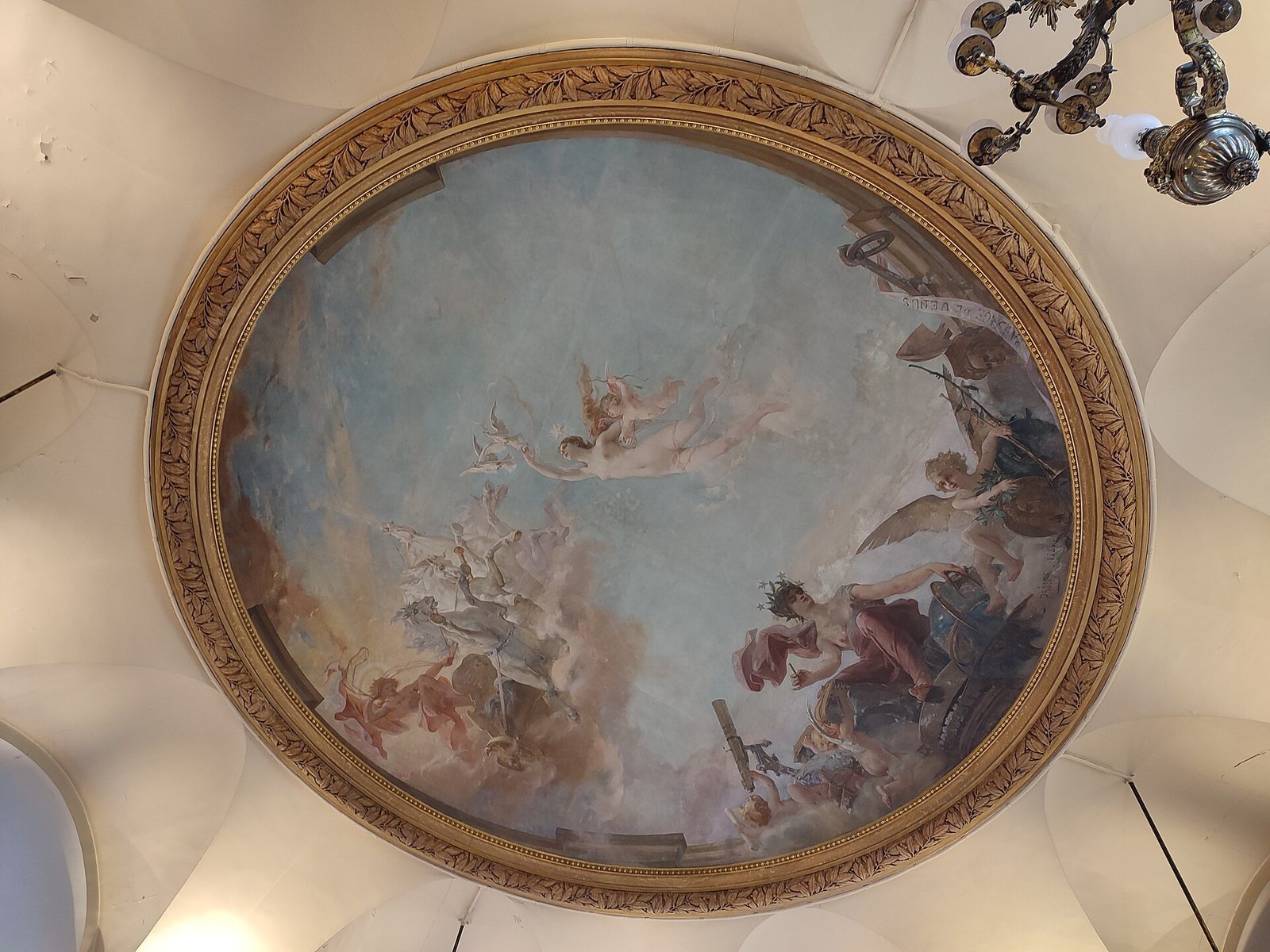
The Council Chamber is in the eastern tower and has an antechamber. Dupain’s 1884 ceiling painting depicts Venus passing in front of the Sun. The chamber also contains a copy of Rigaud’s portrait of Louis XIV and portraits of 15 observatory directors. The library is also housed in the eastern tower, and its collections include archives, manuscripts, instruments, paintings, sculptures, photographs, and graphic works.
Great Cassini Room
The second floor contains the Great Cassini Room, also known as the Meridian Room. The chamber is 33 metres long and 11 metres high. In 1729 Jacques Cassini had a brass line marking the Paris Meridian set into the floor, with engraved marble bearing the zodiac signs along its sides. An opening high in the south wall lets sunlight indicate the Sun’s position at noon. Two pillars added in 1784 strengthened the room’s vault.
Roof and geodetic marker
The roof was initially flat so that observing instruments could be placed on it. Soufflot altered it during restoration in 1784; in 1786 Cassini IV built a small observatory there, equipped with a rain gauge and four instrument stations. A geodetic pillar on the roof has connected astronomical measurements, since 1883, to the system for measuring positions on Earth established at the cross on the Panthéon.
Telescopes and observing instruments
Main dome and Arago refractor
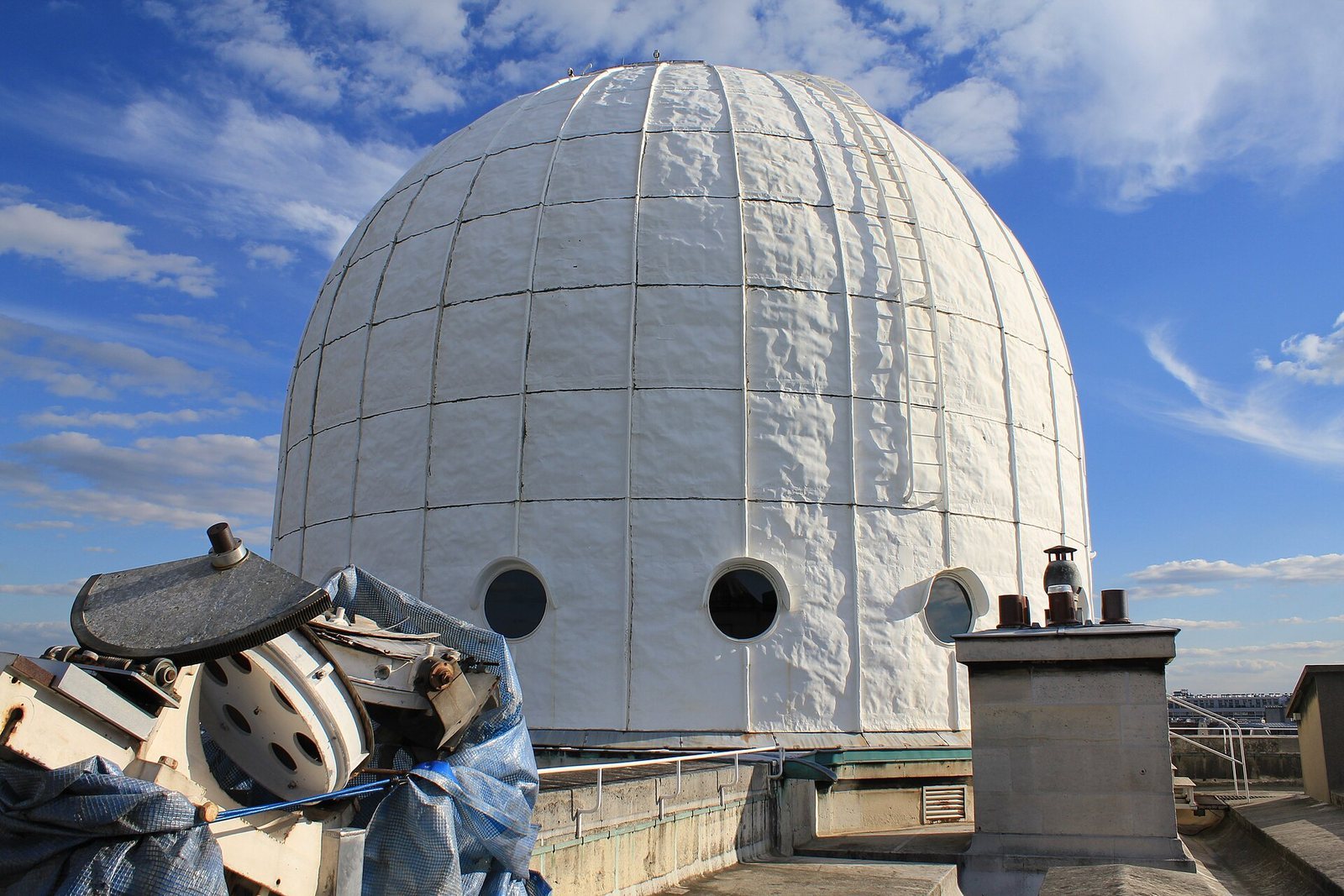
The main dome, begun in 1846 at Arago’s instigation and designed by Alphonse de Gisors, houses the Arago equatorial refractor. This lens-based telescope is mounted to track the sky as Earth turns. Dated to 1850, it entered service in 1854, a year after Arago’s death. Its aperture is 38 centimetres and its focal length 9 metres. Brünner made its mount, initially from wood; Lerebours produced its first optics, and the Henry brothers made a second objective lens in 1881. It was considered the largest refractor of its time by its dimensions. After more than a century of scientific use, it is now used occasionally for teaching and public observation.
Sky Map Pavilion
The Sky Map Pavilion, constructed in 1870 and 1892, has a dome that once housed an astrograph, a telescope designed for photographing stars, built for the Carte du Ciel project. In 1885 the Henry brothers made its two optical components, a 33-centimetre photographic telescope and a 24-centimetre visual telescope sharing one tube. Paul Gautier made the mechanical parts. The telescope was dismantled, and the pavilion’s dome remains.
Grand Coudé
The Grand Coudé used two flat mirrors to direct light between its objective lens and eyepiece. This arrangement kept the eyepiece fixed, allowing an observer to work from the observing room. It had interchangeable lenses for visual and photographic work, optics by the Henry brothers, and a mechanism made by Paul Gautier. In operation from 1891 to 1939, it produced 10,000 photographs for a photographic atlas of the Moon, among other results. It was taken apart for safekeeping during the Second World War, and the building later stood abandoned.
Meridian instruments
Meridian instruments, which measure celestial objects as they cross the north–south line, were installed on the first floor of the eastern extension from 1834. That position proved unsuitable for precise work, so a new telescope for meridian observations was placed under a garden shelter in 1878, with funding from Raphaël Bischoffsheim. A new shelter, the Meridian Pavilion, was built there in 1951. Satellite measurements later made this kind of observation obsolete.
Other recorded instruments
The observatory’s instrument history includes a Marly tower moved to the southern gardens in 1685 to carry telescope lenses and demolished in 1705, and a quadrant, an instrument for measuring angles, installed in 1732. Dom Noel made a reflecting telescope for Louis XV in the late eighteenth century with a 61-centimetre bronze mirror. The mirror was repolished in 1805 and tarnished again within two years; the telescope was dismantled in 1841.
A Bellet telescope with an 8.4-centimetre aperture was placed on the roof in 1804, and a Short reflector was acquired in 1807. The observatory also had a 9-centimetre Dollond telescope and a Lerebours telescope. A 24.4-centimetre Lerebours instrument installed in 1823 was used by Arago to observe Halley’s Comet in 1835. Gambey’s wall-mounted graduated circle and transit instrument, used to measure a celestial body crossing the meridian, were installed in 1837. A transit circle by Secretan and Eichens followed in 1863.
In 1875 the observatory built a 120-centimetre reflecting telescope with a silver-coated glass mirror polished by Martin. The mirror’s weight caused it to deform under gravity and reduced image quality once mounted. A Henry photographic telescope with a 13-inch objective was acquired in 1886. For the 1907 transit of Mercury, mobile instruments on the terrace included Foucault–Eichens reflectors with 40- and 20-centimetre apertures, a 40-centimetre Martin–Eichens reflector, and several small refractors.
Extensions, garden buildings, and sculpture
Wings and garden pavilions
An eastern wing was added in 1832 and a western wing in 1839. The western wing first contained an amphitheatre, which was replaced by an official residence in 1854. Other extensions date to 1730, 1810, 1834, and 1850. The gardens contain the Grand Equatorial Pavilion, built in 1889, the Baillaud Pavilion, and the Meridian Pavilion. The Meridian Pavilion was designed by André Remondet and built by Jean Prouvé in 1951. Buildings A and B along Avenue Denfert-Rochereau date from 1976 and 1978.
Courtyard statue and western tower
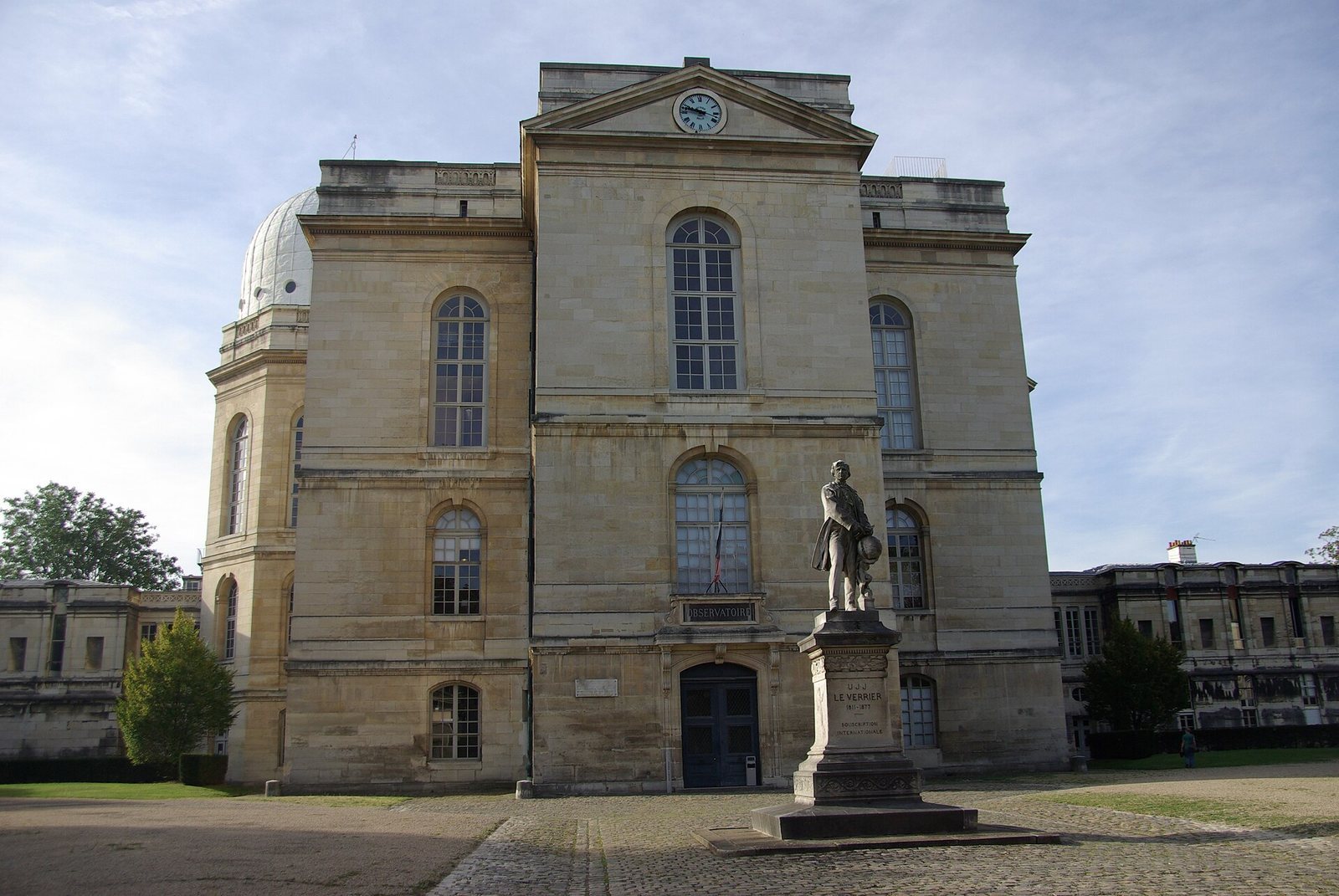
Chapu’s marble statue of Urbain Le Verrier was installed in the courtyard in 1889. A dome placed on the western tower in 1858 was removed in 1974 and reused at the Saint-Véran observatory.