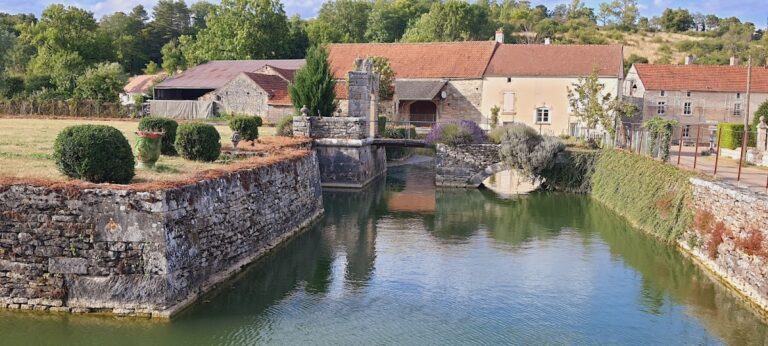
Parc Buffon: A Historic Castle Park in Montbard, France


Site at a Glance
- Rating
- 4.4
- Popularity
- Low
- Country
- France
- Primary era
- Medieval
- External website
- Open
- Eras represented
- Medieval, Early Modern
- Civilizations
- Duchy of Burgundy, French
- Site type
- Military
- Remains
- Castle
On this page10 sections
History
Parc Buffon is a historic castle park in Montbard, France, created in the eighteenth century from the remains of a medieval fortress. Its origins reach back to the last quarter of the eleventh century, when a feudal wooden castle stood on a rocky mound above valleys leading toward Paris, Dijon, and Semur-en-Auxois. The site served as a strategic observation post, and Montbard began to develop around it.
The medieval castle
The first lord associated with the castle was Bernard I of Montbard, who lived from 1040 to 1103. He was the father of André of Montbard, one of the nine founders and the fifth master of the Order of the Temple, a medieval military-religious order formed during the Crusading period. Bernard was also the father of Saint Alèthe of Montbard, the mother of Saint Bernard of Clairvaux, a major twelfth-century Cistercian reformer.
In 1189, Hugh III, Duke of Burgundy, exchanged his castle at Époisses with the lords of Montbard for Montbard Castle. The former feudal family consequently lost Montbard, although it retained other fiefs. During the thirteenth century, Hugh IV, Duke of Burgundy, began replacing the earlier stronghold with a stone fortress. Between 1300 and 1340, the Burgundian dukes added a surrounding rampart and defensive towers.
A Burgundian residence
During the fifteenth century, the castle was frequently occupied by the Valois dukes of Burgundy, members of the ruling house that governed a powerful Burgundian state. On 13 April 1423, Anne of Burgundy married John of Lancaster, Duke of Bedford, in the castle chapel by proxy for Pierre de Fontenay. John of Laignes, abbot of Fontenay, performed the ceremony.
After Charles the Bold died in 1477, the last major Valois duke of Burgundy, the fief passed to King Louis XI of France. The king entrusted its administration to families chosen through royal favor, first installing Philippe de Hochberg, Marshal of Burgundy. His heiress, Jeanne de Hochberg, married Louis I of Orléans-Longueville in 1504. About fifty years later, the fief passed through marriage to Philippe of Savoy-Nemours.
From abandoned castle to scientific park
The castle was auctioned in 1687, and Abbé Lorin, the parish priest of Montbard, made the winning bid. Eighteenth-century descriptions portray the building as abandoned and partly ruined. In 1718, Benjamin-François Leclerc, the father of Georges-Louis Leclerc de Buffon, acquired the seigneurial rights of the Montbard castellany with an inheritance received by his son.
After his father remarried in 1732, Buffon brought a legal action to obtain access to his inheritance and asked the king for authority to manage the castle. He received that authorization in 1733. Between 1733 and 1742, Georges-Louis Leclerc de Buffon, an eighteenth-century French naturalist, transformed the neglected fortress into the three-hectare Parc Buffon.
From 1749 to 1788, Buffon spent much of his working day at the park writing his Histoire naturelle, a large-scale effort to describe the natural world. The project included contributions from Louis Jean-Marie Daubenton, a naturalist and anatomist, and Bernard-Germain de Lacépède, another naturalist associated with its continuation. Louis XV made Buffon the first Count of Buffon in 1774. Buffon had been born at Montbard in 1707 and died in Paris in 1788.
Public park and museum complex
In 1870, the town of Montbard bought the castle after it had again fallen into neglect and converted it into a public park. Parc Buffon is now also an LPO nature reserve, managed within a French bird-protection organization’s network of habitat and bird-conservation sites. The Tour de l’Aubespin became a classified historic monument in 1862. The castle and park received historic-monument and classified-natural-site protection in 1947, while the tower, castle, and garden entered the Maisons des Illustres designation in 2011.
The former castle is associated with the Buffon Museum, which occupies the old stables and presents the development of science during the Enlightenment, including the work of Buffon and Daubenton. Its collections include the original 44 volumes of Buffon’s Histoire naturelle, scientific instruments, and exhibitions concerning the history of the site.
Remains
The fortress mound and surviving defenses
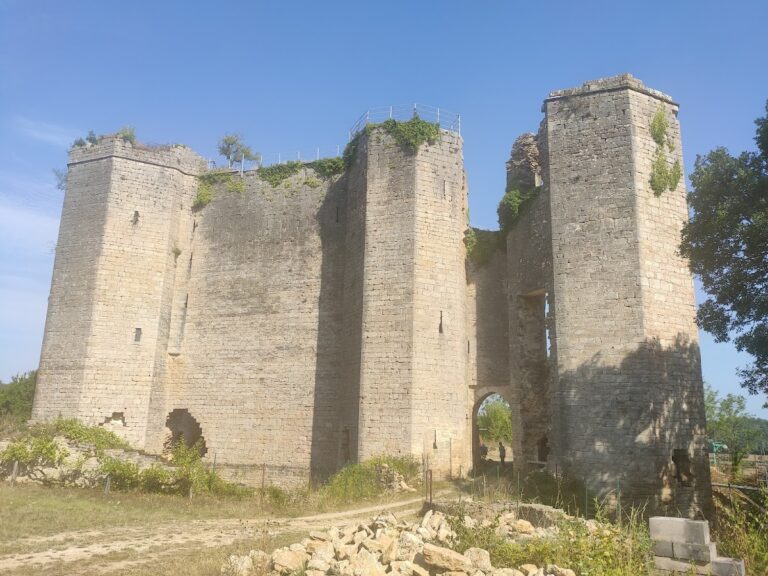
The surviving remains of the late thirteenth- or early fourteenth-century fortress occupy a rocky mound above the valleys directed toward Paris, Dijon, and Semur-en-Auxois. Masonry from the first thirteenth-century fortification remains on the eastern side. The defensive enclosure was formed by a rampart built between 1300 and 1340, with the Aubespin Tower and Saint-Louis Tower surviving from the defensive towers associated with the castle.
The Aubespin Tower
The Aubespin Tower was formerly the polygonal main tower, or keep. Its facades retain scattered blocks with bossage, masonry made with roughly projecting stones. Machicolations, projecting openings used by defenders to drop or discharge missiles onto attackers below, were installed at the top. Inside, four levels retain pointed-ribbed vaults characteristic of medieval Gothic construction. Buffon left the tower untouched during the creation of the park.
The Saint-Louis Tower and altered ramparts
Buffon filled the interior of the rampart with earth mixed with stones from the castle, producing a single level across the former defensive enclosure. He lowered the ramparts and altered the Saint-Louis Tower, removing one storey so that he could install his library. The tower also served as one of Buffon’s residences and workplaces. The nearby castle chapel was dedicated to Saint Louis, while Buffon left the Saint-Urse Church untouched.
The landscaped terraces and museum buildings
Buffon built a study on the western rampart and used the neighboring Hôtel de Buffon at the Petit Fontenet as another residence and workplace. He arranged the park around fourteen terraces in French and Italian garden styles, embellishing them with trees, flowers, and animals from different continents. A promenade occupies the foot of the first enclosure, and a statue commemorates Louis Jean-Marie Daubenton.
The Buffon Museum is housed in the former stables below the park’s main entrance. The buildings and terraces therefore preserve both the material remains of the medieval fortress and the physical setting of Buffon’s eighteenth-century scientific work.
Nearby sites