MuséoParc Alésia: An Archaeological Museum and Interpretation Center in France


Site at a Glance
- Rating
- 4.4
- Popularity
- Medium
- Country
- France
- Primary era
- Classical
- External website
- Open
- Eras represented
- Classical, Modern
- Civilizations
- French, Roman
- Site type
- Military
- Remains
- Camp
On this page6 sections
History
MuséoParc Alésia is an archaeological museum and interpretation center in France, located at Alise-Sainte-Reine, where the Battle of Alesia took place in 52 BC during the Gallic Wars. The conflict opposed the Roman army commanded by Julius Caesar, the Roman military commander and statesman who led the conquest of Gaul, to Gallic forces led by Vercingetorix, a leader who united several tribes against Rome.
From the Battle of Alesia to the first exhibition
The battle and siege form the historical foundation of the complex. Alesia became associated with the confrontation between Caesar’s army and the Gallic resistance led by Vercingetorix, placing the site within the wider Roman conquest of Gaul during the first century BC.
MuséoParc Alésia opened in March 2012. Its permanent exhibition during the period from 2012 to 2021 examined the Battle of Alesia, the Roman conquest of Gaul, Caesar and Vercingetorix, and the organization of the Gallic armies. It also presented archaeological work undertaken under Napoleon III and the later mythical interpretation of Alesia and the Gauls.
A wider history of the site
A renewed permanent exhibition opened on 3 July 2021. It broadened the chronological scope from the Neolithic period, the later prehistoric era associated with farming and settled communities, to the present. The exhibition follows the transition from the Celtic world to the Gallo-Roman world, the cultural environment created through interaction between Roman institutions and local Celtic communities, as well as the emergence of Christianity and the history of the modern village.
The revised exhibition incorporated objects studied and restored by the departmental conservation service since 2002. More than 600 original archaeological, ethnological, and documentary items relating to Alesia and the myth of the Gauls are presented. The archaeological and ethnological collections associated with Alesia have held the official French “Musée de France” designation, a status governed by museum legislation and applied to collections held in the national heritage interest. The designation was extended to the interpretation center in 2017. The Department of Côte-d’Or is responsible for the building and collections, while operation was delegated to the public local company MuséoParc Alésia.
Remains
The complex combines a circular museum building with an adjoining outdoor area devoted to full-scale reconstructions of the Roman siege works. Its exhibitions use films, dioramas, models, maps, multimedia displays, ancient everyday objects, archaeological finds, and reproductions of weapons and siege machines to explain the conquest of Gaul, the siege, the opposing armies, and the logistics of the battle.
The circular museum building
The principal building is a fully glazed cylinder 52 meters in diameter, with approximately 1,200 square meters of space. A surrounding lattice of larch wood evokes fortifications and Roman siege and watch towers. Designed by Bernard Tschumi’s practice, the building follows France’s High Environmental Quality approach, a framework intended to reduce the environmental impact of buildings through design, construction, and operation. Its circular form represents the encirclement of the Gauls by Roman forces.
Five levels are arranged around a semi-circular, helical ramp that leads to a circulation gallery, an exhibition platform, and conference rooms. Curved partition walls divide the first-floor exhibition platform into thematic areas, while the second floor contains an auditorium. The permanent exhibition follows a chronological circulation gallery shaped by the building’s circular form and continues through eight immersive spaces.
A planted roof terrace forms a ring-shaped walking route with views over the plain, Mont-Auxois, and the surrounding hills associated with the Roman army’s positions. Oak and birch trees grow on the terrace.
Reconstructed Roman siege works
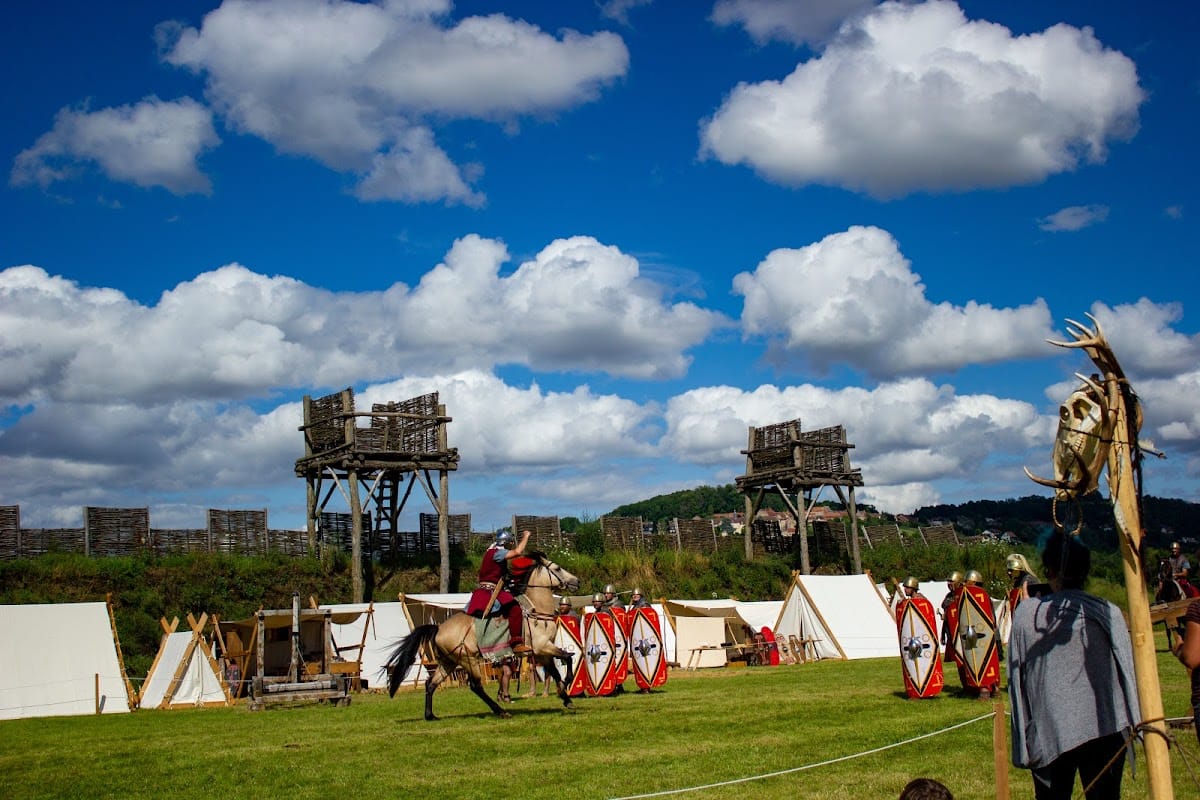
The adjoining outdoor area covers approximately 6,500 square meters and was designed by landscape architect Michel Desvigne. Along approximately 100 meters, it reconstructs sections of the Roman contravallation and circumvallation at full scale. A contravallation was a fortified line facing a besieged settlement, while a circumvallation was an outer line intended to protect the besieging army from attacks beyond the siege.
The reconstruction includes a glacis, watch and defensive towers, ditches, earthworks, ramparts, palisades, and pointed stakes known as cippi. It also contains full-scale reconstructions of a catapult and a scorpio, a Roman torsion-powered artillery weapon that fired bolts. The inner fortification represents the approximately 15-kilometer contravallation that confined the Gauls on Mont-Auxois. The outer fortification represents the approximately 21-kilometer circumvallation that protected the Roman army from the Gallic relief force.