Panathenaic Stadium: An Ancient Greek Stadium and Olympic Venue
Site at a Glance
- Popularity
- Very High
- Country
- Greece
- Primary era
- Classical
- Eras represented
- Classical
- Civilizations
- Ancient Greek, Roman
- Site type
- Entertainment
- Remains
- Stadium
On this page9 sections
History
Ancient Stadium
The Panathenaic Stadium in Athens, Greece, developed from a racecourse used from the sixth century BC. Around 330–329 BC, the Athenian statesman Lycurgus built or substantially monumentalized a stadium there for the Panathenaic Games, a religious and athletic festival held every four years in honor of Athena, the city’s patron goddess. The stadium’s history thus began as part of a festival central to ancient Athens.
Lycurgus persuaded the landowner Deinas to give the ground to the city. An inscription dated 329 BC records that Eudemus of Plataea contributed 1,000 yoke of oxen for the construction of the stadium and a theater. The stadium was probably ready for the Panathenaic Games of 330/329 BC, though it may instead have enlarged or renovated an earlier facility.
Herodes Atticus, an Athenian-born Roman senator and benefactor, rebuilt the stadium in marble around AD 139–144 and raised its capacity to about 50,000. As Christianity spread, the site was largely abandoned. In the late fourth century, Roman emperor Theodosius I banned Hellenistic festivals and bloody spectacles, and the stadium fell into ruin.
Decline and Medieval Use
During Latin rule, when western European crusader states governed parts of Greece, knights held feats of arms at the stadium. Marble was later taken from the structure for use in other buildings. Travelers also described young Athenian women performing marriage-seeking rites in a ruined vaulted passage.
Excavation and Revival
Archaeological work began in 1836, uncovering remains of Herodes Atticus’s stadium. More extensive excavations by Ernst Ziller in 1869–1870 brought marble fragments and four sculpted pillars, or herms, to light. In 1856, Greek benefactor Evangelis Zappas offered to fund a marble covering for the stadium and an exhibition building above its curved end. Architect François Boulanger drew up plans, but the project in that form did not proceed.
Instead, the stadium was prepared for the Zappas Olympics of 1870 and 1875, an early effort to revive the ancient Olympic Games. Workers leveled the track and installed temporary wooden seating for officials. Each event drew an audience of about 30,000. A bridge over the Ilissos in front of the stadium was built in 1874 using money from Zappas’s bequest.
Before the 1896 Olympics, the Greek government, acting through Crown Prince Constantine, sought support from businessman George Averoff. Architects Anastasios Metaxas and Ziller planned a reconstruction based on the excavated remains, and Averoff donated 920,000 drachmas. Work began in 1895. Because of the short schedule, marble covered only the seating around the curved end and the lowest rows beside the track by the time the Games began; the marble work was completed in 1900.
Olympic and Modern Events
The stadium hosted the opening and closing ceremonies of the 1896 Olympic Games and competitions in four of the nine sports: athletics, gymnastics, weightlifting, and wrestling. The Games opened on 6 April, Easter Monday for both Western and Eastern Christian churches and the anniversary of Greek independence. Estimates for the opening-day audience range from about 60,000 to 80,000. Constantine chaired the organizing committee, and his father, King George I, formally opened the Games.
The venue also hosted the 1906 Intercalated Games, additional Olympic gatherings held between the regular four-year editions. From 22 April to 2 May, competitions there included athletics, gymnastics, weightlifting, wrestling, and tug of war.
AEK, an Athens-based sports club, used the stadium for basketball during the mid-to-late 1960s. On 4 April 1968, it defeated Slavia Prague in the European Cup Winners’ Cup final. More than 70,000 spectators attended, and the game is believed to have set a world attendance record for an outdoor basketball match.
During Greece’s military dictatorship of 1967–1974, the stadium hosted large annual events, including the “Festival of the Military Virtues of the Greeks” and ceremonies marking the 21 April 1967 coup. The regime drew on the venue’s connection with antiquity to promote national pride and its political image.
At the 2004 Athens Olympics, the stadium hosted archery from 15 to 21 August and served as the finish for the women’s marathon on 22 August and the men’s marathon on 29 August. It remains the finish point for the annual Athens Classic Marathon and the Greek venue for handing the Olympic flame to the next host nation. In 2012, the flame was handed to Princess Anne for transport to Britain.
The stadium also influenced later designs. Harvard Stadium, built in 1903, was modeled on it. Albert Speer drew inspiration from it for a proposed stadium in Nuremberg designed to hold about 400,000 spectators. Construction began in 1937 but was never completed.
Remains
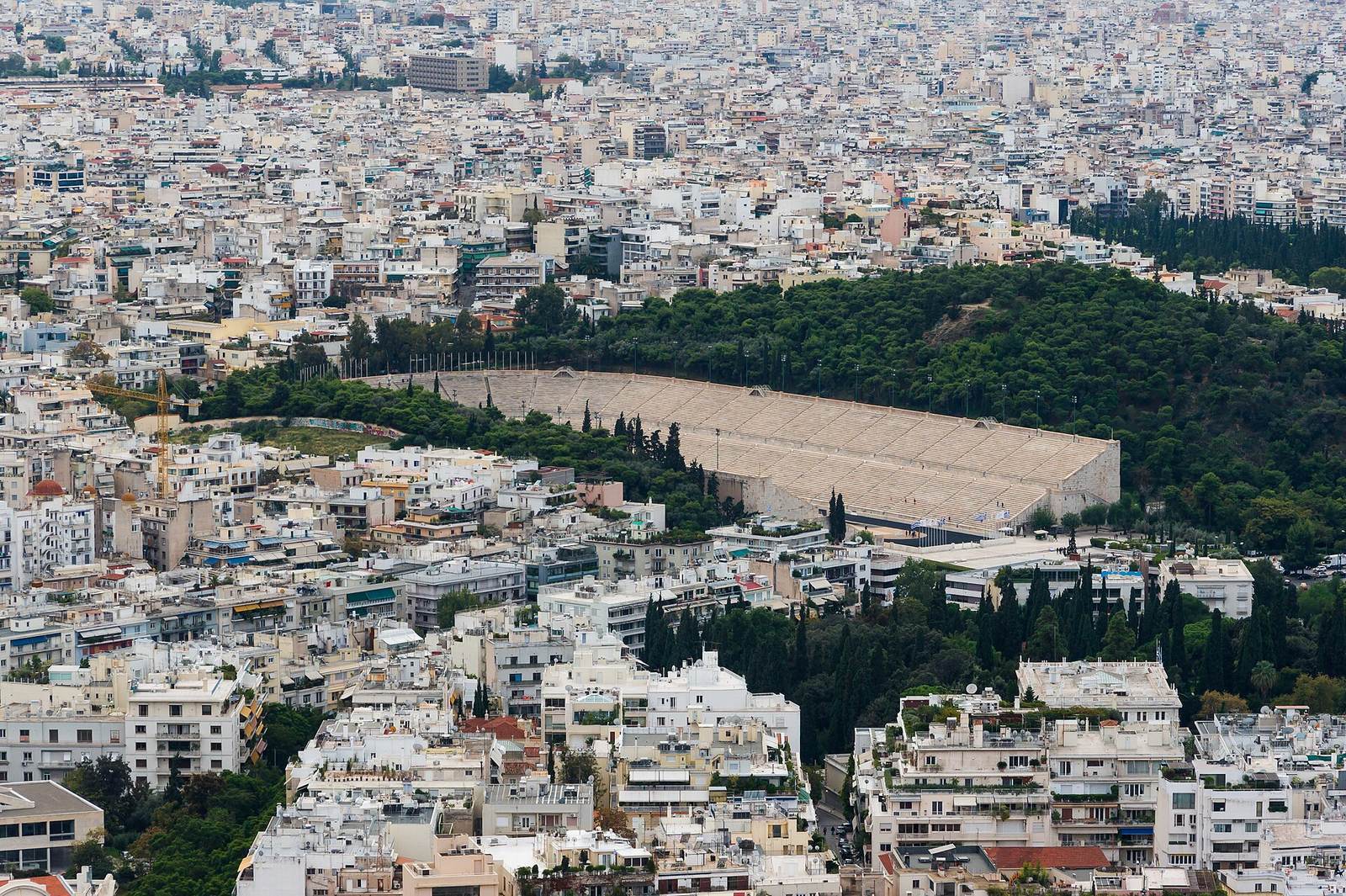
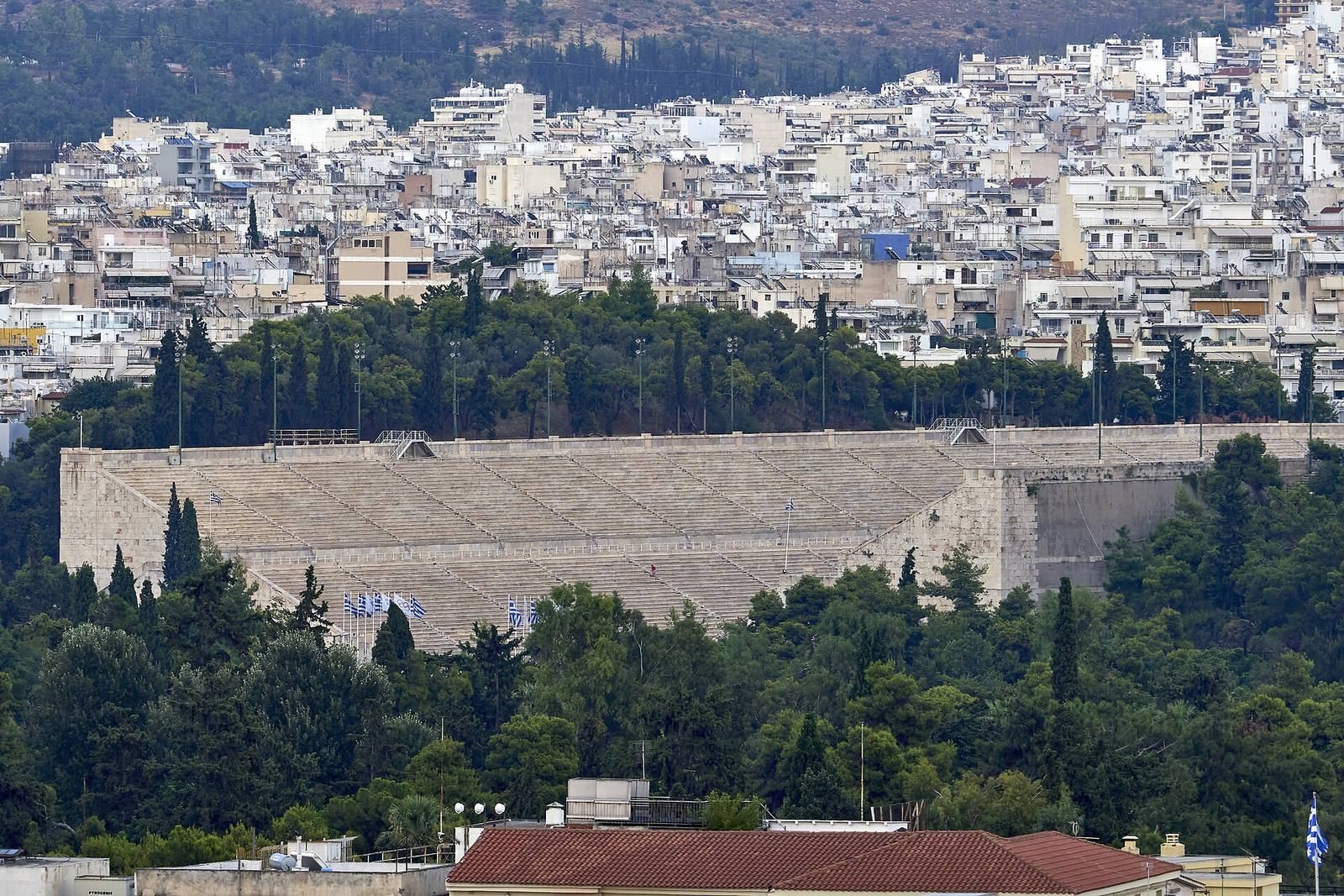
The stadium occupies a natural ravine between the hills of Agra and Ardettos, south of the Ilissos River. Its U-shaped seating follows the contours of the ravine, with the curved end closing the track. The present structure is built entirely of marble and retains the form developed through the ancient stadium and its later reconstruction.
Early Stadium and Medieval Remains
The first racecourse relied on the ravine’s natural slopes for spectators and had no formal seating. Lycurgus’s stadium measured about 260 metres overall, with a track about 204 metres long and 34 metres wide. Tiers of stone benches surrounded the track, and the structure was built from poros stone, a type of limestone. The visible remains had dwindled by the time Athens became the capital under Otto, the first king of modern Greece, to two retaining walls beside the entrance. A fifteenth-century description mentions rows of white marble benches, a portico at the north entrance, and a covered colonnade around the seating area at the south entrance.
Herodes Atticus’s Marble Stadium
The second-century stadium was built with squared blocks of Pentelic marble, quarried from Mount Pentelikon near Athens, and little concrete. Its U-shaped seating combined the Greek stadium form with the scale of Roman buildings, and could accommodate about 50,000 people. Owls, symbols of Athena, decorated the seats. A marble throne from the front row, now in the British Museum, carries a relief of an olive tree and a table bearing wreaths and a Panathenaic amphora, a two-handled prize vessel associated with the festival. An owl forms one of the throne’s front legs. Ten similar thrones have been found around Athens.
Nineteenth-Century Reconstruction
The reconstruction followed the second-century stadium’s dimensions and U-shaped plan, using Pentelic marble. The seating has 50 rows of marble steps and once held about 75,000–80,000 spectators; its present capacity is 45,000. A statue of Averoff by sculptor George Vroutos stands to the right of the entrance. Unveiled on 5 April 1896, it commemorates the businessman whose donation supported the reconstruction. The 1874 bridge was built in front of the stadium over the Ilissos. The river now runs beneath Vasileos Konstantinou Avenue, which covers its former course in front of the entrance.
During preparations for the 1875 Zappas Olympics, temporary wooden tiers for officials were placed at the back of the curved end. The stadium also appears on a Greek commemorative €100 coin minted in 2003 for the 2004 Olympics. Its image is featured on the reverse of Olympic medals awarded in 2004 and at the Summer Games in Beijing in 2008, London in 2012, Rio de Janeiro in 2016, and Tokyo in 2021.