Temple of Olympian Zeus: A Sanctuary and Monument in Athens


Site at a Glance
- Rating
- 4.4
- Popularity
- Very High
- Country
- Greece
- Primary era
- Classical
- External website
- Open
- Eras represented
- Iron Age, Classical
- Civilizations
- Ancient Greek, Roman, Seleucid
- Site type
- Religious
- Remains
- Temple
On this page12 sections
History
The Temple of Olympian Zeus is a Greek sanctuary and temple complex in Athens, Greece, whose colossal Corinthian form was completed in 131–132 AD after construction began around 515 BC. Known as the Olympieion, the sanctuary was dedicated to Olympian Zeus, the chief deity of the Olympian gods, and became one of Athens’ oldest and most important sacred places.
Mythic origins and the archaic project
Pausanias attributed the foundation of the sanctuary to Deucalion, the mythical ancestor of the Greeks. In this tradition, Deucalion established the sacred place to honour Zeus after surviving the flood that had destroyed an earlier human generation. An earlier temple stood on the site by the early sixth century BC.
A new and much larger temple was begun during the Athenian tyranny in the late sixth century BC, conventionally around 515 BC. The project was associated with Pisistratus the Younger and the Pisistratid rulers, the sons and successors of the Athenian tyrant Pisistratus. It reached at least the stepped stone platform, or crepidoma, before the tyranny ended. Work then stopped, and the building remained unfinished during the succeeding democracy.
The architects were traditionally named as Antistates, Callaeschrus, Antimachides, and Phormos, although Porinus has also been proposed for the fourth position. The archaic design was generally Doric, with a plan that recalled the monumental double-colonnade temples of Asia Minor. Its materials and architectural members were later partly reused in the eastern arm of the Themistoclean Wall, the defensive circuit built around Athens after the Persian Wars.
Aristotle later cited the Olympieion as an example of the enormous public works undertaken by tyrannical regimes. The scale of the abandoned project therefore remained part of political and historical discussion even while the temple itself stood incomplete.
Hellenistic construction and Roman completion
Construction resumed in 175 BC under Antiochus IV Epiphanes, the Seleucid king who ruled Syria from 175 to 164 BC. He commissioned the Roman architect Decimus Cossutius to continue the work. The new project retained the earlier temple’s general scale and proportions, but changed its architectural order from Doric to Corinthian and replaced the principal material with Pentelic marble.
Work stopped again after Antiochus’ death around 164 BC. By then, the building had reached at least the level of the entablature, the horizontal architectural assembly carried above the columns, although the exact stage of completion remains uncertain. After Sulla captured Athens in 86 BC, elements from the unfinished temple were taken to Rome for buildings on the Capitoline Hill, possibly including the Temple of Jupiter Optimus Maximus. It is uncertain whether these were columns that had already been erected or architectural members prepared for assembly.
A possible attempt to revive the project under Augustus remains conjectural. Ancient testimony describes plans by allied kings to complete the temple and dedicate it to the Genius of Augustus, but it does not establish that substantial construction took place during his reign.
The decisive phase followed Hadrian’s visit to Athens in 124–125 AD. The Roman emperor, known for promoting Greek culture and major building projects in the city, supported the completion of the temple. It was formally dedicated in 131–132 AD, bringing to completion a project that had begun more than six centuries earlier. Olympian Zeus received the dedication, while Hadrian was honoured alongside the god.
In the Roman period, the Olympieion was regarded as the largest temple in Greece and one of the largest in the ancient world. The sanctuary contained numerous statues and dedications, including representations of Hadrian, the gods, and personifications of the Roman provinces. The Athenians also erected a colossal statue of Hadrian behind the temple in recognition of his benefactions.
Damage, reuse, and archaeological study
The Heruli sack of Athens in 267 AD seriously damaged the temple. It was probably not repaired, and the ruin deteriorated through the following centuries as a result of natural decay, possible earthquake damage, and the systematic removal of building materials. Stone from the temple was incorporated into a nearby basilica in the fifth or sixth century, as well as into medieval houses and churches.
During the Christian period, the complex included a chapel dedicated to Saint John. In the Ottoman period, an open-air prayer place or small mosque occupied the south-eastern part of the precinct. A medieval structure, possibly an observation post, was built above the entablature at the temple’s south-eastern corner.
Ciriaco de’ Pizzicolli, an Italian humanist and antiquarian, visited Athens in 1436 and saw twenty-one of the original 104 columns still standing. In 1759, the Ottoman governor Mustapha Agha Tzistarakis ordered one of Hadrian’s columns to be demolished with gunpowder. Its marble was made into plaster for the Tzistarakis Mosque in Monastiraki. Of the sixteen columns surviving in the modern period, one fell during a storm in 1852.
The earliest documented modern archaeological investigations began in 1886, when Stephanos Koumanoudes excavated north of the precinct. In 1887, Francis Penrose carried out the first known British School at Athens excavation directly around the temple to clarify its architectural plan. Campaigns between 1886 and 1907 helped produce the first scientific reconstruction of Athens’ topography.
Penrose identified important elements of the earlier sanctuary and temple, while Gabriel Welter investigated the foundations and published a report in 1923. John Travlos resumed work north of the precinct in 1956, continued in 1959, and conducted further campaigns in 1961. These investigations exposed early remains, Classical and Roman buildings, and features that Travlos interpreted as archaeological confirmation of an early settlement described by Thucydides on the southern slope of the Acropolis. The temple now forms part of the unified archaeological sites of Athens and is protected and supervised by the Ephorate of Antiquities, the Greek state archaeological service responsible for archaeological sites.
Remains
Hadrianic sanctuary and temple
The Hadrianic complex was arranged around a temple standing at the centre of an open area measuring approximately 250 by 130 metres. A rectangular precinct built of poros, a local stone, enclosed the area. It measured 205.85 by 128.72 metres and was strengthened with engaged piers, which were attached to the enclosure walls. Entry was provided by a small propylon, or gateway building, on the north side.
The Corinthian temple
The completed temple measured 110.35 metres in length and 43.68 metres in width. It was a colossal Corinthian building with two rows of twenty columns along each long side and three rows of eight columns across each short side, making 104 columns in total. The columns rose approximately 17.25 metres and had lower diameters of about 1.70 metres.
The cella, the main enclosed chamber of a Greek temple, contained a colossal chryselephantine statue of Zeus, made with gold and ivory, together with a statue of Hadrian. The emperor was worshipped in conjunction with the god. Statues, busts, and votive offerings decorated the temple and precinct, while statues of Hadrian stood at regular intervals around the outer enclosure. Sixteen columns of the Hadrianic structure survive. Fifteen remain standing, thirteen at the south-eastern corner and three near the south-western corner. The central column of the south-western group collapsed in 1852 and remains on the ground.
The outer precinct
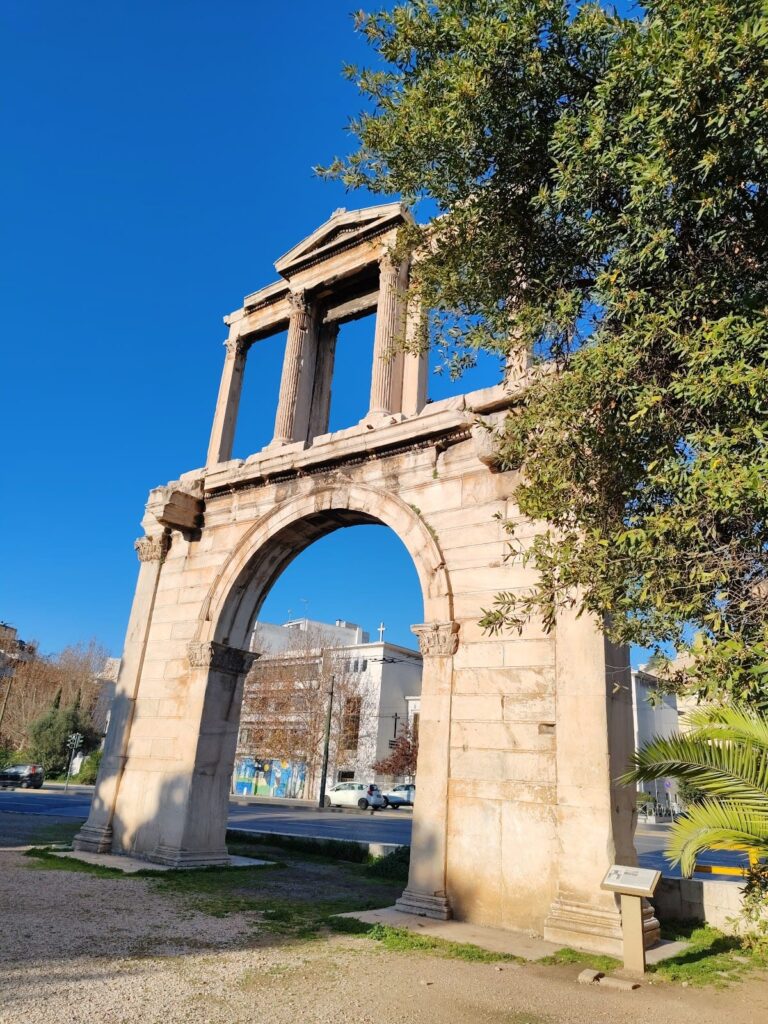
The Arch of Hadrian stands at the north-western corner of the outer precinct. The enclosure’s dimensions and reinforced walls defined the temple’s open setting, while the northern propylon controlled entry into the sacred area. Excavations around the precinct also identified bases for Hadrianic statues placed at regular intervals, linking the imperial imagery to the architectural boundary of the sanctuary.
Archaic temple and surrounding remains
The earlier temple
The archaic temple is known mainly through its foundations and architectural material reused elsewhere. It has been reconstructed as a building approximately 107.7 by 42.9 metres, probably with eight columns across each end and twenty-one along each side. Its foundations were deeper toward the south and west, while the inner columns of the surrounding colonnade had individual foundations. The internal arrangement remains largely conjectural. The building was probably constructed from local limestone or poros and is generally identified as Doric.
Northern excavated area
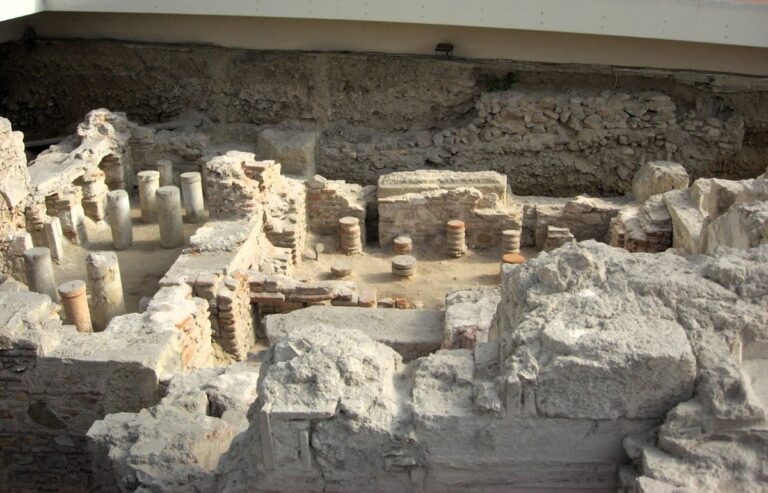
North of the precinct, stretches of a structure have been attributed by John Travlos to the Themistoclean Wall. A ceramic sequence from the last quarter of the eighth century to the second quarter of the sixth century BC was found in the same area. Eva Brann interpreted the pottery as ceremonial and associated it with a probable Archaic necropolis along a road that also passed beneath the later Arch of Hadrian. A marble relief was found north of the enclosure in 1959.
Neighbouring sanctuaries
Investigations around the Olympieion identified several additional religious structures. Immediately north of the sanctuary lay the foundations of a Classical temple interpreted as the sanctuary of Apollo Delphinios, an epithet and cult form of Apollo. A small Roman Doric peripteral temple, meaning a temple surrounded by a single external colonnade, was interpreted as the Kronion, a sanctuary associated with Kronos. Farther south-west were the remains of a large rectangular peristyle, a courtyard or building space surrounded by columns, together with the foundations of a small temple associated with the Panhellenion, Hadrian’s pan-Greek religious and political association.