Panagia tou Kastrou: A Byzantine Church and Former Cathedral in Rhodes


Site at a Glance
- Rating
- 4.4
- Popularity
- Low
- Country
- Greece
- Primary era
- Medieval
- Eras represented
- Medieval, Modern
- Civilizations
- Byzantine, Crusader, Knights Hospitaller, Ottoman
- Site type
- Religious
- Remains
- Cathedral
On this page7 sections
History
Panagia tou Kastrou is an eleventh-century Byzantine church in Greece, located in the medieval city of Rhodes. Built for Greek Orthodox worship, it is described as the oldest and largest surviving Byzantine church in the medieval city and the largest surviving Byzantine church on the island. Its history reflects successive changes in the political control of Rhodes, from Byzantine and Orthodox rule through the Catholic government of the Knights Hospitaller and the Ottoman period.
Byzantine foundation
The original church was built around the eleventh century in the Christian architectural tradition of the Eastern Roman Empire and its successors. It had a domed inscribed-cross plan, in which the main spaces formed a cross within a roughly rectangular building. This arrangement remained visible up to about the level where the arches began.
The Hospitaller cathedral
After the Knights Hospitaller, a Catholic military-religious order that ruled Rhodes from 1309 to 1522, captured the island, the Orthodox church was converted into a Roman Catholic church. It became the archiepiscopal cathedral of the Latin archbishop and continued to be dedicated to the Virgin Mary as Sancta Maria Castelli Rodi.
The building was remodeled during the first half of the fourteenth century, probably after the middle nave and dome collapsed in the earthquake of 1303. The Archdiocese of Rhodes could not finance the reconstruction, so assistance was requested from Pope John XXII, head of the Roman Catholic Church from 1316 to 1334. His coat of arms was placed beside that of Hospitaller Grand Master Hélion de Villeneuve in recognition of the contribution.
During the second half of the fifteenth century, the Knights undertook another intervention, probably in connection with the siege of 1480, when the church suffered extensive damage. The coats of arms of Grand Master Pierre d’Aubusson, who held office from 1476 to 1503, and of the earlier grand masters Antoni de Fluvian and Jean Bonpart de Lastic were displayed as tributes apparently linked to their contributions to restoration work.
Ottoman mosque and renewed Orthodox use
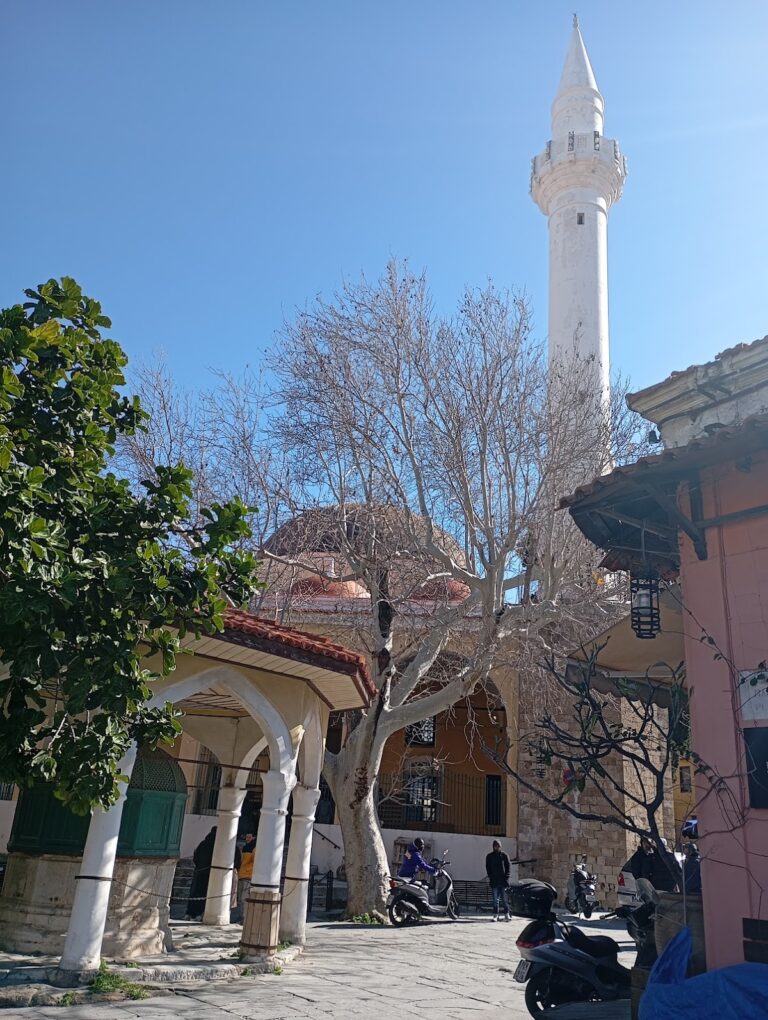
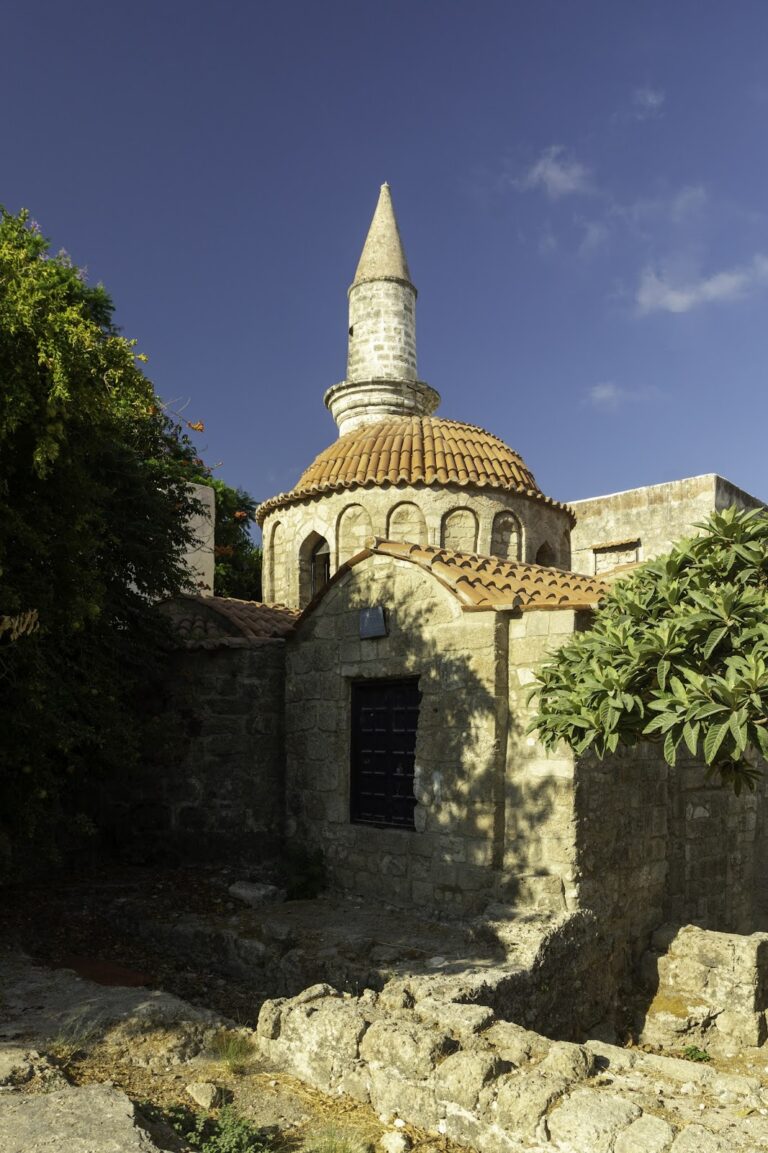
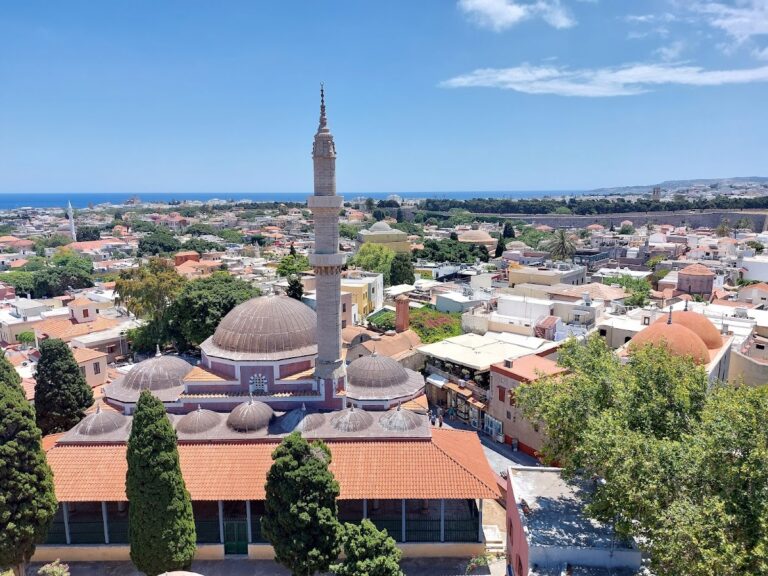
After the Ottoman capture of Rhodes in 1522, the church became a mosque known as Enderun Mosque, or Enderun Camii. A portico was added and a minaret was erected on the south side. The building remained a mosque until after the Second World War. When Rhodes was ceded to Greece in 1947, it was converted back into a Christian church, and the portico and minaret were removed during restoration. It has functioned as an active Greek Orthodox church since approximately 1947 and is administered within the Greek Orthodox Metropolis of Rhodes.
Remains
Layout and exterior
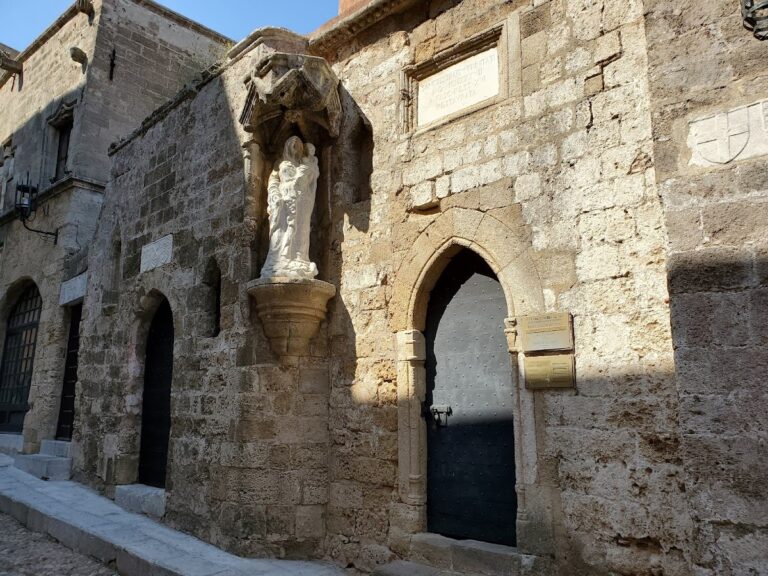
Panagia tou Kastrou stands at the eastern end of the Street of the Knights in the Kollakio, the upper part of the medieval walled city of Rhodes, near the seaport. Built of brick and stone, it is described as Byzantine Gothic in style. The original domed inscribed-cross arrangement can be followed to approximately the beginning of the arches, while the Hospitaller remodeling changed the building into a three-aisled Gothic basilica with a transverse aisle. A basilica is a longitudinal church organized around a central nave and side aisles.
The eastern side adjoins the sea fortification and is formed externally as a tower with rectangular ramparts. On the west façade, a large rectangular frame above the principal entrance once contained a painted image of the Virgin Mary surrounded by saints and knights. The image is now lost. A fountain dated 1881 stands in the outer courtyard, while the portico and minaret associated with the building’s mosque period were removed during restoration.
Surviving painted decoration
Limited painted decoration survives inside the church. A mural showing the Virgin Mary with the Child and two saints is located on the northwestern column supporting the dome and probably dates from the second quarter of the fourteenth century. A figure of Saint Lucia remains on the southern wall and was probably painted by a Western European artist after approximately 1350.
Nearby sites