Château de Buzet-sur-Baïse: A Historic Castle and Estate in France


Site at a Glance
- Rating
- 3.4
- Popularity
- Very Low
- Country
- France
- Primary era
- Medieval
- Eras represented
- Medieval, Early Modern, Modern
- Civilizations
- English, French
- Site type
- Domestic
- Remains
- Castle
On this page15 sections
History
Château de Buzet-sur-Baïse is a historic castle in France whose foundation belongs to the early eleventh century, when the Gascon ruler Sanche ordered a fortified residence at Buzet. The site later became an aristocratic residence and wine-growing estate, while its surrounding hilltop settlement was gradually reshaped into a park.
Foundation and medieval lordship
The first written reference to Buzet appears in a charter issued by Bernard Guilhem, count of Gascony between 997 and 1009. The charter records property within Buzet’s jurisdiction but does not mention a castle. A later charter by Sanche, who ruled Gascony from 1009 to 1032, describes a domain called Buzet that he donated to the monks of Saint-Pierre de Condom and identifies a castle he had ordered to be fortified. This fortified residence is generally regarded as the beginning of the castle’s history.
By the middle of the thirteenth century, the monks had lost their lordship. Bernard de Rovignan acknowledged possession of the castle and its dependencies in 1259, while the customs of 1273 show that Buzet had two co-lords. The Piis, also called Pins, family held half of the castle with Bernard de Rovignan by 1286. Aymeri de Savignac and Bernardus Peloti also held rights at Buzet, although those rights did not necessarily include possession of a castle.
This co-lordship, a feudal arrangement in which two lords shared jurisdiction over one domain, explains why Buzet had two castles facing one another. English soldiers pillaged and burned both buildings in 1293 and 1294 after Bernard de Rovignan raided the Agenais and changed allegiance to the French king. The attack was later cited by Philip the Fair among the reasons for the War of Guyenne, a conflict between the French and English crowns fought from 1294 to 1297.
The Albret and Noaillan inheritances
On 23 December 1385, Bérard d’Albret, lord of Sainte-Bazeille and brother of Arnaud-Amanieu, lord of Albret, bought the lordship of Buzet and its dependencies from Jean de Rovignan for 2,000 gold francs. He also acquired the inheritance of the last Piis lords and became Buzet’s sole lord. One of the castles was then abandoned and became known as the old castle.
Charles II, lord of Albret, recovered the Sainte-Bazeille inheritance in 1435 but soon transferred Buzet. On 24 February 1436, he pledged the castle to Louis de Noaillan, lord of Fréchou, as payment for 2,000 livres owed for the purchase of Boulogne. The arrangement became a definitive exchange in 1445. In 1464, Charles II’s eldest son, Jean d’Albret, confirmed that his family had abandoned its rights at Buzet.
Buzet stood near the frontier between French and English-held territories and beside an important route during the Hundred Years’ War. It apparently escaped assault during the invasion led by the earl of Huntingdon in 1439. The army passed nearby, then turned south at Damazan toward Vianne and Mézin.
From noble residence to managed estate
The marriage of Béatrix de Noaillan and Antoine de Grossolles in 1504 changed the castle’s role. Antoine made Buzet his principal residence, and his descendants continued to live there until the end of the seventeenth century. King Charles IX spent the night at Buzet on 1 August 1565 while travelling from the Albret court at Nérac toward Bordeaux. The Grossolles family supported the royal and Catholic party in a region containing many Protestant strongholds, and the king arrived with several thousand members of his court.
Antoine Agesilas de Grossolles, lord of Buzet and a participant in the Fronde, died at the Battle of the Faubourg Saint-Antoine on 2 July 1652. The Fronde consisted of rebellions against royal authority and centralizing government during the minority of Louis XIV. His widow, Marie-Françoise Le Hardy de La Trousse, remained at the castle, but their children moved to Paris and Versailles. Until the 1760s, the castle was generally unoccupied and the lordship was administered by stewards.
From the 1760s, Emmanuel François de Grossolles, count of Flamarens, modernized the estate with new avenues and gardens. Agésilas Joseph de Grossolles continued the work in the 1780s. He added a western wing, installed a modern bathroom, rebuilt the northern and southern terraces, and planned to transform the remains of the old fortified village into an ornamental park.
Revolution, restoration, and nineteenth-century expansion
During the French Revolution, Agésilas-Joseph de Grossolles joined the Buzet National Guard and adopted revolutionary ideals. His property came under threat after members of his family emigrated in 1793, and he was imprisoned preventively at Toulouse. An order of 14 October 1793 called for fortified castles in the district to be destroyed. A procedural dispute over the height of Buzet’s towers in relation to the main residential building delayed the order’s execution and saved the castle.
Improvement work resumed after the Revolution. When Agésilas-Joseph de Grossolles died without a direct heir in 1818, his cousin Joséphine de Grossolles succeeded him and transferred the castle to her husband, Christophe de Beaumont. They made Buzet their principal residence and received visitors including George Sand, the pen name of the novelist Amantine-Lucile-Aurore Dupin.
In 1852, Marie de Beaumont, the family’s last heiress, married Alfred de Noailles and transferred the castle to him. Alfred divided his time between Paris and Buzet. During the 1860s, under the direction of the Bordeaux architect Duphot, he added an eastern wing, demolished the old castle and the last houses of the fortified settlement, and converted the parish church into a private chapel.
Alfred also developed Buzet as a model wine-growing operation. He expanded the export of Buzet wine as far as China, Japan, and the United States, and invested continuously in combating phylloxera, a vine pest that devastated European vineyards and required large-scale agricultural intervention.
Decline, wartime use, and preservation
After Alfred de Noailles died in 1895, his widow remained at the castle until her death in 1915. Their children considered the property too expensive to maintain and sold it on 15 January 1931 to Giovanni Kröss and his brothers. Born in South Tyrol, the brothers had been Austrian before the province became part of Italy after the First World War. The Kröss family used the castle occasionally for receptions and otherwise left it empty.
From 1939 to 1942, the castle sheltered refugees from Bas-Rhin, including residents of the Bischwiller asylum. Between 22 June and 14 July 1944, its eastern wing housed the 5th Company of the Deutschland Regiment, part of the rear command of the 2nd SS Division Das Reich. The regiment shot several inhabitants in the town before departing.
The property was placed under sequestration as foreign-owned property from 1944 to 1951. Holiday colonies made minor repairs, but the building was already suffering advanced deterioration. In 1951, the state returned the castle to the Kröss family after deciding that maintenance costs were too high. Strained relations with Buzet’s mayor, René Dupouy, prevented the family’s return. The abandoned building was then stripped by local inhabitants, who removed marble, mirrors, and the grille from the vegetable garden.
Doctor Chapey of the Committee for the Protection of Historic Monuments and Sites led a preservation campaign in 1966 and 1967, concentrating on the eastern wing and the church, which were among the most damaged parts of the estate. On 15 September 1969, an arson attack destroyed the eastern wing, although firefighters saved the main building.
Regional residents bought the castle from the Kröss family in 1972 for a symbolic sum. Unable to restore the burned wing and concerned that it would discourage buyers, they demolished the eighteenth- and nineteenth-century wings, including the older chapel covered by the eastern wing. The work also removed the principal entrance, which had stood between the eastern wing and the eastern tower.
Two doctors from Bordeaux, the Demangeat couple, bought the castle in 1981 and carried out its final major works. These included repairs to the eastern tower’s roof and framework in 1995. Their heirs placed the property and its 12-hectare park on the market in 2014, and the Cave des Vignerons de Buzet acquired the estate in 2018.
Château de Buzet-sur-Baïse is protected as a historic monument. Its facades and roofs, ground-floor fireplaces, dining room, reception room, outbuildings, round park tower, architectural remains in the park, and columned portico were inscribed in 1989. The painted ceilings of the first-floor bedrooms were classified in 1991, and the château received a further historic-monument inscription in 2015.
Remains
The castle and surviving medieval fabric
Main residential building
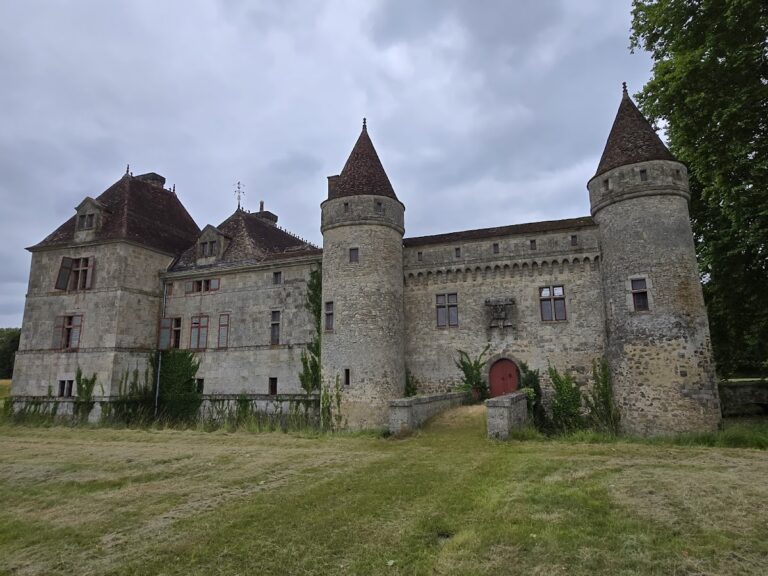
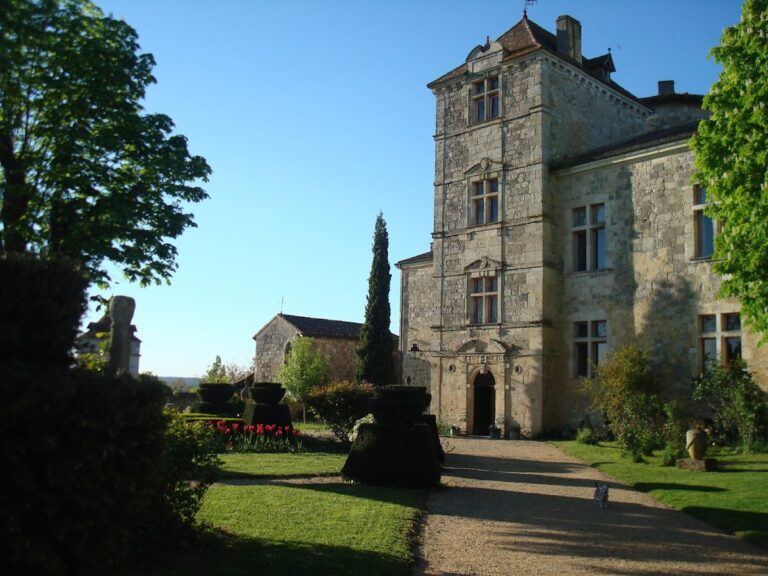
The surviving complex is centered on the main residential building, whose oldest visible parts probably date from the late thirteenth or early fourteenth century, after the destruction of the two earlier castles. The building retains sixteenth-century fabric, including an octagonal tower on the southern facade that contains a spiral staircase. Further embellishment took place in the early seventeenth century, when the first-floor ceilings were painted with emblems and coded symbols derived from a work by the Italian scholar Andrea Alciati.
Eastern tower and related structures
An eastern tower forms part of the present complex, together with outbuildings, a round tower in the park, architectural remains in the park, and a columned portico. The eastern tower’s roof and framework were repaired in 1995. The eighteenth- and nineteenth-century wings that once extended west and east were demolished in 1972, and the former main entrance at the junction of the eastern wing and eastern tower disappeared with them.
Remnant of the second castle
A tower facing the present castle is the only surviving remnant of the second medieval castle. Alfred de Noailles demolished the other remains of the old castle in the nineteenth century but retained this highest tower. After a hydraulic ram, a water-powered pump, was installed, the tower served as a water tower.
The fortified settlement and transformed park
Haut-Buzet
A fortified settlement developed below the two castles, probably from the eleventh century. Known later as Haut-Buzet, it occupied a narrow hilltop and included the castles, a church, walls, and ditches. Water was difficult to obtain, and the settlement long depended on a drinking trough and two wells. Seventeenth-century land surveys record about thirty families. The settlement had probably been larger during the Middle Ages, then declined as its lords converted the area into an ornamental park.
During the 1760s and 1770s, chestnut trees were planted beside roads and on a terrace, and a large tree-lined square was created opposite the castle. The eastern fortified gate, known as the Eastern Gate, was demolished. From 1783, Agésilas-Joseph de Grossolles systematically bought houses in Haut-Buzet for demolition, removing more of the former settlement as the estate’s landscape was reorganized.
Gardens and ornamental buildings
The former seigneurial orchard became an orangery, a sheltered garden building for citrus trees and other plants requiring protection from cold. Beyond it, a Chinese-inspired reception area was created with an ornamental bridge and three pavilions. One pavilion resembled a pagoda, while the cottage pavilion survives. The Parisian architect Soufflot the Roman directed these works. Georges Jacob supplied furniture for the Chinese pavilion, Pierre-Joseph Lécrivain painted it, Antoine Bell carried out the joinery, Clément the ironwork, and Hugaud the carpentry.
Agésilas-Joseph also demolished further town walls to create a straight view along the main street from the castle courtyard to the reception area behind the vegetable garden, passing the church forecourt. In the 1820s, Christophe de Beaumont resumed the transformation of Haut-Buzet. He bought nearly all the remaining houses and, after disputes with the municipality during the 1830s, expropriated most of the land still belonging to it in the former village. He replaced the earlier Chinese-inspired garden with an English-style landscape garden, leaving the park with a combination of English and Chinese-inspired features.
Church and surviving settlement remains
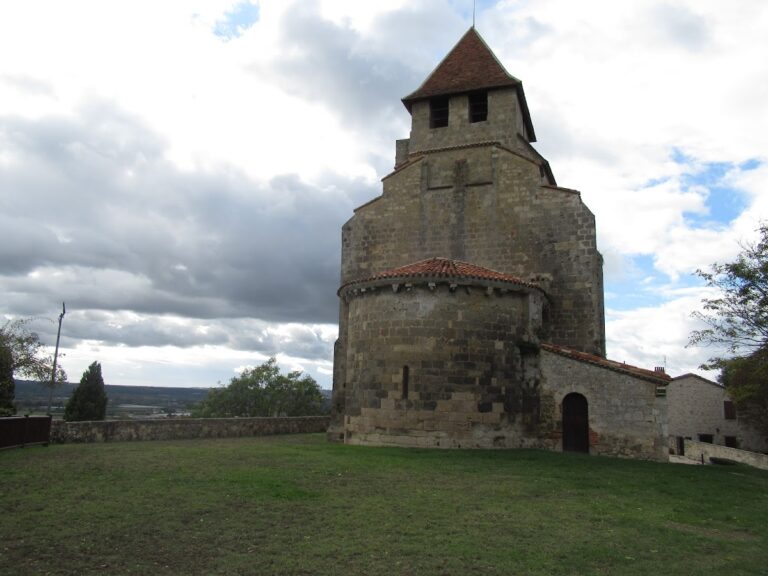
The parish church was abandoned after its nave collapsed in November 1849. Alfred de Noailles bought it in 1870 and converted its bell tower into a private chapel. He also removed the last communal paths. The last resident of Haut-Buzet sold his house in 1866, and the settlement now survives through peripheral ruins and the former house of the shoemaker Lacombe, which was incorporated into the lords’ stables to enlarge them.
During the Kröss period, the neglected park was used as an orchard and vegetable garden. The estate now includes a 12-hectare park whose surviving features preserve parts of the former fortified settlement, the ornamental gardens, and later service buildings.