Santa Maria della Pace: A Renaissance and Baroque Church in Rome


Site at a Glance
- Rating
- 4.7
- Popularity
- Medium
- Country
- Italy
- Primary era
- Early Modern
- External website
- Open
- Eras represented
- Medieval, Early Modern
- Civilizations
- Papal States
- Site type
- Religious
- Remains
- Church
On this page17 sections
History
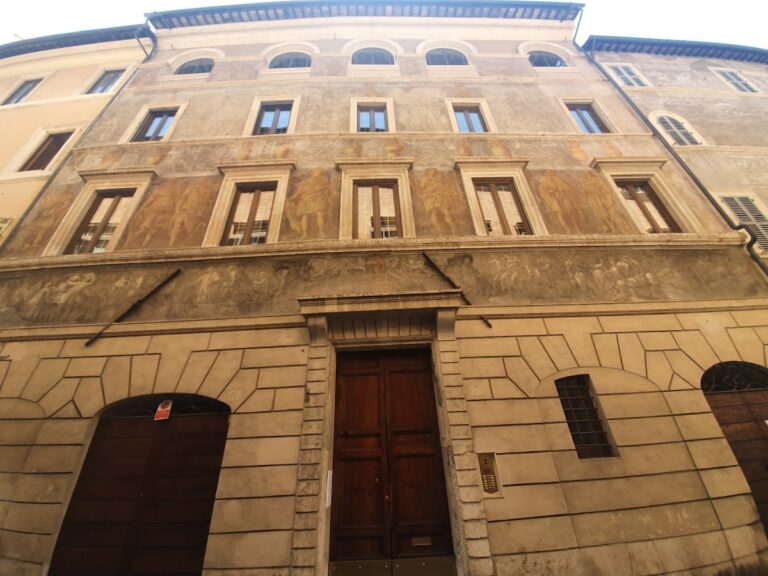
Santa Maria della Pace is a Roman Catholic church in Rome, Italy, whose present building was commissioned in 1482 and combines Renaissance and Baroque elements. It stands in the rione Ponte, near Piazza Navona, and belongs to the Diocese of Rome. The church occupies the foundations of an earlier building dedicated to Sant’Andrea de Aquarizariis, a title associated with Rome’s water carriers’ corporation.
Foundation under Sixtus IV
Pope Sixtus IV ordered the new church after a Madonna image at the site was believed to have bled miraculously in 1480. The building was dedicated anew to the Virgin Mary. Baccio Pontelli and Meo del Caprino have both been proposed as its architect, but the original designer remains uncertain.
Traditions about the foundation also connect it with the Pazzi conspiracy, a plot in Florence that caused fears of a wider war. According to this account, Sixtus IV vowed to erect a major church dedicated to the Madonna if the danger passed. Other explanations for the dedication to peace associate it with the miraculous image or with the Peace of Bagnolo, a treaty connected with the conflicts of the period.
In 1487, the church and its adjoining convent were entrusted to the Canons Regular of the Lateran. The complex later became associated with the Order of Preachers. The former monastery eventually changed from monastic use to secular and cultural purposes.
Renaissance development
The church acquired an important Renaissance setting in the early sixteenth century. Between 1500 and 1504, Donato Bramante built the cloister for Cardinal Oliviero Carafa. It was Bramante’s first major work in Rome and formed a carefully ordered addition to the religious complex.
Several chapels and monuments were also created during this period. The Ponzetti family installed funerary monuments in 1505 and 1509, while Baldassarre Peruzzi painted the chapel’s frescoes, including an altarpiece dated 1516. In 1514, Raphael began the frescoes of the Sibyls and angels in the Chigi Chapel. After Raphael’s death, Sebastiano del Piombo completed the unfinished work, and Timoteo Viti painted four prophets according to Raphael’s designs.
Santa Maria della Pace has been a titular church since 1587. A titular church in Rome is assigned to a cardinal as the symbolic seat of his title. It is also designated as Chile’s national church. The titular cardinal is Francisco Javier Errázuriz Ossa, archbishop of Santiago.
Seventeenth-century rebuilding
In 1611, the Rivaldi family financed the rebuilding and enlargement of the tribune and high altar. The project included a substantial burial crypt beneath the altar, providing a funerary space for the family.
Between 1656 and 1667, Pope Alexander VII commissioned Pietro da Cortona to restore the church and reshape the small space before it. Several houses were demolished so that the new Piazza della Pace could take its asymmetrical trapezoidal form. Its shape allowed carriages to turn and created a unified urban setting for the church. Alexander VII belonged to the Chigi family, whose associations are also reflected in features of the facade.
The church’s earlier organ, made in 1506 by Giovanni Matteo di Niccolò and Giovanni Francesco Donadio, known as il Mormanno, was dismantled during Alexander VII’s renovation. In 1665 it was reassembled in Santa Maria Assunta at Ariccia by the organ builder Matteo Marione. The present organ is a nineteenth-century instrument that may incorporate earlier material. It has fourteen non-functioning stops and stands in a Baroque case made between 1656 and 1661.
Later use and conservation
The former convent buildings were restored in 1997 and converted into a cultural and meeting center. Their lower rooms host art exhibitions, and the Bramante cloister is also used for contemporary-art exhibitions. Santa Maria della Pace retains Italian national-heritage status and continues to serve for ordinary Catholic worship.
Remains
The church building
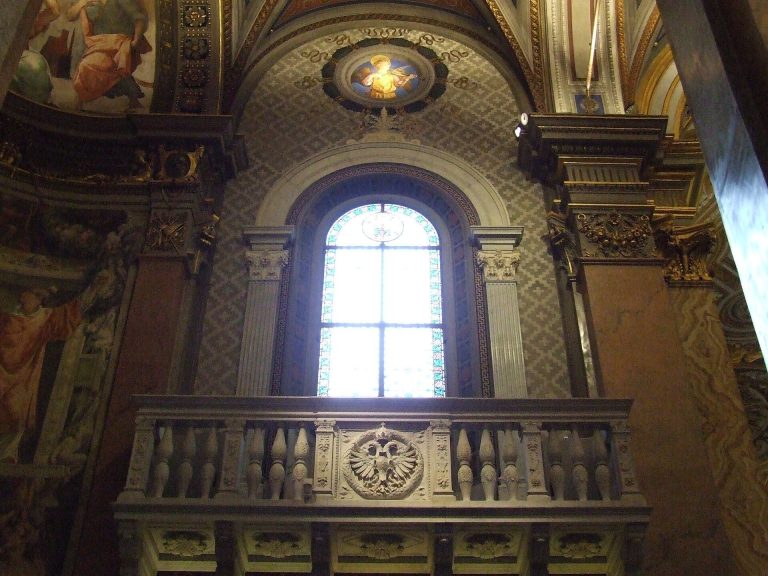
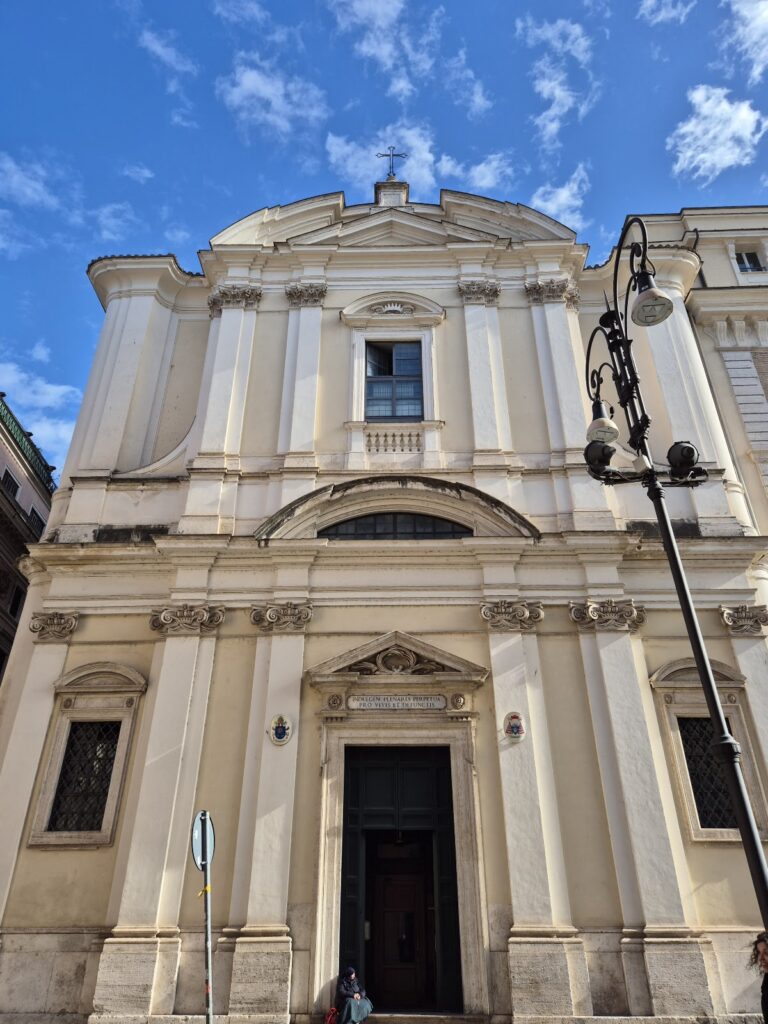
The church is entered through an original fifteenth-century doorway. Its interior has a short nave without side aisles, an octagonal central space, and a terminal tribune crowned by a cupola. The central area is covered with octagonal coffering and ribs that radiate from the lantern, an early combination of these two forms of dome ornament. Antonio da Sangallo the Younger designed the octagonal tribune, while Pietro da Cortona designed its stucco decoration.
Facade and entrance
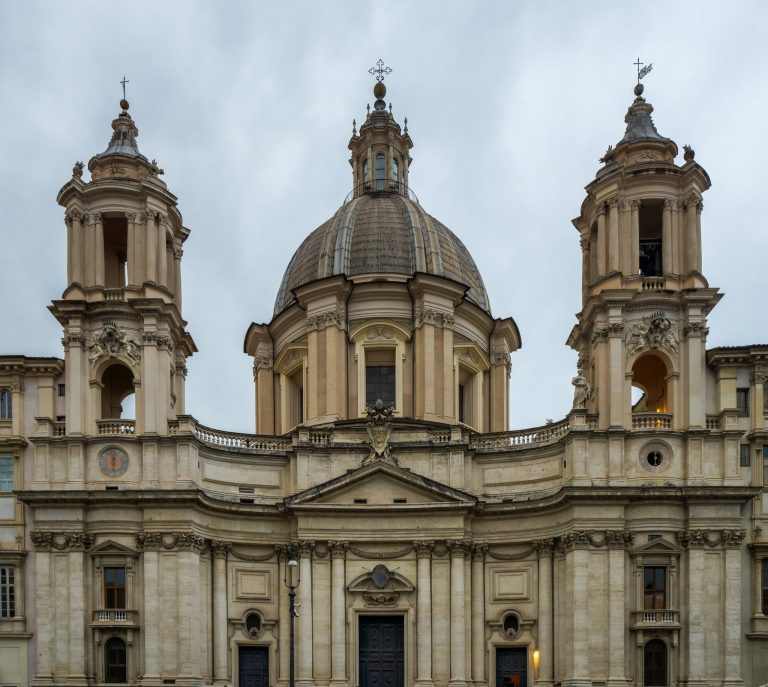
Pietro da Cortona’s facade projects into the small Piazza della Pace and uses two architectural orders. A semicircular pronaos, meaning an entrance portico, is supported by paired Tuscan or Doric columns. Concave side wings and narrow arches extend toward the adjoining streets. Alternating concave and convex forms give the composition a broader and more theatrical effect.
The facade carries the Latin inscription Suscipiant montes pacem populo et colles iustitiam, meaning “May the mountains bring peace to the people and the hills justice.” Low-relief roundels show Sixtus IV and Alexander VII. Oak-leaf motifs and references to mountains presumably allude to the Chigi family. On the upper facade, curved travertine panels were cut to create matching grain patterns.
High altar and tribune
Carlo Maderno designed the high altar in 1614 to frame the fifteenth-century Madonna and Child image known as the Madonna della Pace. Allegorical figures of Peace and Justice stand on the pediment above it and are attributed to Stefano Maderno. The altar area also includes the Nativity and Annunciation by Passignano, while Francesco Albani painted the vault and apse decoration between 1612 and 1614. Lavinia Fontana painted the saints in the arch during the same period.
The drum of the tribune contains four major paintings. From the right are Carlo Maratta’s Visitation of 1655, Baldassarre Peruzzi’s Presentation in the Temple of 1524, Raffaello Vanni’s Birth of the Virgin, and Giovanni Maria Morandi’s Transit of the Virgin. Another chapel contains Girolamo Siciolante da Sermoneta’s Adoration of the Shepherds.
Organ and funerary monument
The present organ is positioned on the choir loft to the left of the choir. Its Baroque case dates from 1656 to 1661, and the instrument itself is from the nineteenth century, possibly retaining earlier material. A Renaissance funerary monument to Bishop Giovan Andrea Boccaccio is also preserved in the church. It was made by the Lombard sculptor Luigi Capponi, a follower of Andrea Bregno.
Chapels and painted decoration
Chigi Chapel
The first chapel on the right is the Chigi Chapel, commissioned by the papal banker Agostino Chigi and attributed in its architecture to Raphael. Raphael began the frescoes of the Sibyls and angels over the arch in 1514. Sebastiano del Piombo completed the unfinished frescoes after Raphael’s death, while Timoteo Viti painted Habakkuk and Jonah on the left and David and Daniel on the right, following Raphael’s designs.
The Sibyls receive divine messages from angels, with three putti between them. The chapel also contains Cosimo Fancelli’s bronze high-relief of Christ carried by angels and statues of Saint Catherine and Saint Bernardino made by Fancelli with Ercole Ferrata.
Cesi Chapel
The second chapel on the right is the Cesi Chapel, designed by Antonio da Sangallo the Younger and associated with the date 1525. Simone Mosca produced the Renaissance decoration of the outer arch and is credited with its sphinxes. Vincenzo de’ Rossi made the statues of Saints Peter and Paul in the niches, the reliefs of prophets and angels on the arch, and the reclining figures on the tombs of Angelo Cesi and Francesca Carduli Cesi, dated approximately 1550 to 1560.
Rosso Fiorentino painted the Creation of Eve and the Original Sin. Carlo Cesi later painted the Holy Family with Saint Anne for the altar, replacing Rosso Fiorentino’s Deposition.
Ponzetti Chapel
The first chapel on the left is the Ponzetti Chapel. Its two Ponzetti family funerary monuments date from 1505 and 1509. Baldassarre Peruzzi painted the Renaissance frescoes, including the 1516 altarpiece of the Madonna and Child with Saints Bridget and Catherine and Cardinal Ferdinando Ponzetti. He also painted biblical scenes in the apse.
The decorative program includes episodes from the Old and New Testaments, among them the Nativity, the Adoration of the Magi, and the Flight into Egypt.
Mignanelli Chapel
The second chapel on the left incorporates marble taken from the ruins of the Temple of Jupiter Capitolinus. Marcello Venusti painted the Madonna in Glory with Saints Ubaldo and Girolamo for the altar. Filippo Lauri painted the lunette showing the Expulsion from Paradise and the Family of Adam in 1657.
Olgiati Chapel and chapel of the crucifix
The Olgiati Chapel, the first chapel to the right of the altar, contains Orazio Gentileschi’s Baptism of Christ, painted in 1607. Opposite it, another chapel contains a fifteenth-century wooden crucifix and a gilded, painted marble altar attributed to the school of Andrea Bregno and dated around 1490. Pope Innocent VIII donated the altar.
Chiostro del Bramante
The Chiostro del Bramante is a precisely square cloister arranged on two levels. Its ground-floor portico consists of sixteen square pilasters, four on each side, joined by semicircular arches. On the upper level, pilasters align with those below, while slender free-standing columns are placed between the arches.
The plan follows a repeated module equal to the width of the portico. The central space measures four by four modules, while the adjacent refectory measures two by four. The sixteen supports create a continuous portico covered by groin vaults, which are vaults formed by the intersection of two barrel vaults. The two levels follow proportional rules associated with Vitruvius, with the upper order reduced in height by one quarter.
The lower level uses Ionic pilasters supporting an entablature with a continuous frieze and semicircular arches on projecting strips. The upper level uses pseudo-Corinthian pilasters, with free-standing columns of the same order doubling the rhythm of the supporting arches. Its austere, nearly undecorated treatment differs from Bramante’s earlier Milanese work, which used more Lombard-style ornament.
The lunettes on the rear walls are painted with scenes from the life of the Virgin, together with episodes concerning the church and its miraculous image. The cloister’s former monastic spaces now accommodate cultural uses, including art exhibitions in the lower rooms.