Sant’Apollinare alle Terme Neroniane-Alessandrine: A Late-Baroque Titular Church in Rome


Site at a Glance
- Rating
- 4.5
- Popularity
- Low
- Country
- Italy
- Primary era
- Early Modern
- External website
- Open
- Eras represented
- Early Modern
- Civilizations
- Papal States
- Site type
- Religious
- Remains
- Church
On this page18 sections
History
Early foundation and religious use
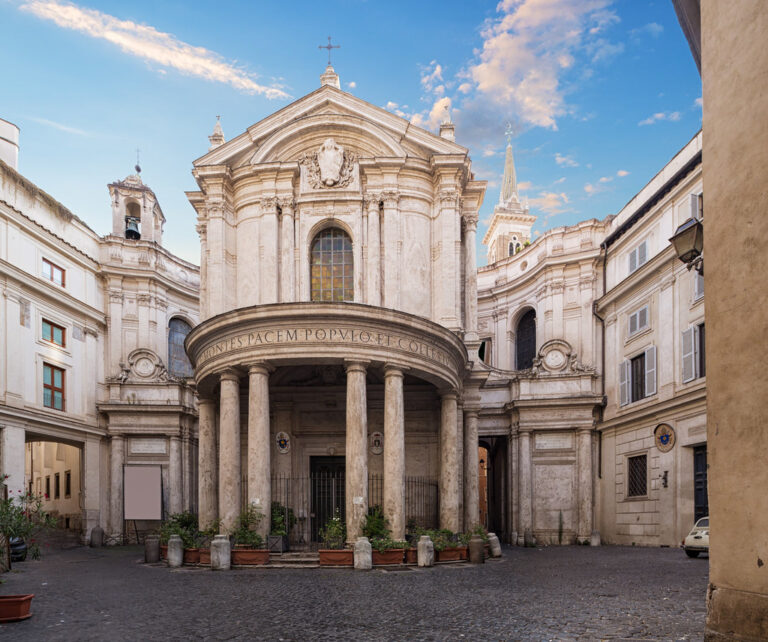
Sant’Apollinare alle Terme Neroniane-Alessandrine is a Roman Catholic titular church in Rome, Italy, dedicated to Saint Apollinaris, traditionally regarded as the first bishop of Ravenna and an early Christian martyr. The present late-Baroque building was rebuilt between 1742 and 1748, while a church probably stood on the site by the seventh century. It was first recorded in 780 during the pontificate of Pope Hadrian I, who is traditionally credited with establishing it over earlier Roman and imperial structures.
The church probably first served eastern Basilian monks, members of monastic communities following traditions associated with Saint Basil the Great, who had fled persecution during periods of Byzantine iconoclasm, when opposition to religious images affected the Byzantine world. By 1284, a chapter of canons held the church, which was then described as a papal chapel served by eight clerics. It became a parish church in 1562.
Jesuit administration and eighteenth-century rebuilding
In 1574 Pope Gregory XIII granted Sant’Apollinare to the Jesuits, the Catholic order formally known as the Society of Jesus. The church served the adjacent Collegium Germanicum in the Palazzo di Sant’Apollinare, later united with the Hungarian College as the Collegium Germanicum et Hungaricum. The Jesuits retained responsibility until their suppression in 1773, after which the church passed to the Lazarists, or Congregation of the Mission.
By the late seventeenth century, the building was in poor condition. A complete reconstruction was considered for years, probably delayed by financial difficulties. In 1702, one chapel was redecorated for Saint Francis Xavier, and its marble statue by Pierre Le Gros was retained when the church was rebuilt. Pope Benedict XIV commissioned Ferdinando Fuga to undertake the reconstruction in 1742. The work continued until 1748, and the completed church was rededicated on 21 April that year.
Seminary, titular status, and later roles
Sant’Apollinare housed the Pontifical Roman Seminary from 1825 until the seminary moved to the Collegio Romano in 1848. In 1884, the future Pope Pius X was consecrated bishop in the church. The building became a minor basilica in 1984, an honorific papal status granted to churches of particular religious or historical importance.
Its titular status, meaning assignment in Rome to a cardinal as a church title, changed several times. It was briefly established under Antipope Anacletus II in the 1130s, restored by Pope Leo X on 6 July 1517, and abolished by Pope Sixtus V on 13 April 1587. Pope Pius XI re-established it on 26 May 1929 as Titulus Sancti Apollinaris ad Thermas Neronianas-Alexandrinas. It was a presbyteral title in earlier periods and is now a diaconal title, although some holders were designated pro illa vice as cardinal-priests.
The church has also served as a rectoral church of the parish of Sant’Agostino in Campo Marzio and as the academic church of the Pontifical University of the Holy Cross. On 18 December 1990 it was entrusted to Opus Dei, a personal prelature of the Catholic Church focused on Christian holiness in ordinary life and work. Its new chaplain formally took office on 1 September 1991.
Burials, controversy, and restoration
On 24 April 1990, the crypt received the burial of Enrico De Pedis, leader of the Banda della Magliana, with the authorization of Cardinal Ugo Poletti. Public investigations connected the burial with the disappearance of Emanuela Orlandi. The tomb was opened in 2012. On 18 June that year, De Pedis’s remains were removed, transferred to Prima Porta Cemetery, cremated, and scattered at sea.
The interior was restored in a campaign completed in 2008. This work forms part of the church’s modern history while preserving the architectural and artistic arrangement created after Fuga’s eighteenth-century rebuilding.
Remains
Exterior and overall plan
Facade
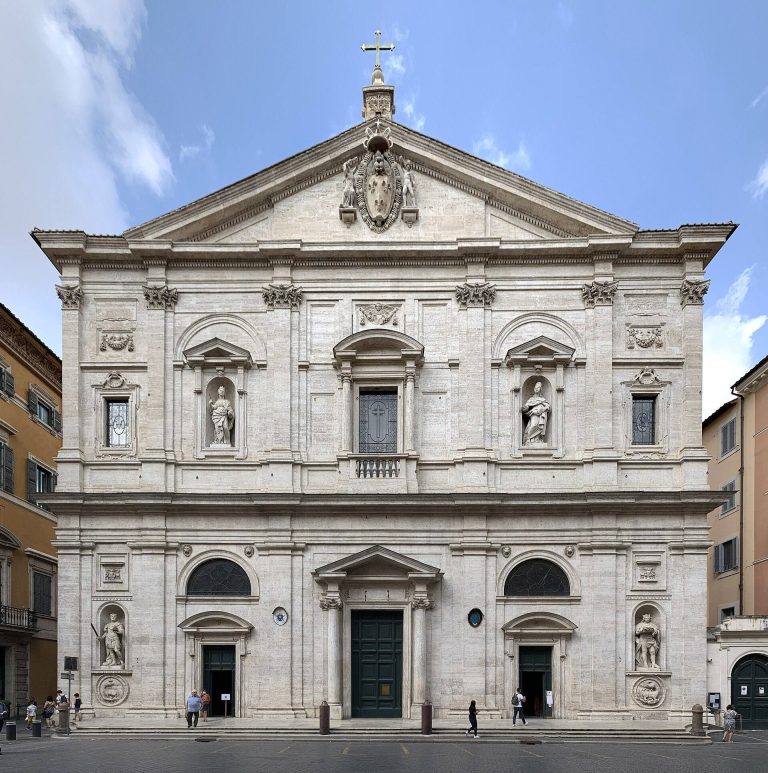
Fuga’s two-storey facade was completed in 1742 and combines late-sixteenth-century forms with Baroque elements in a design that points toward Neoclassicism. The lower level has Ionic columns, a central doorway flanked by windows, and a triangular tympanum, the bounded triangular area within the pediment. Above it, a large central window with a balcony is accompanied by two smaller side windows and Corinthian elements. A double tympanum crowns the composition.
Dome and campanile
Fuga also reconstructed the dome, which rises between the nave and presbytery. The 1748 dome carries stucco patterns based on a Greek cross and ends in a lantern, a raised structure that admits light above a dome. Its lantern contains a dove symbolizing the Holy Spirit. A nearby campanile has arched openings and a pyramidal roof.
Plan and adjoining palazzo
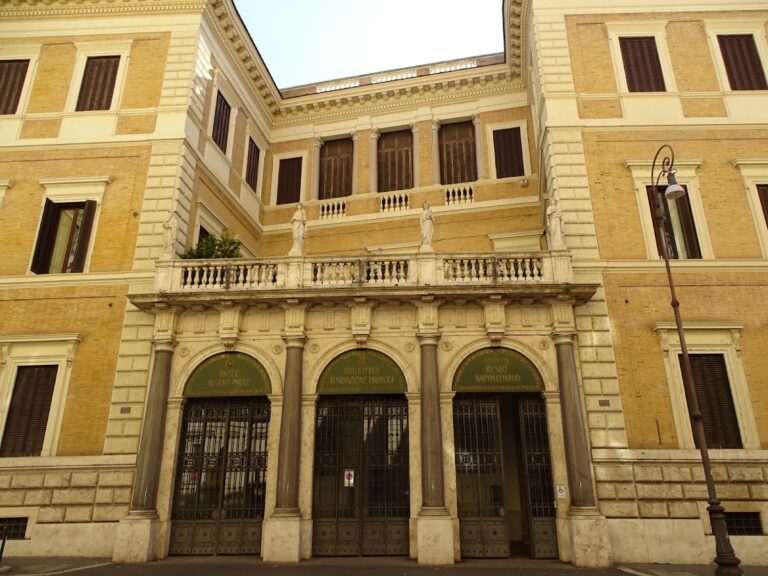
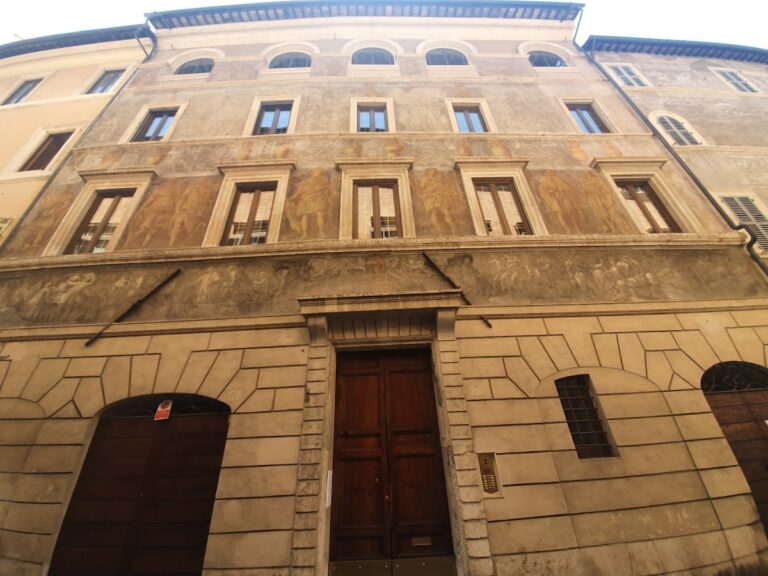
The church has a single nave, two rows of side chapels, and three principal sections. A wedge-shaped entrance area contains an image of the Madonna. Beyond it, the nave is divided by galleries into six chapels, while the presbytery surrounds the high altar beneath a saucer-shaped dome lit by the lantern. The adjoining palazzo includes a colonnaded courtyard and Baroque fountains, among them one attributed to Bernini.
Nave, altar, and chapels
Nave and high altar
Corinthian pilasters line the nave and support the arches opening toward the side chapels. Its barrel-vaulted ceiling bears Stefano Pozzi’s fresco The Glory of Saint Apollinaris. The inlaid marble pavement carries the names of former cardinals, and eighteenth-century confessionals remain in the nave. Above the entrance, the organ stands on a large gallery with curved wings.
Pope Benedict XIV commissioned the high altar, whose stucco decoration is by Bernardino Ludovisi. Its altarpiece, an early-seventeenth-century painting by Ercole Graziani the Younger, shows the consecration of Saint Apollinaris as bishop of Ravenna. The work is a copy of Graziani’s earlier painting for Bologna Cathedral.
Right-hand chapels
The chapels on the right are dedicated to Saint Aloysius Gonzaga, Saint Joseph, and Saint Francis Xavier. Ludovico Mazzanti painted the Saint Aloysius altarpiece. The Saint Joseph Chapel contains Giacomo Zoboli’s Holy Family with Angels, painted in 1748. Pierre Le Gros’s marble statue of Saint Francis Xavier stands in the chapel dedicated to that saint.
Left-hand chapels
The chapels on the left honor Saint John of Nepomuk, Saint Josemaría Escrivá, and Saint Ignatius of Loyola. The Saint John chapel has an altarpiece by Placido Costanzi. The chapel of Saint Josemaría, formerly dedicated to the Crucifix, contains a modern altar painting by Angelo Zarcone. Carlo Marchionni’s altarpiece in the Saint Ignatius chapel depicts its patron venerating the Madonna.
Tombs and liturgical furnishings
The Saint Ignatius chapel contains the tomb of the writer and archaeologist Francesco Antonio Zaccaria, who died in 1795, and the tomb of Cardinal Gaetano Bedini, who died in 1864. The latter monument was funded by the Polish Husarzewski family. A silver crucifix and altar candlesticks are attributed to Luigi Valadier. Relics of the martyrs Saint Tiburtius and Saint Eustratius, together with those of Saint Orestes and his companions, were deposited in the basilica.
Chapel of Graces and crypt
Chapel of Graces
The elliptical Chapel of Graces stands outside the church proper and is entered through a doorway on the left. Its principal work is a 1494 Renaissance fresco of the Virgin, Queen of Apostles, also described as the Madonna and Child with Saints Peter and Paul. Priests covered the image with lime whitewash during the Sack of Rome to protect it. It was rediscovered in 1645 after two boys and a soldier took refuge in the church during an earthquake. Peter Anton von Verschaffelt later provided the fresco with a marble frame and gilded-stucco cherubs.
Crypt
The crypt contains the burial of the Baroque-period composer Giacomo Carissimi, who died in 1647, and that of Cardinal Domenico Iorio, who died in 1954. It also held De Pedis’s former tomb before his remains were removed in 2012.