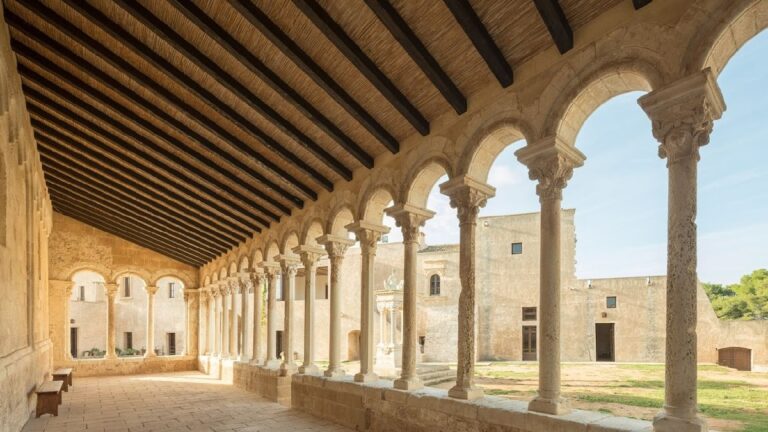
Brindisi Cathedral: A Norman Cathedral Basilica in Italy


Site at a Glance
- Rating
- 4.6
- Popularity
- Low
- Country
- Italy
- Primary era
- Medieval
- External website
- Open
- Eras represented
- Medieval, Early Modern, Modern
- Civilizations
- Italian, Kingdom of Naples, Kingdom of Sicily, Norman
- Site type
- Religious
- Remains
- Cathedral
On this page12 sections
History
Brindisi Cathedral, formally the Cathedral Basilica of the Visitation and Saint John the Baptist, is a Norman-period cathedral in Brindisi, Italy, built in the Apulian Romanesque tradition. Construction began in the latter part of the eleventh century and was completed in 1143. The church serves the Catholic Archdiocese of Brindisi-Ostuni and is dedicated to the Visitation of the Virgin Mary and Saint John the Baptist.
Norman foundation and royal ceremonies
The cathedral was consecrated by Pope Urban II in 1089. Urban II was the late-eleventh-century pope who promoted the First Crusade. The Romanesque basilical plan belongs to the Norman-period building, when Norman rulers and institutions were established across southern Italy and Sicily.
Brindisi Cathedral later became the setting for important dynastic ceremonies. In 1193, Roger, the son of Tancred, was crowned king of Sicily there and married Irene, daughter of Isaac II Angelos, emperor of Constantinople. On 9 November 1225, Emperor Frederick II married Isabella of Brienne, queen of Jerusalem, in the cathedral.
Earthquake, restoration, and religious role
An earthquake severely damaged the cathedral in 1743. Reconstruction followed, and the building was rebuilt three years later, in 1746. Further restoration campaigns subsequently reshaped and repaired the church while retaining elements of its earlier plan and fabric.
On 10 July 1867, Pope Pius IX elevated the cathedral to the rank of minor basilica, a papal title granted to churches of particular religious and historical importance. The restored cathedral reopened for worship on 18 November 2007. Another restoration campaign began in January 2019, and the church reopened for Corpus Domini, the Christian feast focused on the Eucharist, on 23 June 2019. Restoration of the organ began in 2021.
Devotion to Saint Theodore of Amasea, also known as Theodore Tiron, has been associated with the cathedral for approximately eight centuries. Saint Theodore was an early Christian martyr whose cult was important in both Eastern and Western Christianity. His mortal remains are kept in a chapel dedicated to him. On 6 January 2010, Archbishop Rocco Talucci of Brindisi-Ostuni gave the chapel the title “ecumenical,” establishing it as a privileged place of prayer for Catholics and Orthodox Christians. A permanent Theodorian Studies Centre at the cathedral supports research into the saint’s veneration, art, literature, liturgy, music, popular traditions, and ecumenism.
Local tradition also connects Brindisi with a vessel believed to be one of the six water jars used at the wedding at Cana. The tradition appears in the 1470 itinerary of Giovanni and Anselmo Adorno and in other local writings, which state that Crusaders brought the vessel to Brindisi. Another tradition holds that Saint Theodore directed the forced landing at Brindisi of the ship carrying his relics during the age of Frederick II.
Remains
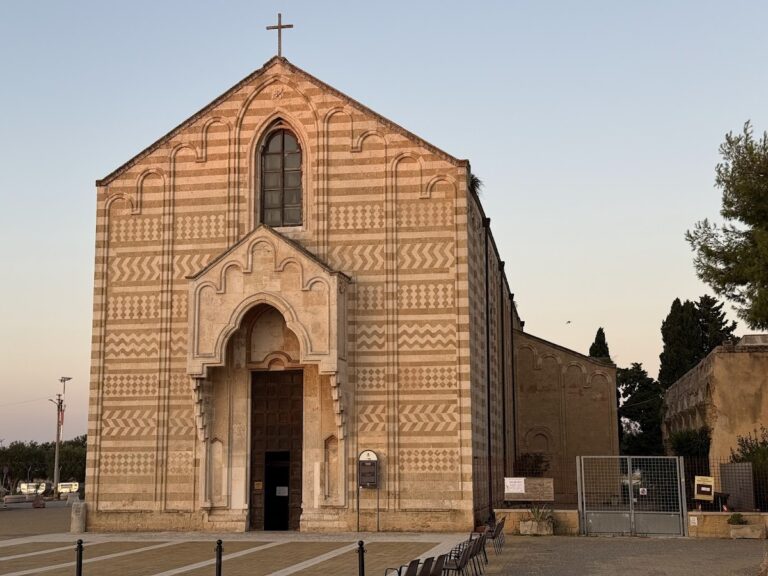
Brindisi Cathedral retains a three-aisled Romanesque basilical layout without a transept. A basilical plan is an elongated church arrangement organized around a central nave and side aisles. The plan is comparable to that of the Basilica of Saint Nicholas in Bari. The present facade occupies the position of the original and is divided vertically into three sections corresponding to the aisles, while the building also incorporates Baroque elements introduced through later rebuilding.
Facade and exterior features
Cathedral facade
A pediment completed the facade during the 1920s. In 1957, it was replaced by statues of Saint Theodore, Saint Lawrence, Saint Leucius of Alexandria, and Saint Pius X. The 2007 restoration replaced these figures with four light-colored statues carved in Lecce stone. Each statue is 2.90 metres high, representing Saint Leucius, Saint Theodore of Amasea, Saint Lawrence of Brindisi, and Saint Justin de Jacobis.
Apse and bell tower
A cornice supported by elephant heads survives on the right apse, the rounded end of the church. Beside the cathedral stands a bell tower completed in 1795.
Interior furnishings and sacred features
Mosaic pavement and furnishings
Fragments of a mosaic pavement dated 1178 survive inside the cathedral. Its figures and stylistic features relate to the contemporary mosaic at Otranto, made by the priest Pantaleone between 1163 and 1165. The interior also contains a wooden choir made in 1594 by local woodcarvers, a sixteenth-century baptismal font, and several eighteenth-century paintings.
Chapel of Saint Theodore
The chapel of Saint Theodore of Amasea contains the saint’s relics, an icon of him, and a dome. A reliquary ark, a container for sacred relics, depicts the landing at Brindisi of the relics. Part of the ark is attributed to Dalmatian goldsmiths of the thirteenth century.
Cathedral organ
The organ stands on a wooden structure in the gallery above the entrance facade. The Fratelli Ruffatti firm of Padua built it during the 1970s, and restoration began in 2021.
Episcopal and seminary buildings
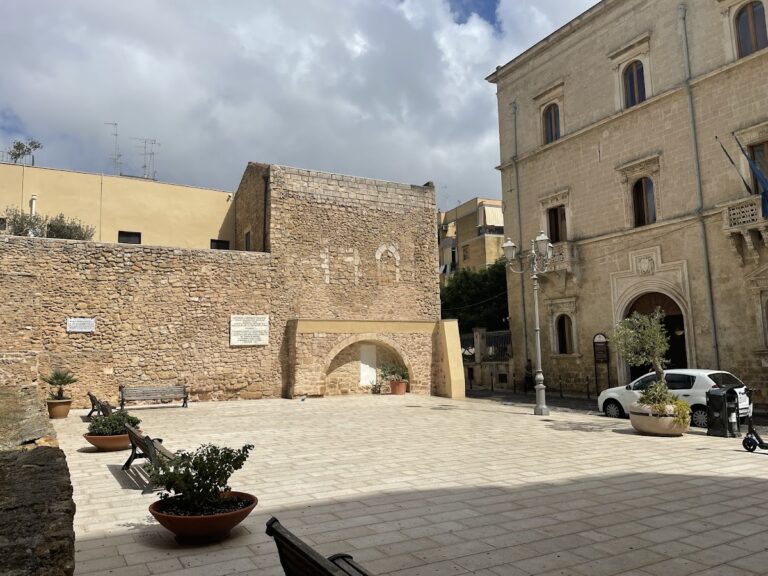
The episcopal palace and the seminary palace stand opposite the cathedral. The seminary palace was built in the eighteenth century with materials taken from the destroyed Basilica of Saint Leucius, an ancient early Christian church.
Nearby sites