Palazzo Dugnani: A Historic Rococo Palace in Milan


Site at a Glance
- Rating
- 4.3
- Popularity
- Low
- Country
- Italy
- Primary era
- Early Modern
- External website
- Open
- Eras represented
- Early Modern
- Civilizations
- Duchy of Milan, Habsburg, Holy Roman Empire, Spanish
- Site type
- Domestic
- Remains
- Palace
On this page12 sections
History
Palazzo Dugnani is a historic palace in Milan, Italy, whose origins reach back to the seventeenth century. Developed into a larger residence in the eighteenth century, it combines a Rococo exterior with Baroque interior features and became an important setting for Milanese social, intellectual, and cultural life.
From the Cavalchini residence to the Casati palace
The site began as a modest patrician residence belonging to the Cavalchini family, who retained it until 1730. That year, the property was sold to the Casati family, who undertook the construction of the larger palace. The Casatis later sold the building to the Dugnani family in 1753.
The Dugnani family and Milanese intellectual life
Under the Dugnani family, the palace became a prominent meeting place for Milanese intellectuals and a venue for grand social gatherings and literary salons. The Accademia dei Fenici, an amateur literary society, was founded there in 1762. The poet Andrea Oltolina was among those associated with its gatherings. The family also included Cardinal Antonio Dugnani, an Italian cardinal of the Catholic Church.
From private palace to civic institution
After the death of the last direct heir, Teresa Dugnani Viani, in 1835, the property passed to Count Giovanni Vimercati. Beginning in 1837, Vimercati installed his collection of flora and fauna specimens in the palace under the name “Natural History Museum.” In 1846, he sold both the building and the collection to the Municipality of Milan. Palazzo Dugnani then became the first home of the Civic Museum of Natural History, whose collections were later transferred to the museum’s present building on Corso Venezia.
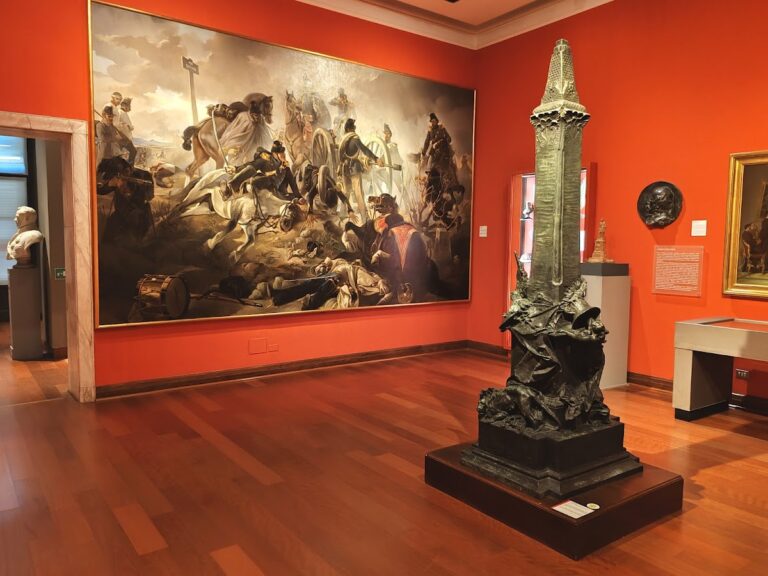
The palace subsequently housed the Alessandro Manzoni Civic School for Girls until 1977. It is now used for the Cinema Museum, the Serre Laboratories, and several annual exhibitions. The Municipality of Milan remains its owner. The historic gardens were incorporated into a larger public-garden complex remodeled during the nineteenth century. The architect Balzaretto began this work in 1848, suspended it during revolutionary unrest, and resumed it in 1855.
Remains
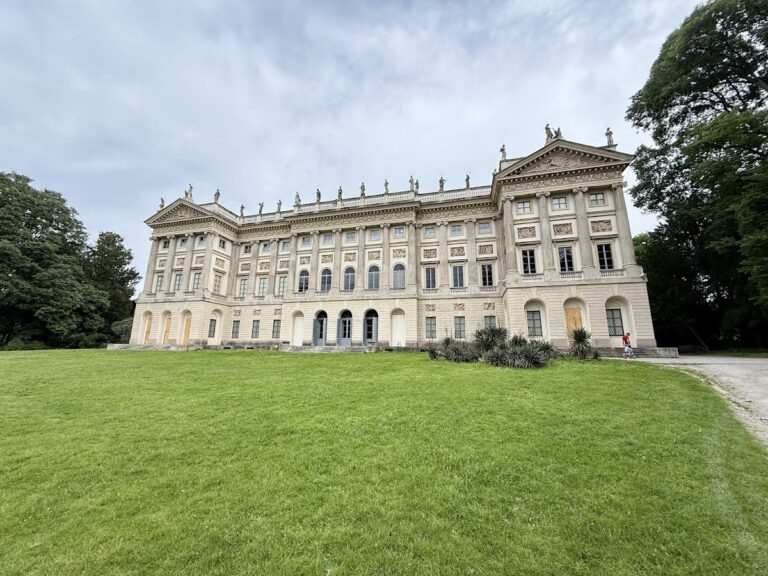
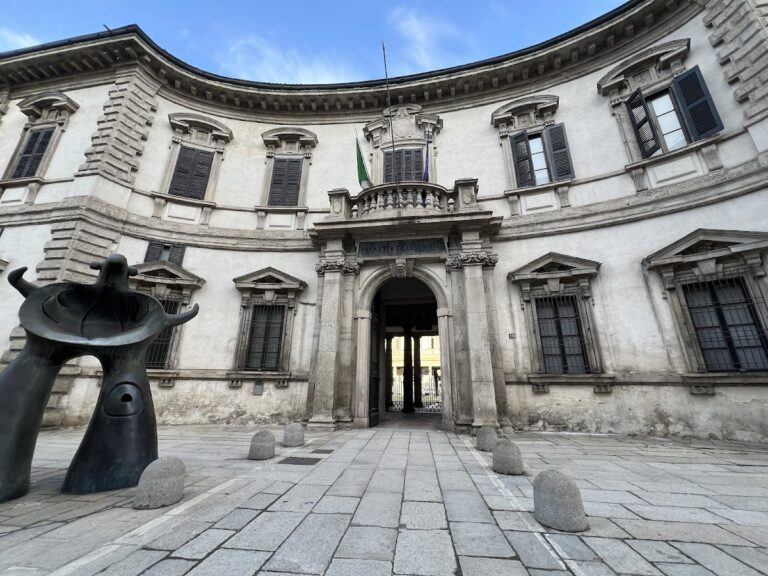
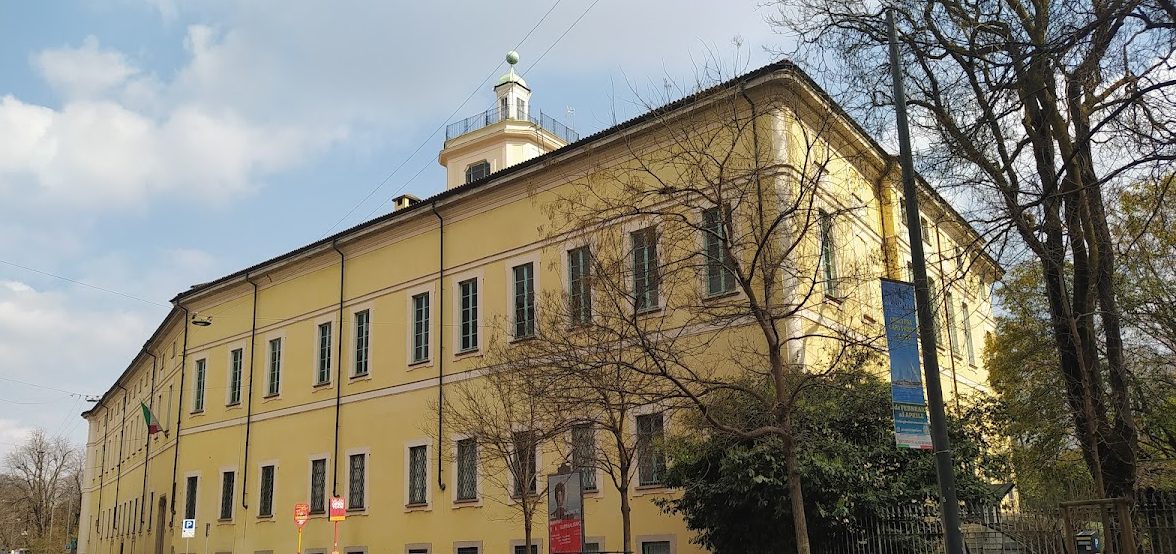
Palazzo Dugnani preserves two contrasting exterior compositions. The street-facing elevation emphasizes an octagonal belvedere turret, an elevated feature designed to provide a view, crowned by a lantern, a small roof structure that admits light or crowns a turret. The opposite front faces the park and is porticoed, with a central body set behind more projecting lateral wings. The building also retains traces of its former gardens within the later public-garden setting.
Exterior and grounds
Street-facing elevation
The street side is defined by the octagonal belvedere turret and its lantern. This feature gives the elevation its most distinctive vertical element, while the exterior as a whole reflects the palace’s Rococo character.
Park-facing front and gardens
On the park side, the porticoed front is arranged around a recessed central body and projecting lateral wings. Surviving traces of the earlier gardens remain associated with the palace, although the gardens were incorporated into the larger nineteenth-century public complex.
Painted interiors
Decorative fresco program
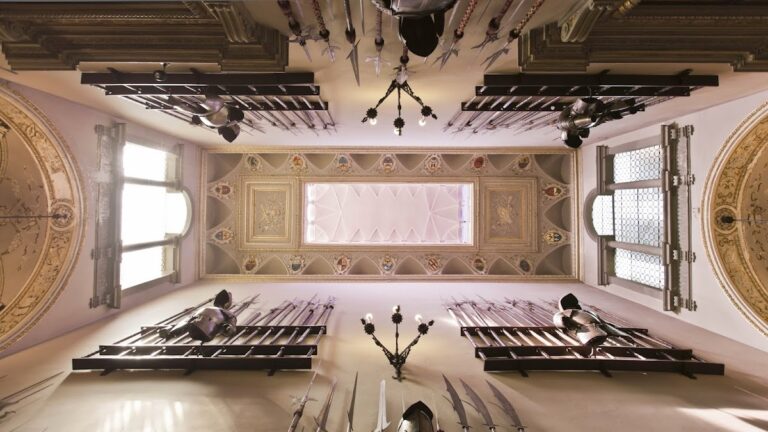
Large frescoes by Ferdinando Porta survive on the walls and ceilings. Porta worked with Giovanni Antonio Cucchi, Mattia Bortoloni, and Magatti on the palace’s decorative program, which contributes to the Baroque character retained by the interiors.
First-floor ballroom
The first-floor ballroom contains a monumental ceiling painting by Giovanni Battista Tiepolo, dated 1731–1732. Tiepolo, an eighteenth-century Venetian painter known for large illusionistic frescoes, depicted mythological figures moving across a clear sky and included episodes concerning Scipio and Masinissa. Count Giuseppe Casati commissioned the frescoes around 1731, after his family had gained a higher position among Milanese noble houses. Casati had been made a count in 1728 and received the fief of Spino d’Adda, a territorial holding granted in return for service or allegiance, in 1730.
The cycle is associated, with some uncertainty, with episodes from the history of Scipio Africanus as recounted by the Roman historian Livy. Its subjects include Scipio’s apotheosis, the death by poison of Sophonisba of Carthage, Scipio’s alliance with the Numidian king Masinissa, Scipio or Hasdrubal before the ruins of Cirta, and the Clemency of Scipio. The figures wear colorful and fanciful costumes. Works associated with the palace also include Tiepolo’s Allegory of the Dugnani Family and Stories of Scipio and Masinissa.
Wartime conservation
In 1944, a substantial part of the frescoes was detached from the walls as protection against possible damage during the Second World War. The paintings remain conserved on canvas in their original positions within the palace.
Nearby sites