Palazzo del Duca: A Renaissance Ducal Residence in Senigallia, Italy

Site at a Glance
- Rating
- 4.4
- Popularity
- Low
- Country
- Italy
- Primary era
- Early Modern
- External website
- Open
- Eras represented
- Early Modern, Modern
- Civilizations
- Duchy of Urbino
- Site type
- Domestic
- Remains
- Palace
On this page12 sections
History
Palazzo del Duca, also known as Palazzo Ducale, is a Renaissance ducal residence in Senigallia, Italy, built in the mid-sixteenth century for Guidobaldo II della Rovere’s fortification project. Designed by Gerolamo Genga, it formed part of the renewed city known as the “Pentagonal Senigallia” and provided a representative setting for the duke and his court.
A residence within the fortified city
Guidobaldo II, Duke of Urbino, intended the palace for temporary stays by himself, his court, foreign ambassadors, and other distinguished travelers moving along the Adriatic coast. His principal residence was in Pesaro, while Senigallia was considered unsuitable for a permanent court because troops were continually passing through the city.
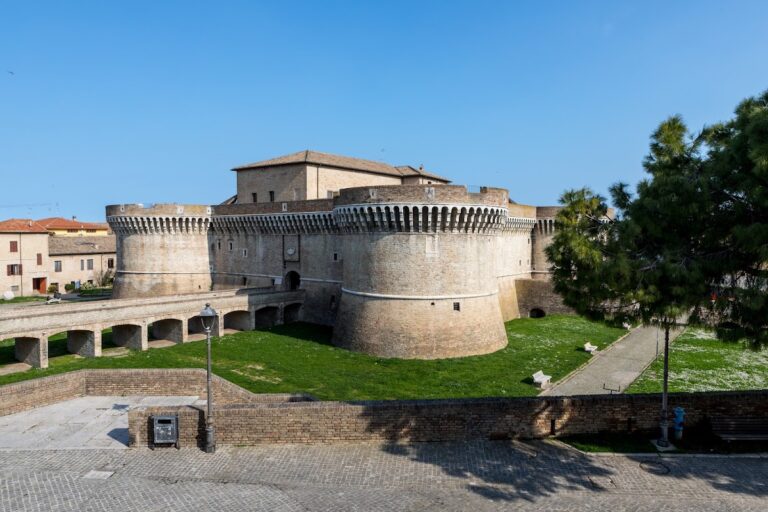
The building stood opposite the Rocca Roveresca, a Renaissance fortress, giving the residence a prominent ceremonial position and associating it directly with Della Rovere authority. The square before the palace served as its formal court and, from the sixteenth century, as a military exercise ground. Guidobaldo could observe these activities from the palace windows.
The original residence contained 34 rooms. It was later enlarged to 64, probably at the initiative of Guidobaldo’s son and successor, Francesco Maria II della Rovere, who became duke in 1574. The expansion may have reflected Senigallia’s increasing economic importance and Francesco Maria’s wish to maintain a residence larger than those being constructed by other noble families in the city. Some documents attribute parts of the enlargement to Giovanni della Rovere, but that attribution remains uncertain.
The fountain and the changing court
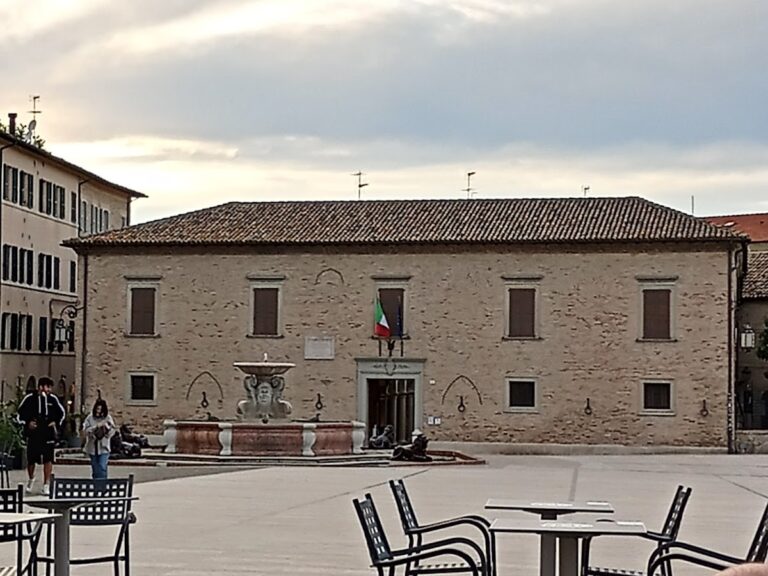
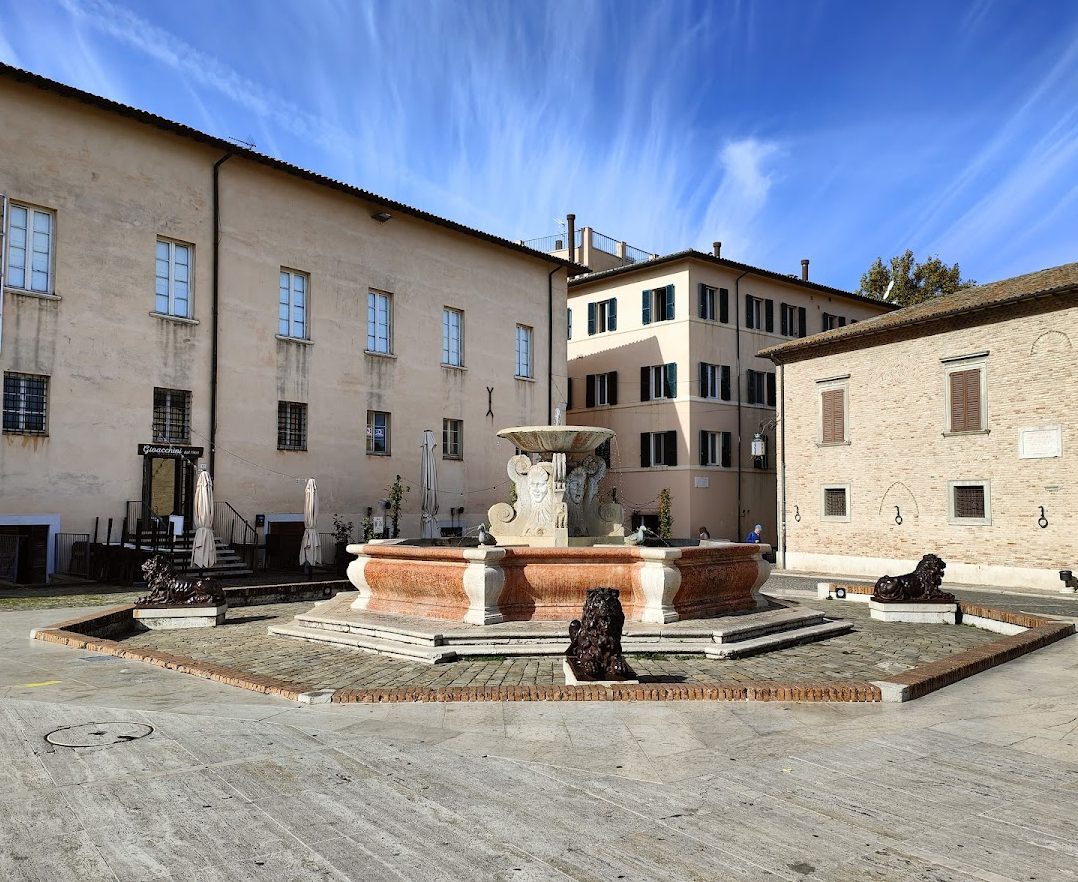
Francesco Maria II commissioned the fountain in front of the palace as an expression of ducal supremacy. Work began on 22 December 1600 under the design of Mastro Stefano de Tomaso, and the fountain was completed in 1602.
After Francesco Maria II died on 28 April 1631, the Duchy of Urbino was annexed to the Papal States, territories governed by the pope. Its lands became the Legation of Pesaro and Urbino, which lasted until Italian unification. The cities of the former duchy retained their sixteenth-century statutes, while Senigallia underwent commercial growth through the Fiera della Maddalena.
Urban changes soon reduced the palace and its square’s role in everyday city life. Construction of Senigallia’s Jewish ghetto began in 1632 a few metres from the court, and the Rocca Roveresca was converted into a prison. Together, these changes contributed to the marginalization of the ducal complex.
Leasing, inheritance, and state ownership
Following an economic crisis in the duchy, Vittoria della Rovere arranged for Palazzo del Duca to be leased. Its tenants included the Duranti family of Senigallia, the Honorati family of Pesaro, and, from 1653, the brothers Paolo Emilio and Guido Ubaldo di Filippo Galeotti of Gubbio.
Vittoria’s inheritance was complicated by the exclusion of women from succession. She married Ferdinando II, Grand Duke of Tuscany, in 1634, and the Rovereschi properties passed under Medici control. Her will, dated 9 October 1676, transferred the properties to her second son, Cardinal Francesco Maria de’ Medici. After his death, they passed to Gian Gastone de’ Medici and then to his sister Anna Maria Luisa.
Under a treaty dated 31 October 1737, the Medici heir became Emperor Francis I of the House of Lorraine, and the Senigallia court property became imperial property. The Camera Apostolica, the papal administrative and financial institution, completed its purchase of the duchy on 26 October 1763. A dispute with the emperor’s heirs followed his death because of legal restrictions on the sale. In 1777, the Church entrusted Palazzo Ducale to Prince Orazio Albani.
The Albani family retained ownership during the first half of the nineteenth century. A later dispute between Antonietta Simonetta Litta Visconti and Cardinal Giuseppe Albani ended with a judgment on 23 January 1861. The decision assigned direct ownership to Cardinal Albani and beneficial ownership to the Milanese noblewoman.
From royal headquarters to modern use
In 1860, the year Senigallia was annexed to the Italian state, the palace became the residence of Royal Commissioner Lorenzo Valerio. It also served as the Commissarial headquarters for the Marche while Ancona awaited liberation.
Ownership became increasingly divided during the twentieth century. In 1919, Prince Emanuele Ruspoli sold the palace to Alfredo Tacchi. Tacchi transferred two-thirds to Alfredo Marzocchi and Ernesto Benigni, then sold his remaining third in 1920 to Marzocchi, Benigni, and Carlo Antonietti. Later inheritances increased the number of owners further.
The earthquake of 1930 severely damaged the building. Its structure was fractured, and an entire storey was removed. The third floor, whose richly furnished rooms were probably used mainly as bedrooms rather than servants’ quarters, was subsequently demolished. Palazzo del Duca is now used for museum and exhibition purposes, with part of the building devoted to commercial use. It also hosts exhibitions and conferences.
Remains
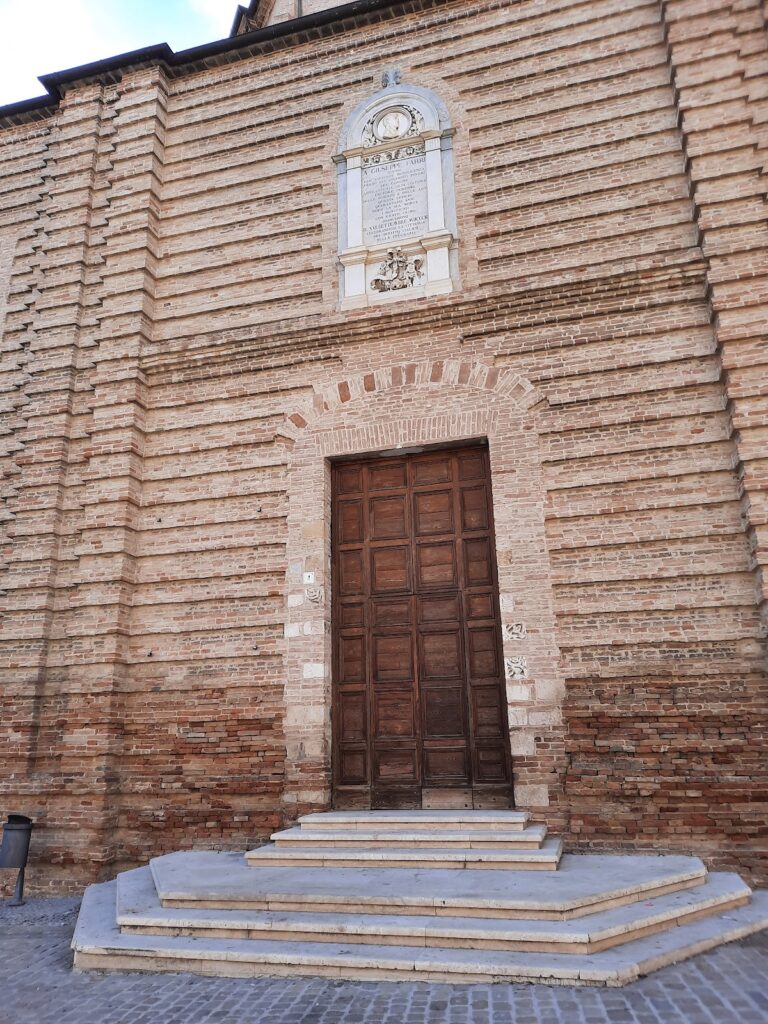
Palazzo del Duca occupies the long side of Piazza del Duca, directly opposite the Rocca Roveresca. The square was originally larger and functioned as the palace’s formal courtyard. It was kept clear for military exercises and initially contained no fountain. The first building was an elegant, proportionally symmetrical palazzetto, or relatively small urban palace, with a central portal of white stone raised three steps above the square. The later enlargement disrupted that symmetry, leaving the portal off-centre in the completed facade.
Building plan and surviving structure
Original palace
The oldest part is probably the left-hand section. Its position is indicated by the portal’s clear asymmetry, the sixteenth-century ducal coat of arms in the representative hall, and plans showing a kitchen and service rooms capable of operating independently from the rest of the residence.
Interior arrangement
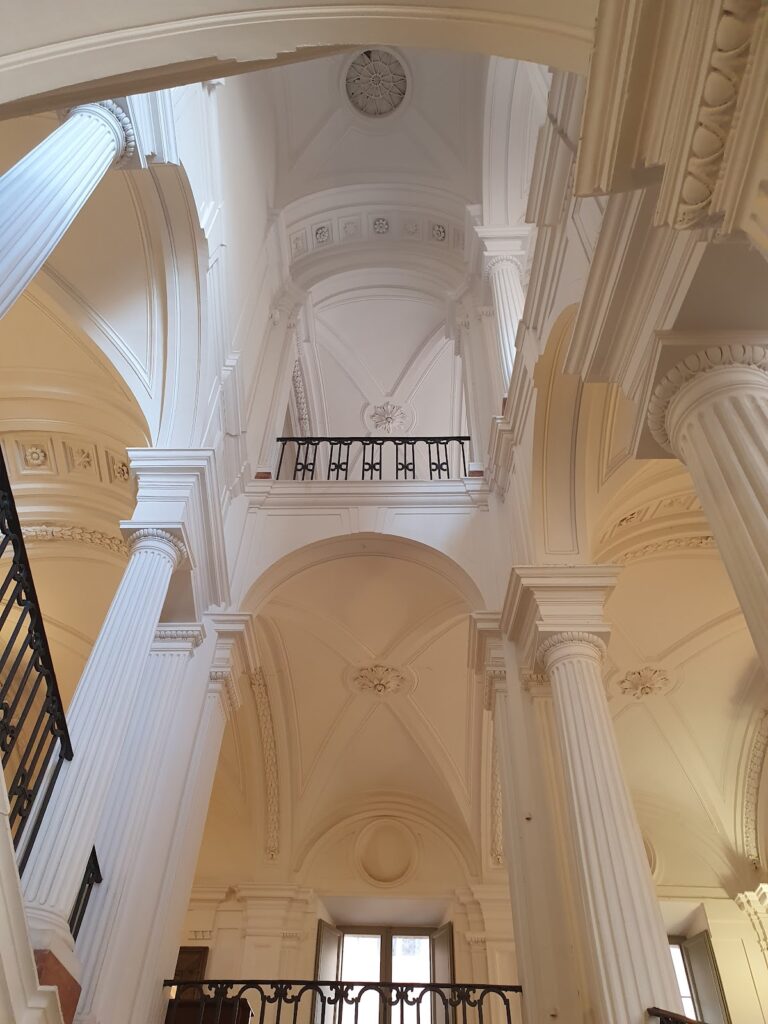
Plans from 1756 in the Registro Albani show the original Guidobaldo-era complex extending across parts of the blocks along Via Marchetti and Via Arsilli. The ground floor contained the main staircase and atrium, the space beneath the stairs, four storerooms including an oil store, two service entrances, six rooms, a small courtyard, and a small stairway connecting with a secret passage to the piano nobile, the principal ceremonial residential floor. A large courtyard with a well stood alongside two stables. The plan also included a woodshed with stairs to the upper kitchen, a small courtyard with a loggia, a chicken coop, and two small storerooms.
The piano nobile continued the main staircase and included its landing, a large hall, an antechamber, three bedrooms, a small courtyard, and a small room with a secret passage probably leading toward the Rocca. Three kitchen rooms and a private chapel completed the arrangement shown in the plans.
Decorated ceilings
The palace’s interior ceilings are traditionally attributed to Taddeo Zuccari, a prominent sixteenth-century Italian painter associated with courtly fresco decoration. The attribution is partly based on comparisons with grotesque paintings at Villa Farnese in Caprarola. The ceilings are dated to 1553–1555, when Zuccari was at Guidobaldo’s court. Guidobaldo also commissioned him to paint the frescoes of the chapel in Urbino Cathedral.
The decorated ceilings cover about 150 square metres and originally contained 49 coffers, recessed decorative ceiling panels. Forty-two remain visible. Their imagery includes festivals, popular and carnival themes, and elements drawn from sixteenth-century imagination, reflecting the residence’s temporary ceremonial purpose and the celebrations held for the duke and his court.
The decorations use Renaissance grotesque imagery inspired by ancient Pompeian frescoes. Plants, animals, human figures, fantastic beings, and contradictory scenes combine to create a playful “world turned upside down.” One putto wears an imperial crown, reversing the expected order of social authority. Guidobaldo’s coat of arms appears foreshortened and is carried through the air by angels.
The quartered coat of arms includes a black eagle on gold, an uprooted golden oak on blue, a crowned black eaglet on alternating blue and gold bands, and a complex fourth quarter of silver and red bands, golden fleurs-de-lis on blue, a gold cross on silver with four smaller crosses, and gold-and-red bands. A gold frame with a pendant lamb connects the emblem to the Order of the Golden Fleece, a prestigious European order of chivalry. The heraldic composition expresses Guidobaldo’s Montefeltro adoption, Della Rovere lineage, position as Duke of Urbino, and Aragonese adoption.
Symbolic ceiling scenes
Individual coffers present symbolic stories. One shows two female animal figures playing with fire, an image associated with life, festivity, and the presence of distinguished visitors in Senigallia.
The coffer known as the “Birth” depicts a large-bellied mythological female figure giving birth above a reclining woman who appears to suffer the pains of life. Its subject expresses continual renewal through the opposition of old age and birth.
The “Lawyers” coffer shows an old and a young lawyer beneath a balanced scale of justice. A patient ox lends them its ears while they stroke those of a donkey. The younger lawyer reads law books and points toward the ground, whereas the older one places his books beneath his feet.
The “Artists” coffer depicts artists working with donkey’s ears amid plates, bowls, glasses, and a cooking pan. The portrait on the easel represents the “Moor,” described as the infidel threatening Christian society.
Fountain of the palace court
The fountain before the palace was originally made of Verona stone and fitted with an elaborate hydraulic mechanism. Four ducks, cast at Senigallia’s mint foundry by the Urbinate sculptor Donnino Ambrosi, were arranged to appear to float on the water. Their design evoked the salt marshes and their drainage.
In 1889 the fountain was restored and decorated with four lions. The ducks were lost and later found locally. Two of them still decorate the Fountain of the Geese.
Nearby sites