Palazzo del Carretto di Gorzegno: A Historic Palace in Turin


Site at a Glance
- Rating
- 4.8
- Popularity
- Low
- Country
- Italy
- Primary era
- Early Modern
- External website
- Open
- Eras represented
- Early Modern
- Civilizations
- Duchy of Savoy, Kingdom of Sardinia
- Site type
- Domestic
- Remains
- Elite Residence
On this page7 sections
History
Palazzo del Carretto di Gorzegno is a historic palace in Turin, Italy, built in the seventeenth century during the eastward expansion of the city toward the Po. The redevelopment was ordered by Charles Emmanuel II, the duke of Savoy whose government promoted Turin’s growth, and directed by Amedeo di Castellamonte, a Savoyard architect and urban planner.
Seventeenth-century construction
Count Francesco Giacinto Gallinati acquired the site in 1686 from the widow of the notary Giovanni Bernardino Fornelli of Bussoleno, who was acting as guardian of her minor children. Gallinati, the general controller of the finances of the Savoyard kingdom and the builder of Palazzo Ferrero della Marmora, also acquired the property that included the site of Palazzo Barbaroux. He completed construction of the palace in 1689.
The building then passed briefly to the Marquis Perrachino of Cigliano and to Giovanni Battista Benedetti. In 1756, Count Vittorio Felice Caissotti di Chiusano purchased it. Caissotti di Chiusano was governor of Susa and later became a general commanding all the infantry of the Sardinian Army, a Gentleman of the Chamber, and a Grand Cross Knight of the Order of Saints Maurice and Lazarus. During his ownership, an additional storey was raised so that the palace corresponded with the neighboring residence owned by the Vaudagna family, now Palazzo Barbaroux.
Del Carretto ownership and later transfers
Marquis Carlo Tete Del Carretto di Gorzegno bought the residence in 1768. He was an honorary Gentleman of the Chamber who had served as a minister of state and grand chamberlain in 1750. He enlarged his apartment on the principal floor and added another storey in 1796, continuing the palace’s physical development.
In 1866, Del Carretto’s heirs sold the palace to Count Luigi Biandrate di San Giorgio for 110,000 lire, with a further 2,000 lire paid for its furnishings. Albina Gianoli, the wife of the lawyer and Turin local-history scholar Ferdinando Rondolino, bought it from Biandrate’s daughters, Maria Luisa and Lydia, in 1916.
Modern transformation and restoration
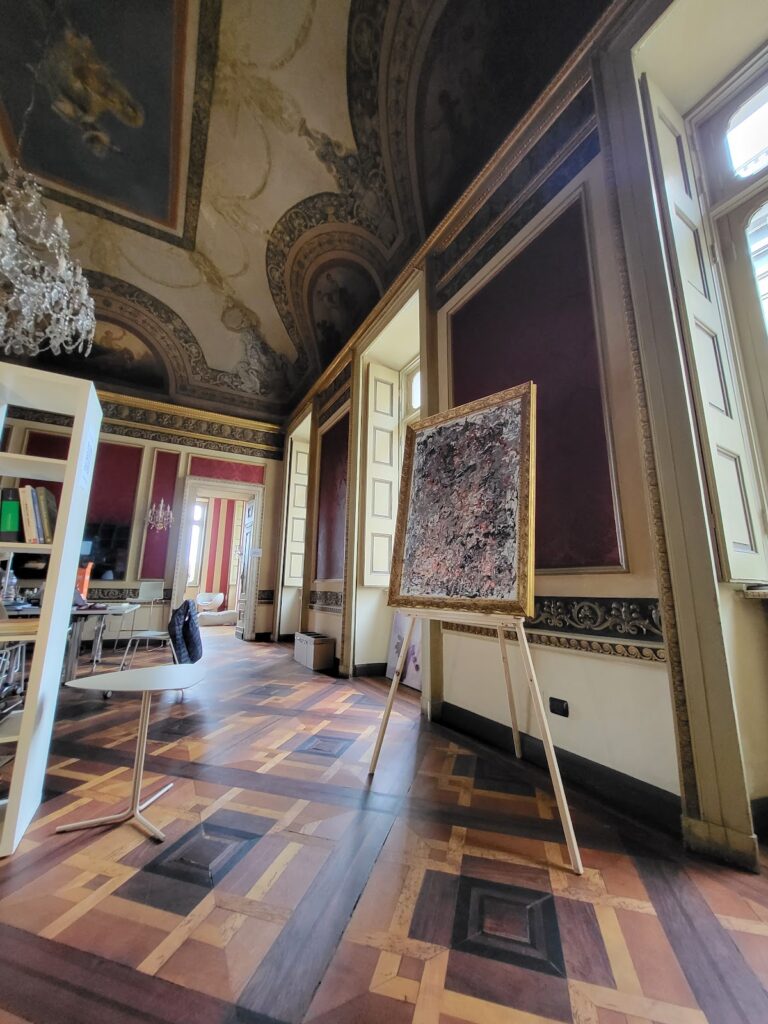
In 1972, the Province of Turin purchased the palace from Piero Rondolino, Ferdinando Rondolino’s grandson, for 200 million lire and subjected the building to a radical functional transformation. A fire damaged the palace in 1995, after which it was carefully restored. In 2017, the principal floor became a six-suite hospitality facility, while the former Salone delle Feste was converted into a modern art gallery.
Palazzo del Carretto di Gorzegno forms part of the UNESCO World Heritage designation, an international recognition applied to cultural and natural properties judged to have exceptional value to humanity.
Remains
Layout and exterior
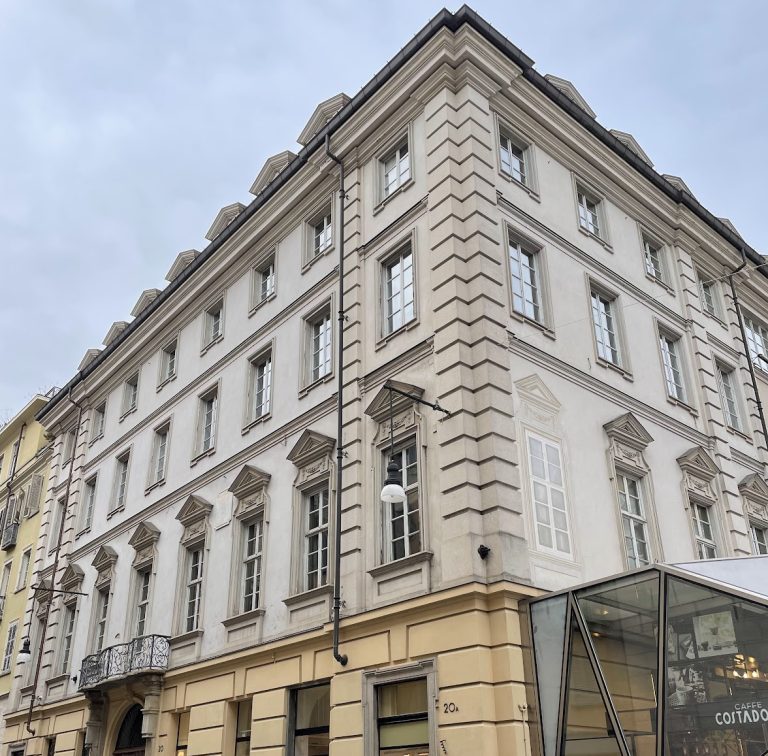
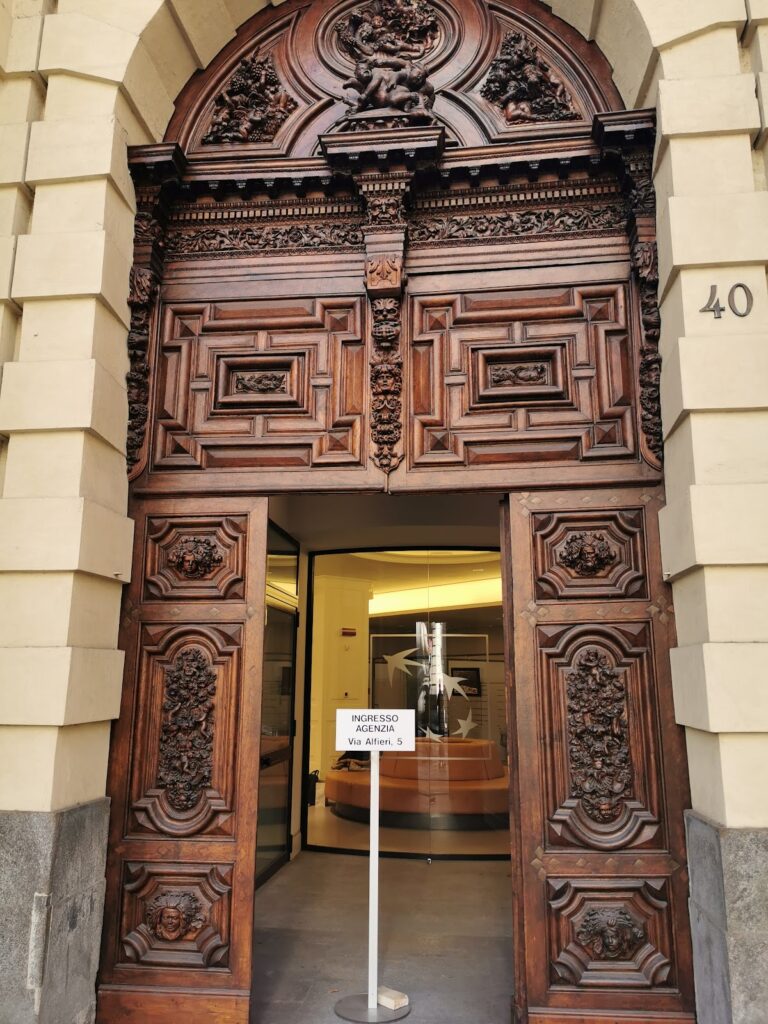
The palace has a sober, elegant façade and rises four storeys above ground. Its plan follows a C-shaped layout that opens toward the garden of Palazzo Dal Pozzo della Cisterna. From the entrance, the sequence of spaces progresses through an entry passage, an entrance hall, and a courtyard, with the garden at the end. The courtyard is enclosed by a wall topped with pinnacles and includes a fountain. The present building combines this late-seventeenth-century arrangement with the storeys added during the eighteenth century and the enlarged principal-floor apartment.
Decorated interiors
Important elements of the palace’s first late-seventeenth-century decoration survive in the former Salone delle Feste, the ceremonial reception hall, and in one of the suites. Friezes and paintings depict emblems, devices, and landscapes. The interiors also retain characteristic ceilings with wooden beams decorated with rosette motifs. Other parts of the residence were later modernized in the Baroque style, a European architectural and artistic approach known for theatrical decoration, movement, and elaborate spatial effects.