Palazzo d’Avalos: A Renaissance Marquises’ Palace in Vasto



Site at a Glance
- Rating
- 4.5
- Popularity
- Low
- Country
- Italy
- Primary era
- Early Modern
- External website
- Open
- Eras represented
- Medieval, Early Modern
- Civilizations
- Kingdom of Naples, Spanish
- Site type
- Domestic
- Remains
- Palace
On this page7 sections
History
Palazzo d’Avalos is a Renaissance-style palace in Italy, located in the historic center of Vasto, Abruzzo. It became the residence of the Marquises of Vasto and remained so until 1806, while today it serves as a civic museum complex.
Medieval origins and the d’Avalos residence
The present palace incorporates or stands over a fifteenth-century predecessor, possibly a Benedictine monastery. In 1427, the condottiero, a professional military commander who led troops under contract, Giacomo Caldora purchased the earlier structure when he was lord of Vasto. An earthquake damaged it in 1456.
The Spanish aristocratic d’Avalos family became lords of Vasto in 1496. Rather than live in the town castle, they chose to refurbish the palace. Francesco Ferdinando d’Avalos, the family’s second marquis, began a major refurbishment in 1552. His brother, Cardinal Innico d’Avalos d’Aragona, promoted the work, whose designs are attributed to the local Franciscan monk Valerio de Sanctis. The facade facing the piazza was generally complete by the end of the sixteenth century.
Sixteenth- and seventeenth-century changes
Vasto and its surrounding area faced attacks and depredations by Ottoman corsairs during the sixteenth century, including forces led by Piyale Pasha. In 1573, Isabella Gonzaga, the widow of Francesco Ferdinando, granted part of the palace to the Università of Vasto. This institution was the town’s civic communal government, rather than a modern university.
During the seventeenth century, Cesare Michelangelo d’Avalos commissioned a fountain for the space in front of the palace, while a theater and grand staircase were added to the complex. His alliance with Austrian Imperial forces during the War of the Spanish Succession, an early-eighteenth-century conflict over the Spanish monarchy involving major dynastic and imperial powers, led to his exile from Vasto between 1701 and 1713. During this period, the palace was sacked.
Decline and civic reuse
During the Napoleonic invasions, the d’Avalos family moved to Naples. Much of the palace’s interior had been removed by the early nineteenth century. The theater nevertheless continued to host performances until 1832, including a work presented in honor of Ferdinando II of the Bourbon dynasty, King of Naples.
The commune purchased Palazzo d’Avalos in 1974. The Archaeological Museum moved there from the former convent of San Francesco during 1989 to 1998, the Costume Museum opened in 1995, and the Pinacoteca reopened in 1999. The Pinacoteca, an art gallery organized around paintings, began with a 1898 donation from the brothers Giuseppe, Filippo, Nicola, and Francesco Paolo Palizzi, together with other donors. Its contemporary-art gallery was formed around the Paglione-Olivares family donation.
Remains
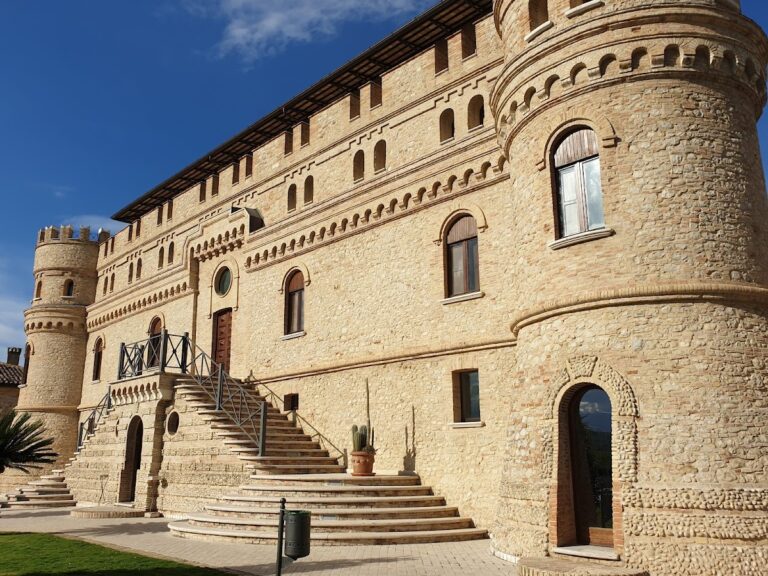
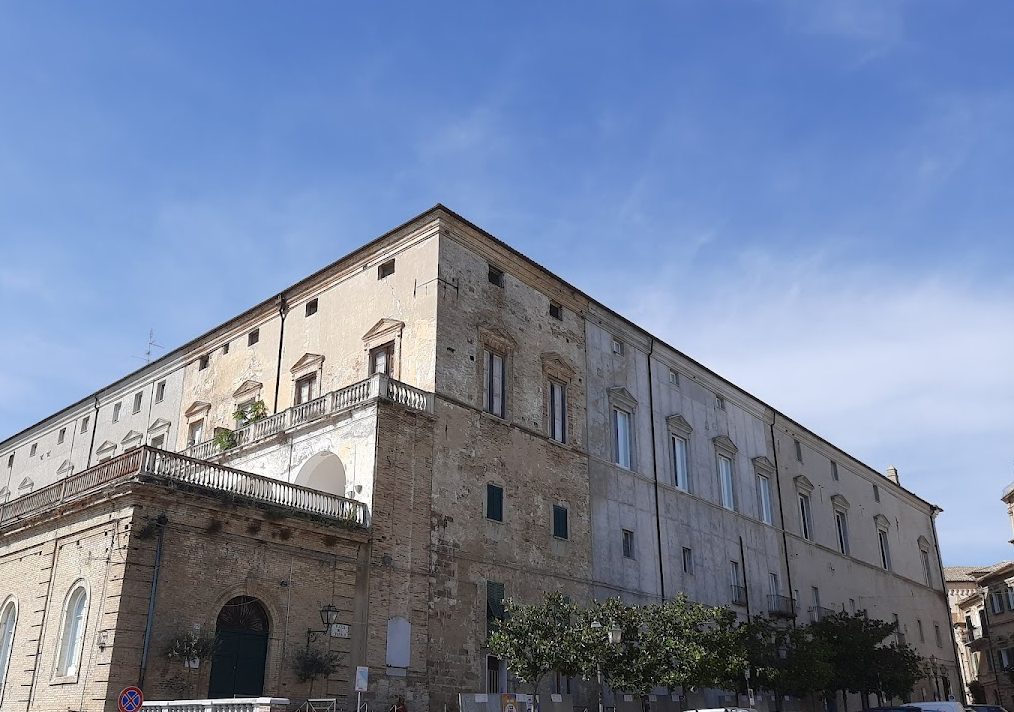
Palazzo d’Avalos is a square Renaissance block with a large internal courtyard. It stands immediately southeast of Vasto Cathedral, facing Piazza Lucio Pudente. The building’s fabric incorporates or overlies the earlier fifteenth-century structure, while the piazza facade belongs broadly to the late sixteenth-century refurbishment.
Palace exterior and historic additions
The palace presents the formal massing of a Renaissance residence organized around its internal courtyard. A fountain was installed in front of the building during the seventeenth century. The same period brought a theater and a grand staircase to the complex. The theater remained in use for performances until 1832.
Civic museum collections
The Archaeological Museum contains numerous Roman artifacts. The Costume Museum holds nineteenth-century clothing, including a hand carriage.
The Pinacoteca includes works by Filippo Palizzi, Francesco Paolo Michetti, Gabriele Smargiassi, and Giulio Aristide Santoro. Its contemporary-art gallery contains works by the Italian artists Bonichi, Carmassi, De Stefano, and Falconi, as well as by the Spanish artists Mensa, Orellana, Ortega, and Quetglas.
Nearby sites