Palazzo Contarini Polignac: A Renaissance Palace on Venice’s Grand Canal


Site at a Glance
- Rating
- 4.6
- Popularity
- Low
- Country
- Italy
- Primary era
- Medieval
- External website
- Open
- Eras represented
- Medieval
- Civilizations
- Venetian
- Site type
- Domestic
- Remains
- Palace
On this page8 sections
History
Palazzo Contarini Polignac, also known as Palazzo Contarini Dal Zaffo, is a fifteenth-century Venetian palace in Italy, overlooking the Grand Canal in Venice’s Dorsoduro district. Probably built during the second half of the fifteenth century, it is generally regarded as an early example of Renaissance architecture in Venice and reflects Lombard influence.
Origins and Contarini ownership
The architect remains unknown. The design has been attributed to Giovanni Buora, Mauro Codussi, and Pietro Lombardo, but no attribution is certain. The building’s Renaissance character combines elements associated with Byzantine architecture, the traditions of the Eastern Roman Empire, with later Renaissance and Tuscan forms.
The Contarini dal Zaffo family rebuilt the palace between 1562 and 1582 without changing its exterior. Its name refers to Giorgio Contarini, a member of Venice’s leading Contarini patrician family, who held the title Count of Jaffa in Palestine. “Zaffo” was the Venetian form of Jaffa.
The palace remained connected with the Contarini family until 1758, when it passed to the Manzoni family of Bergamo. It later belonged to the Angaran family before being acquired by Winnaretta Singer in 1901.
The Singer and Polignac period
Winnaretta Singer, an American heiress and daughter of Isaac Singer, became Princess de Polignac through her marriage to the French composer Edmond de Polignac. During their period of ownership, the palace hosted intellectual salons and musical evenings attended by figures including Arthur Rubinstein, Fritz Kreisler, Vladimir Horowitz, Igor Stravinsky, Enrico Caruso, Nellie Melba, and Luisa Tetrazzini.
In the summer of 1932, Francis Poulenc presented the premiere of his Italian Concerto for two pianos at the palace. After the property was inherited by Singer’s nieces, it became known as Palazzo Contarini Polignac.
Modern use
The palace remains a private residence. Restoration took place between 2004 and 2007, and since 2014 the nonprofit organization Save Venice has supported a library and study center in the building. The library held 4,000 volumes in 2019.
Remains
Marble facade and canal entrance
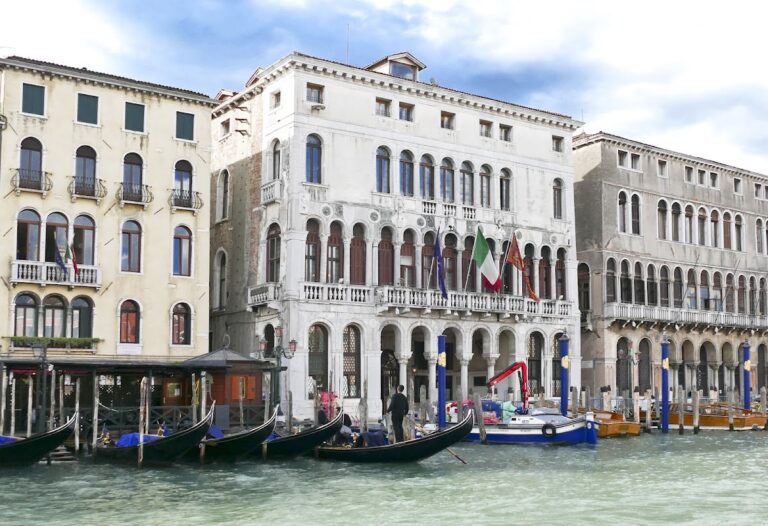
Palazzo Contarini Polignac is a three-level Renaissance building with a facade entirely covered in polished marble tiles. Its design brings together Byzantine, Renaissance, Tuscan, and Lombard-related elements. High arched windows rest on central columns, while small round openings provide additional decoration. These forms are understood as features carried over from an earlier Byzantine structure on the site.
The two noble floors have matching arrangements. Each has a central five-light window, divided into five openings, with two single-lancet windows on either side. At ground level, six round-arched openings accompany a central portal that gives direct access to the canal. The right side shares a wall with Palazzo Brandolin Rota. On the left, a three-light window on the second floor and a covered terrace on the first floor overlook a garden open to the Grand Canal and adjoining Palazzo Balbi Valier. Another multi-light window appears on the rear facade.
Interior and courtyard features
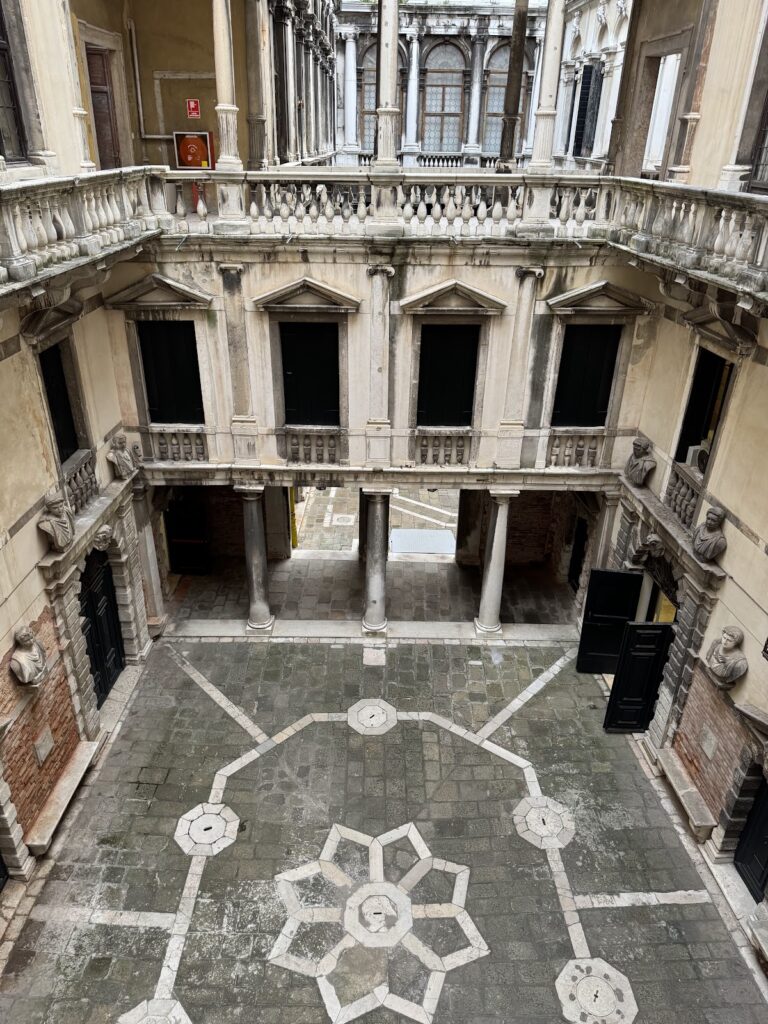
On the side opposite the canal, the building opens onto a courtyard containing an original well. Several frescoes by Giandomenico Tiepolo survive inside in good condition. Tiepolo was a Venetian painter and the elder son of the eighteenth-century painter Giovanni Battista Tiepolo.
Palace in art
Claude Monet painted the palace twice from a gondola in 1908. One of his views shows the lower part of the marble facade with the canal in the foreground.
Nearby sites