Palazzo Loredan Cini: A Renaissance Palace and Museum in Venice


Site at a Glance
- Rating
- 4.2
- Popularity
- Low
- Country
- Italy
- Primary era
- Early Modern
- External website
- Open
- Eras represented
- Early Modern
- Civilizations
- Venetian
- Site type
- Domestic
- Remains
- Palace
On this page13 sections
History
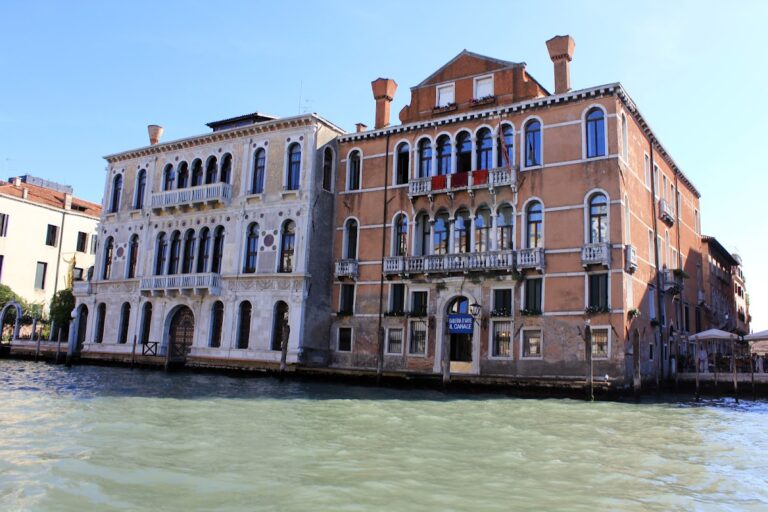
Palazzo Loredan Cini is a Renaissance-style palace complex in Venice, Italy, on the Grand Canal in the Dorsoduro district. Standing between Campo San Vio and Palazzo Balbi Valier at the junction of the Grand Canal and the Rio San Vio, it developed from the union of the former Palazzo Foscari-Loredan and the adjoining Palazzo Grimani.
The Foscari-Loredan Palace
The site of the Foscari palace had previously belonged to the Giustinian family and developed during the fourteenth and fifteenth centuries. In 1428, the Republic of Venice purchased it for 6,500 ducats and transferred it to the Marquis of Mantua. About a decade later, the property was confiscated and granted to Francesco Sforza. It was later appropriated again, sold at public auction, and acquired by Doge Francesco Foscari.
Under Elisabetta Venier Foscari, the palace was rebuilt in the mid-1560s. Members of the Foscari family continued to occupy it until 1797. During the Austrian occupation, the building was used as barracks for Croatian soldiers. In the nineteenth century, it housed the Scuola Superiore di Commercio, an institution devoted to advanced commercial education.
The Grimani Palace and Later Owners
The adjoining Grimani palace was built between 1564 and 1567 for Vincenzo Grimani of the Santa Maria Formosa branch of the Grimani family. The wider complex later became associated with the Loredan family and passed to the Caldogno and Valmarana families.
During the nineteenth and twentieth centuries, the former Grimani palace was the residence of Prince Carlos, also known as Carlo VII of Bourbon-Two Sicilies. Carlo VII was the nineteenth-century claimant and political leader of Carlism, a Spanish traditionalist monarchist movement associated with a Bourbon succession claim. The palace consequently served as a headquarters for the movement.
Vittorio Cini and the Gallery
Vittorio Cini acquired the Palazzo Foscari on the Grand Canal in 1920 after marrying the actress Lyda Borelli. He then merged it with the adjoining palace. Cini was a major Italian industrialist and art collector who was politically associated with the National Fascist Party. In 1934, during Benito Mussolini’s rule, he was appointed Senator of Italy.
After Cini’s son Giorgio died in an air crash near Cannes on 31 August 1949, Cini established the Giorgio Cini Foundation in 1951 on the island of San Giorgio Maggiore. He dedicated the institution to his son and supported the restoration of the San Giorgio Maggiore monastic complex. The foundation also undertook cultural preservation, scholarship, patronage, and the study of Venice’s artistic heritage.
From 1956 to 1958, the architect Tomaso Buzzi redesigned the palace interiors. Cini had earlier attempted to make his collection accessible through a proposed museum at Palazzo Grassi, but the project did not succeed before his death in 1977. The collection was subsequently divided among his heirs, with portions assigned to Palazzo Cini in Venice and to Cini’s inherited castle at Monselice.
During the 1980s, Cini’s daughter Yana Cini Alliata di Montereale donated part of her father’s collection and part of the palace to the Giorgio Cini Foundation, keeping the works within an appropriate architectural setting. In 1981, she gave the foundation a group of works with the requirement that they be displayed in the palace. The museum officially opened on 21 September 1984. A further donation in 1985 added more works and two floors of the palace for the gallery. In 1989, Yana’s twin sister, Ilda Cini Guglielmi di Vulci, placed fourteen paintings from the Ferrarese school with the foundation on long-term loan. The palace is now used as a museum, and the Palazzo Cini Gallery presents art from the thirteenth to the eighteenth century, with particular emphasis on Tuscan painting and Ferrarese Renaissance art.
Remains
Palace Layout and Exterior
Grand Canal Façade
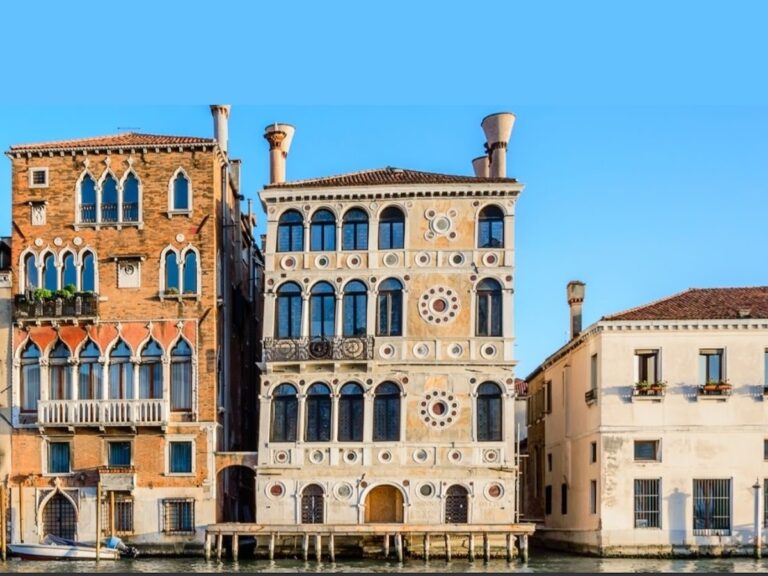
The complex has four floors and three façades, with its principal setting at the meeting point of the Grand Canal and the Rio San Vio. The narrow Grand Canal façade rises through four floors and is organized by a succession of double- and single-opening windows. Frescoes once painted by Giuseppe Porta, a sixteenth-century Venetian painter associated with Mannerism, have disappeared.
Rio San Vio Façade
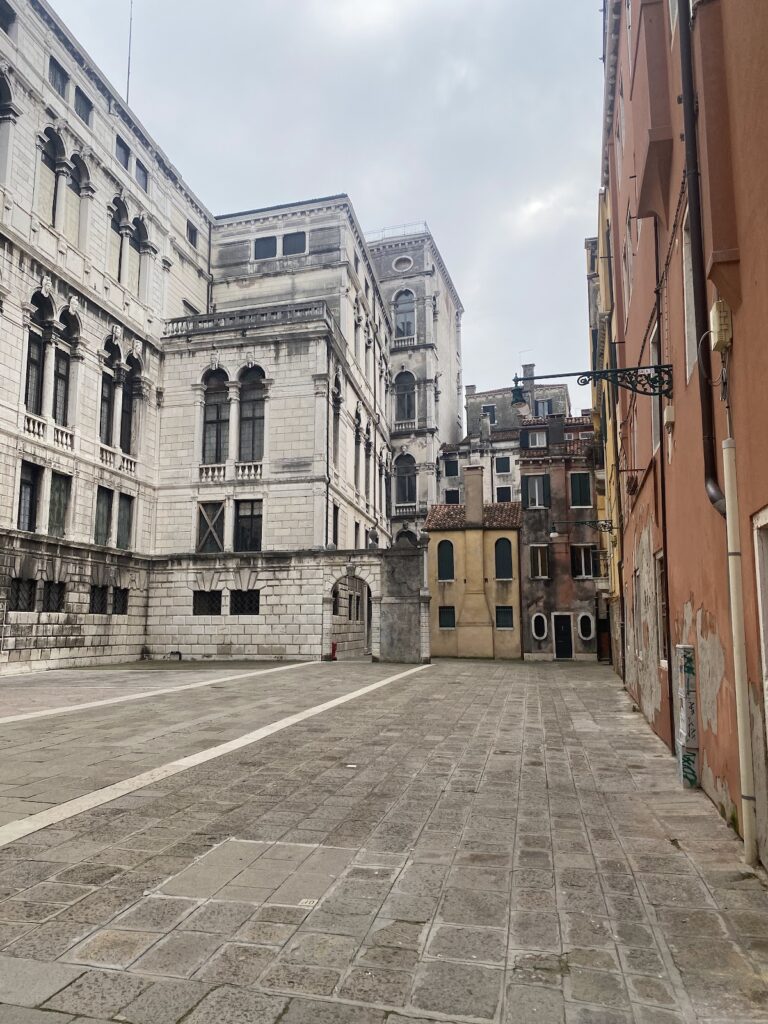
Approximately 50 metres long, the Rio San Vio façade appears in two sections corresponding to the palace’s two component buildings. It faces Campo San Vio and is linked to the campo by a private bridge. The right-hand section has an imposing water portal, a canal-side entrance, together with two five-light windows, each divided into five openings.
The left-hand section has a serliana, a central round-headed arch flanked by two narrower openings with horizontal lintels, in place of the multi-light windows on the other section. Its plain single-opening windows are generally simple in artistic treatment, while the round-headed windows on the piano nobile, the principal representative floor, provide a more distinctive feature.
Rear Façade
The rear façade faces the Forner pool. Rows of single-opening windows are interrupted by another serliana, giving this elevation a rhythm that echoes the architectural language of the Rio San Vio side.
Gallery Collections
Early Tuscan and Italian Painting
The gallery presents paintings and sculptures alongside Renaissance enamel work, furniture, ivories, antique books, jewellery, weapons, and other decorative-arts objects. Its paintings include Madonna and Child by the Master of the Bigallo Crucifix, a second Madonna and Child by a follower of Giovanni Francesco Maineri, and works by Niccolò di Segna, Lorenzo Costa, and Piero della Francesca. Lorenzo Costa’s Madonna and Child dates from 1501 to 1503.
Other works from the collection include Taddeo Gaddi’s St John the Evangelist Drinks from the Poisoned Cup and Assumption of a Saint, Bernardo Daddi’s Crucifixion, a Virgin and Child Enthroned with Saints from Daddi’s studio, and Guariento’s The Ascension of Christ. The gallery also displays the Virgin and Child Enthroned with Two Saints by the Master of the Horne Triptych, the Maestà by the Master of Badia a Isola, and a polychrome-wood Virgin and Child by Nino Pisano.
The collection continues with Christ Mocked, Flagellation, and Crucifixion by the Master of the Poldi Pezzoli Diptych; Madonna and Child by the Master of the Bigallo; Francesco di Neri da Volterra’s Polyptych of Saint Paul, dating from about 1365; Taddeo Gaddi’s Two Apostles, from about 1320; and Sano di Pietro’s The Saviour, from about 1450.
Ferrarese Renaissance Works
Ferrarese Renaissance art is represented by Cosmè Tura’s St George from the Colonna Altarpiece and Michele Pannonio’s Virgin and Child with Saints Nicholas, Jerome, Augustine and Christopher. Panels depicting Saints George, Catherine of Alexandria, and Jerome come from the Griffoni Polyptych, formerly in San Petronio in Bologna.
The gallery also includes Marco Zoppo’s St John the Baptist in the Wilderness, Baldassarre D’Este’s Portrait of Tito Vespasiano Strozzi, an allegorical scene by Dosso Dossi from Alfonso I’s bedroom in the Este Castle, and Battista Dossi’s Holy Family and Young Saint John. Michele Ciampanti’s Adoration of the Shepherds, dating from approximately 1475, belongs to the same broad presentation of early Italian painting.
Works from the Renaissance to the Eighteenth Century
Further paintings include Ludovico Mazzolino’s Pietà, Circumcision, and Presentation at the Temple; Piero di Cosimo’s Holy Family with Saint John the Baptist; Filippo Lippi’s Virgin and Child with Saints, Angels and Donor; and Fra Angelico’s Saint Thomas Aquinas. Sandro Botticelli and his workshop are represented by The Judgement of Paris, dated between 1485 and 1488. Virgin Adoring the Child with Two Angels by Domenico Ghirlandaio and Sebastiano Mainardi dates from the 1490s.
Later works include Pontormo’s Portrait of Two Friends, dated 1522, a polychrome-terracotta Virgin and Child by Giovanni De Fondulis, and Giandomenico Tiepolo’s Portrait in Oriental Style, dated 1753 to 1755. In the Oval Dining Room, approximately 275 pieces of eighteenth-century Venetian porcelain produced by the Cozzi manufactory form a separate group within the palace’s decorative-arts displays.
Nearby sites