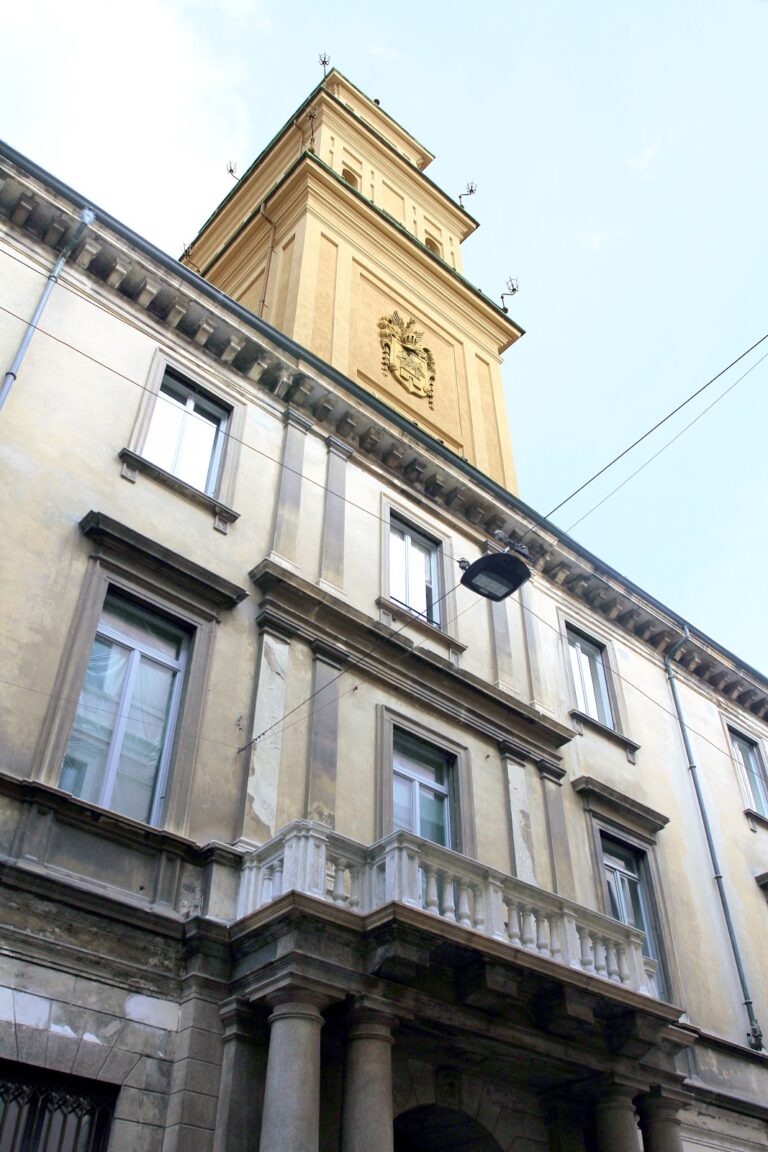
Palazzo Borromeo: A Late Gothic Merchant-Banking Palace in Milan


Site at a Glance
- Rating
- 4.3
- Popularity
- Low
- Country
- Italy
- Primary era
- Medieval
- External website
- Open
- Eras represented
- Medieval
- Civilizations
- Duchy of Milan, Holy Roman Empire
- Site type
- Domestic
- Remains
- Elite Residence
On this page13 sections
History
Palazzo Borromeo is a historic late Gothic palace in Milan, Italy, built for the Borromeo family as a residence and merchant-banking headquarters. Its construction date is uncertain, with origins placed either in the late thirteenth century or in the later fourteenth century. The palace later became closely connected with Milan’s ruling courts and with the family’s growing financial and political influence.
The Borromeo family in Milan
The Borromeos were merchant-bankers originally from Tuscany. Their establishment in Milan followed the execution of Filippo Borromeo after a battle between San Miniato and Florence in 1370. His wife and children fled, and his sons Borromeo and Giovanni founded a bank in Milan. The family expanded its position through financial relations with the Visconti dukes, the ruling dynasty of Milan before Francesco Sforza founded the Sforza dynasty in 1450.
Vitaliano Vitaliani, Giovanni Borromeo’s nephew, became a Milanese citizen in 1416. He took control of the family business in 1431 and added the Borromeo name to his own. As treasurer and counsellor to Duke Filippo Maria Visconti, he received the title Count of Arona in 1445. His office and business activities greatly increased the family’s wealth and property, including the expansion of the palace.
Fifteenth-century expansion
During Vitaliano’s period, substantial additions were made to Palazzo Borromeo while its original late Gothic facade was retained. The family also created the piazza in front of the residence. Tournaments, festivals, celebrations, and other public events took place there, giving the palace an important place in the public life of the surrounding area.
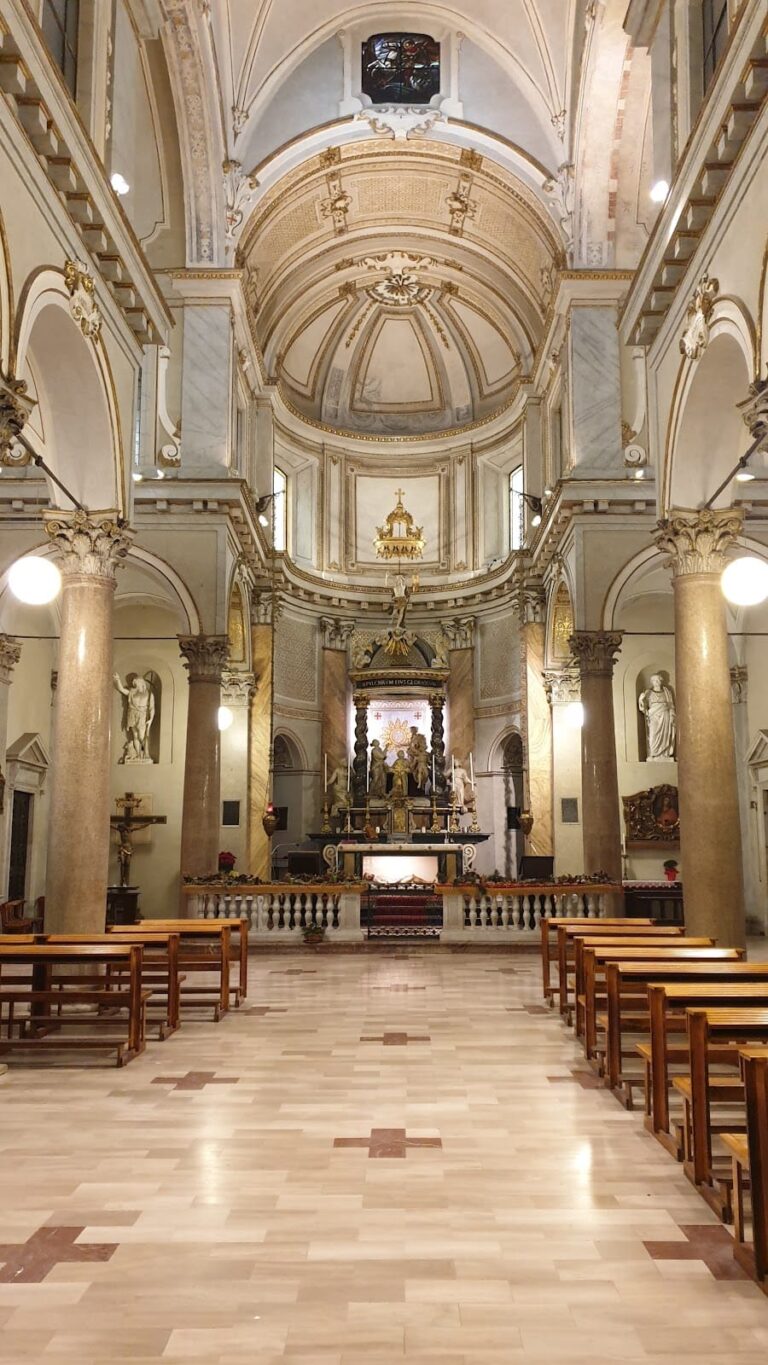
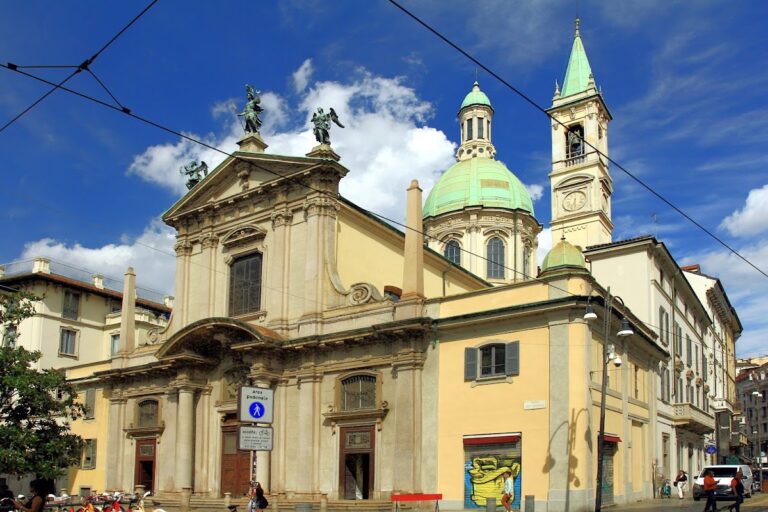
Vitaliano’s son Filippo continued the family’s service to the ducal court after Francesco Sforza became Duke of Milan in 1450. The Borromeo businesses developed international connections, while the family’s art collections were later installed in the palace and displayed publicly during the nineteenth century. Santa Maria Podone, standing across the piazza, also entered the family’s historical setting through Borromeo patronage in 1442. This association included a chapel and later commemorative decoration, including a statue of Saint Charles Borromeo, the sixteenth-century Borromeo cardinal and archbishop of Milan.
War damage and restoration
The rear part of the palace served for a period as the headquarters of the Milanese police. Palazzo Borromeo remained the Borromeo family’s home until 1943 and continues to be owned by the family, although it is now divided among offices, studios, and apartments.
Allied bombing during the Second World War badly damaged parts of the complex in 1943, including courtyard structures and one wall of the frescoed hall. The palace was later reconstructed and restored toward its fifteenth-century appearance. The most notable postwar work took place in the 1950s under the direction of Ferdinando Reggiori, an architect and archaeologist. His restoration revealed additional fresco decoration in the palazzina. Fragments from the Room of Aesop’s Fables, attributed to Michelino da Besozzo, were moved to the Borromeo family’s Rocca di Angera, while the surviving paintings in the Room of the Borromeo Games remained in the palace.
Remains
Palazzo Borromeo retains a late Gothic character, although successive alterations have left the complex without complete stylistic unity. Its exposed-brick facade preserves traces of medieval windows and doors, which vary in size and are irregularly placed. A wooden-ceilinged entrance passage leads into the principal courtyard. Behind the older building are two courtyard wings added during Vitaliano’s period, forming a sequence of service and formal spaces.
Facade and entrance
The main facade is organized around a fifteenth-century portal commissioned by Vitaliano. Its pointed arch reflects French Gothic influence, and the archivolt, the decorative band following the curve of an arch, is carved with vine tendrils and clusters of oak leaves. Alternating blocks of red marble from Verona and pink Candoglia marble frame the entrance. Above the doorway, a crowned camel carried in a basket represents the family’s long-distance and exotic trade. The rectangular area above the portal originally held an Annunciation scene with the archangel Gabriel and the Virgin Mary. The painting faded and was damaged, but remained visible until 1943.
Courtyard complex
Service court
The smaller courtyard accommodated horses, merchandise, and business transactions. It belonged to the practical side of the residence and headquarters, complementing the more formal inner court behind it.
Cortile d’onore
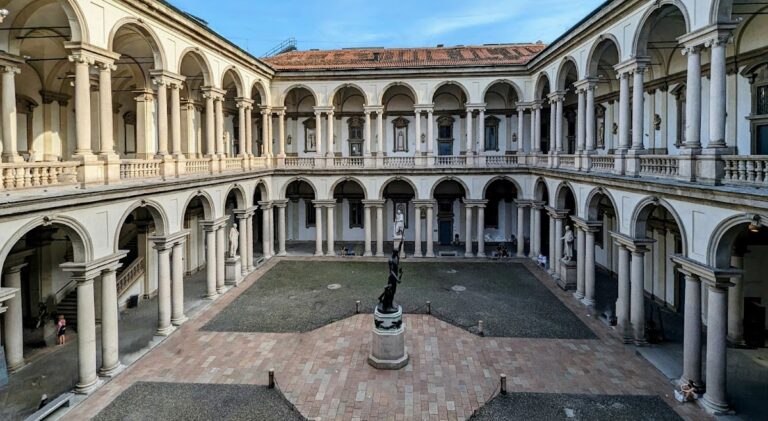
The larger inner court, or cortile d’onore, served as the formal reception and entrance space for the family and its guests. It is the best-preserved part of the palace. Porticoes run along three sides and rest on short, sturdy columns of serizzo, a durable granite widely used in northern Italian construction. Their capitals are carved as large stylized leaves, while the pointed arches echo the shape and proportions of the main portal.
Parts of the original wall frescoes remain visible in the courtyard. The paintings above the porticoes on three sides suffered severe damage in 1943. The fourth side is occupied by the two-storey palazzina, or smaller palace building, and retains remains of older facade frescoes restored in 1985 by Valeriano Dalzini.
Palazzina
The palazzina has six large arched windows and one small square window, all surrounded by elaborate terracotta decoration characteristic of Lombardy during the period. Its plastered-brick facade carries a repeated pattern of a count’s coronet, groups of heraldic rings, and the Borromeo motto, humilitas, meaning “humility.”
Secular frescoes
Room of the Borromeo Games
The Room of the Borromeo Games preserves a fresco cycle probably created during the 1440s or around 1450. Three walls survive in good condition, while the fourth was destroyed in 1943. The scenes present elegantly dressed men and women taking part in courtly leisure activities in a garden, including tarot, a ball game, and the dance-like game of palma. The subject is secular late Gothic recreation rather than religious narrative.
The painter remains uncertain. The cycle has been attributed at different times to Pisanello, Masolino da Panicale, Michelino da Besozzo, and other artists. Many scholars regard it as the work of a Lombard painter, with the Zavattari family, Cristoforo Moretti, Giovanni Zenone da Vaprio, and Michelino da Besozzo among the proposed attributions. The paintings are regarded as a major surviving Lombard example of late Gothic secular decoration and influenced similar schemes in other Lombard palaces.
Room of Aesop’s Fables
Fresco fragments from the Room of Aesop’s Fables were uncovered during Reggiori’s postwar restoration of the palazzina. Attributed to Michelino da Besozzo, they were removed from Palazzo Borromeo and transferred to the Borromeo family’s Rocca di Angera.
Nearby sites