Chiesa di San Sepolcro: Milan’s Church of the Holy Sepulchre
Site at a Glance
- Rating
- 4.8
- Popularity
- Low
- Country
- Italy
- Primary era
- Medieval
- External website
- Open
- Eras represented
- Classical, Medieval, Early Modern, Modern
- Civilizations
- Duchy of Milan, Holy Roman Empire, Italian, Roman, Spanish
- Site type
- Religious
- Remains
- Church
On this page15 sections
History
Chiesa di San Sepolcro is a Catholic church in Milan, Italy, founded in 1030 in the central area of the former Roman forum. It follows the Ambrosian rite, the Catholic liturgical tradition associated with the Archdiocese of Milan, and stands within the parish of San Satiro and the archdiocese. Its history connects Milanese worship with the memory of Jerusalem and with the city’s institutions of religious learning.
Foundation and early religious role
Benedetto Ronzone, master of the mint, founded the church privately in 1030 under the dedication of the Holy Trinity. It occupied land belonging to his family near his residence, in a busy central district associated with the mint and commercial activity. The archiepiscopal curia probably approved the foundation partly to reaffirm the historical reality of Christ and the Cross, ideas that had recently been denied in Milan by the heretics of Monforte.
A document from the year of the foundation assigns the church to monks and canons while distinguishing their duties. The monks and canons were responsible respectively for liturgical service and the administration of the church’s property. This arrangement also strengthened the Benedictine presence in Milan. In 1066, the church provided medical care for Arialdo da Carminate, an eleventh-century Milanese cleric associated with the Pataria, a reform movement that opposed aspects of clerical corruption and episcopal authority. His conflicts with Archbishop Guido da Velate formed part of the unrest surrounding the movement.
Rededication during the Crusades
On 15 July 1100, Archbishop Anselmo da Bovisio rededicated the church from the Holy Trinity to the Holy Sepulchre of Jerusalem. The ceremony took place during celebrations for the capture of Jerusalem in 1099 and on the eve of the expedition of 1100. Anselmo granted an indulgence, a remission under specified religious conditions of temporal punishment associated with forgiven sins, to people unable to travel to Jerusalem. Those who visited Milan’s Holy Sepulchre could receive remission of one-third of the penalty for their sins. Anselmo later joined the Crusade of 1101 and died during the expedition.
The church had originally been founded in the form of a cross. After the First Crusade, it was altered to correspond to the Anastasis, the rotunda in Jerusalem traditionally built around the tomb associated with Christ’s burial and resurrection. This arrangement was still attested in the fifteenth century. A dispute over patronage rights arose in the mid-twelfth century, while during the thirteenth and fourteenth centuries the church retained an important place in Milan’s religious center through its role in the Easter liturgy.
Religious and civic importance
During the fifteenth century, San Sepolcro continued to participate in Milan’s religious and civic life. The Dominicans of Santa Maria delle Grazie used it as a place of preaching, adding to its role within the city’s network of religious institutions.
In 1578, Carlo Borromeo selected San Sepolcro as the principal seat of the Congregation of the Oblates of Saints Ambrose and Charles, a Catholic religious congregation he had founded for service and reform in the Archdiocese of Milan. He also established the annual Ceremony of the Holy Nail, a procession from Milan Cathedral to San Sepolcro involving a relic traditionally associated with one of the nails used in Christ’s crucifixion. Borromeo described the church as lying at the “navel” of the city and connected its central position with the Holy Sepulchre of Jerusalem, regarded in Christian tradition as the navel of the world.
Baroque reorganization and later restoration
After the Ambrosian Library was founded in 1605, the church’s deteriorating structures were placed under the care of the architect Aurelio Trezzi. The work gave the facade a Baroque form and incorporated the atrium into the building. The reorganization of the San Sepolcro block created an intended symbolic relationship between the library and the church, presenting them as complementary centers of religious education and the preservation of learning during the post-Tridentine Catholic reform.
Further modifications and restoration took place between 1713 and 1719. The facade was rebuilt again between 1894 and 1897 in a Romanesque style considered more appropriate to the church’s medieval origin. In 1928, the parish of San Sepolcro was suppressed, and the church came under the Ambrosian Library, a major Milanese library and cultural institution founded by Cardinal Federico Borromeo.
War damage and renewed use
Solemn funeral rites for Filippo Tommaso Marinetti, the Italian founder of Futurism, were held at the church on 5 December 1944. During the Second World War, bombing damaged the Ambrosian Library. The lower church was then used with other locations to store the institution’s possessions and became inaccessible. In 1968, the Ambrosian administration restored the lower church for use as an exhibition venue for art.
A major interior renovation took place in 2009, after which the church became accessible again for worship and public use. The crypt reopened on 19 March 2016 after more than fifty years of closure. Since 2014, the church has also hosted Byzantine divine liturgy according to the tradition of Italy’s Italo-Albanian community. The liturgy is sung in Ancient Greek on one week and in Albanian on the next, while some readings, including the Gospel, are given in Italian.
Remains
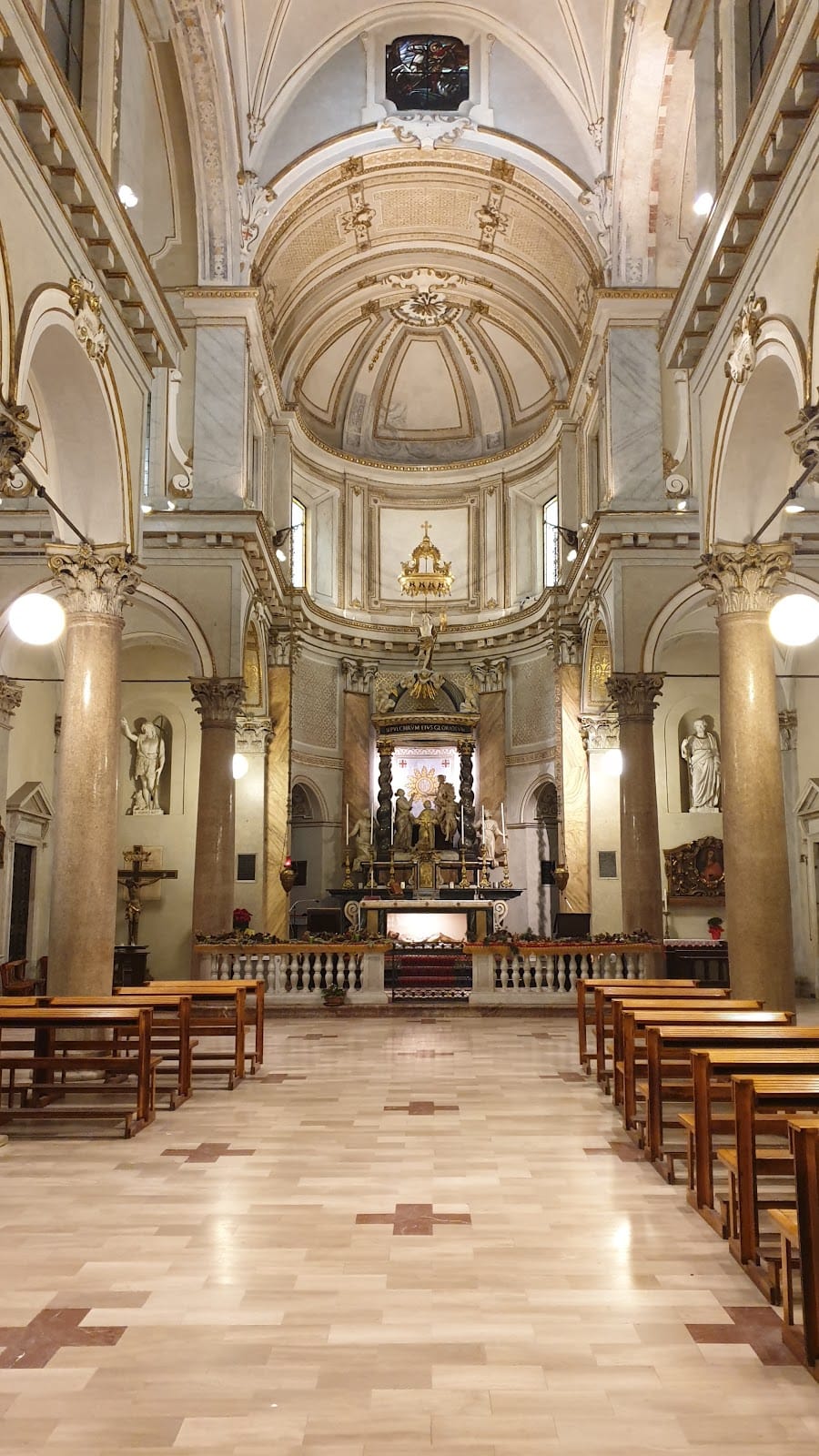
The building has two levels, an upper church and a subterranean lower church. Its present character combines a Romanesque crypt, a Neo-Romanesque exterior, and an interior that remains largely Baroque. The surviving complex brings together medieval associations, later historicist rebuilding, painted decoration, sculpture, and physical evidence of Milan’s Roman urban center.
Exterior and upper church
Facade and bell towers
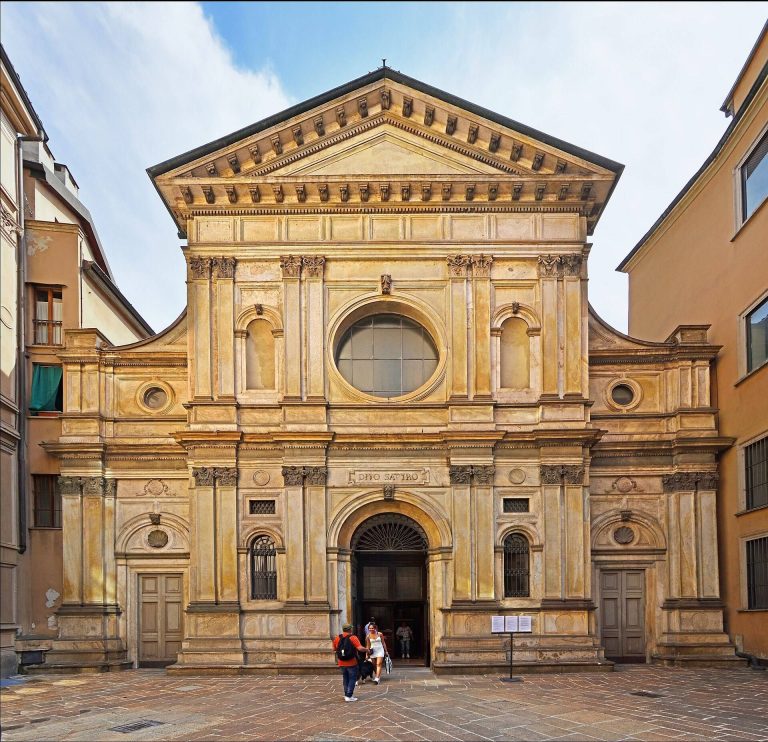
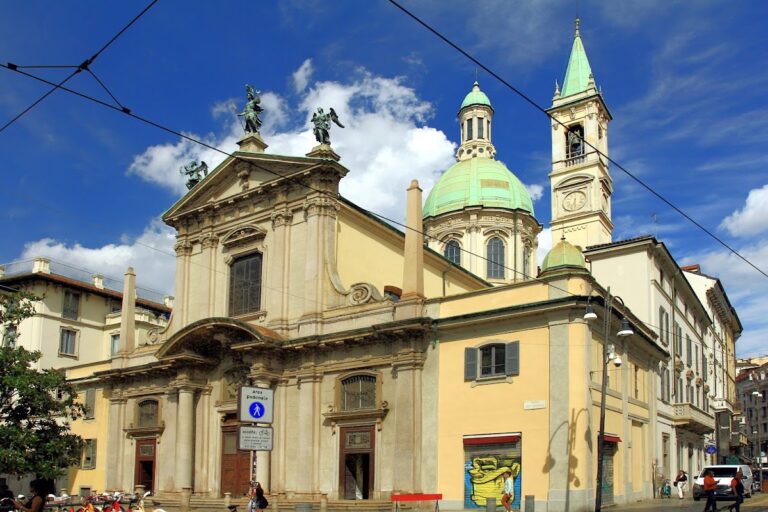
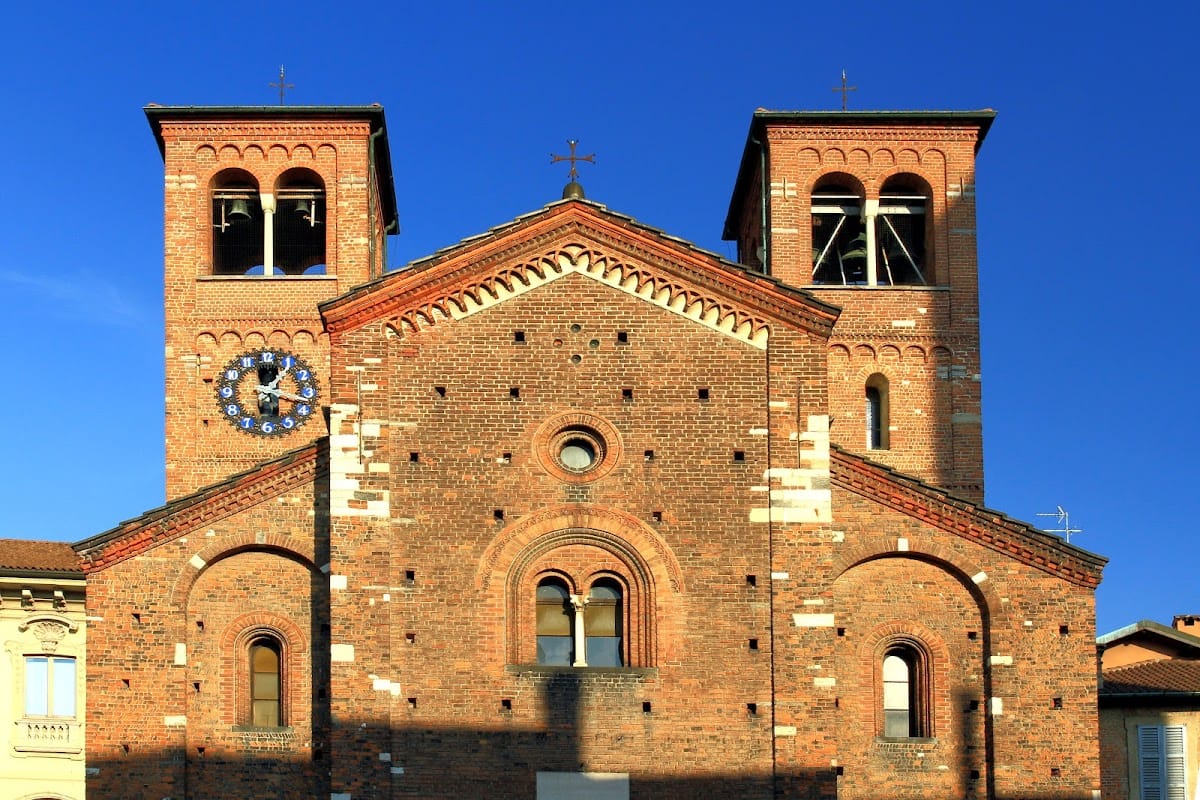
The present facade is a Lombard Romanesque reconstruction carried out between 1894 and 1897 by Gaetano Moretti and Cesare Nava. Its historicist design revived medieval forms, including the massive construction and rounded-arch vocabulary associated with Romanesque architecture. In 1903, the two bell towers were made identical by lowering the right-hand tower to the original height.
Atrium and chapels
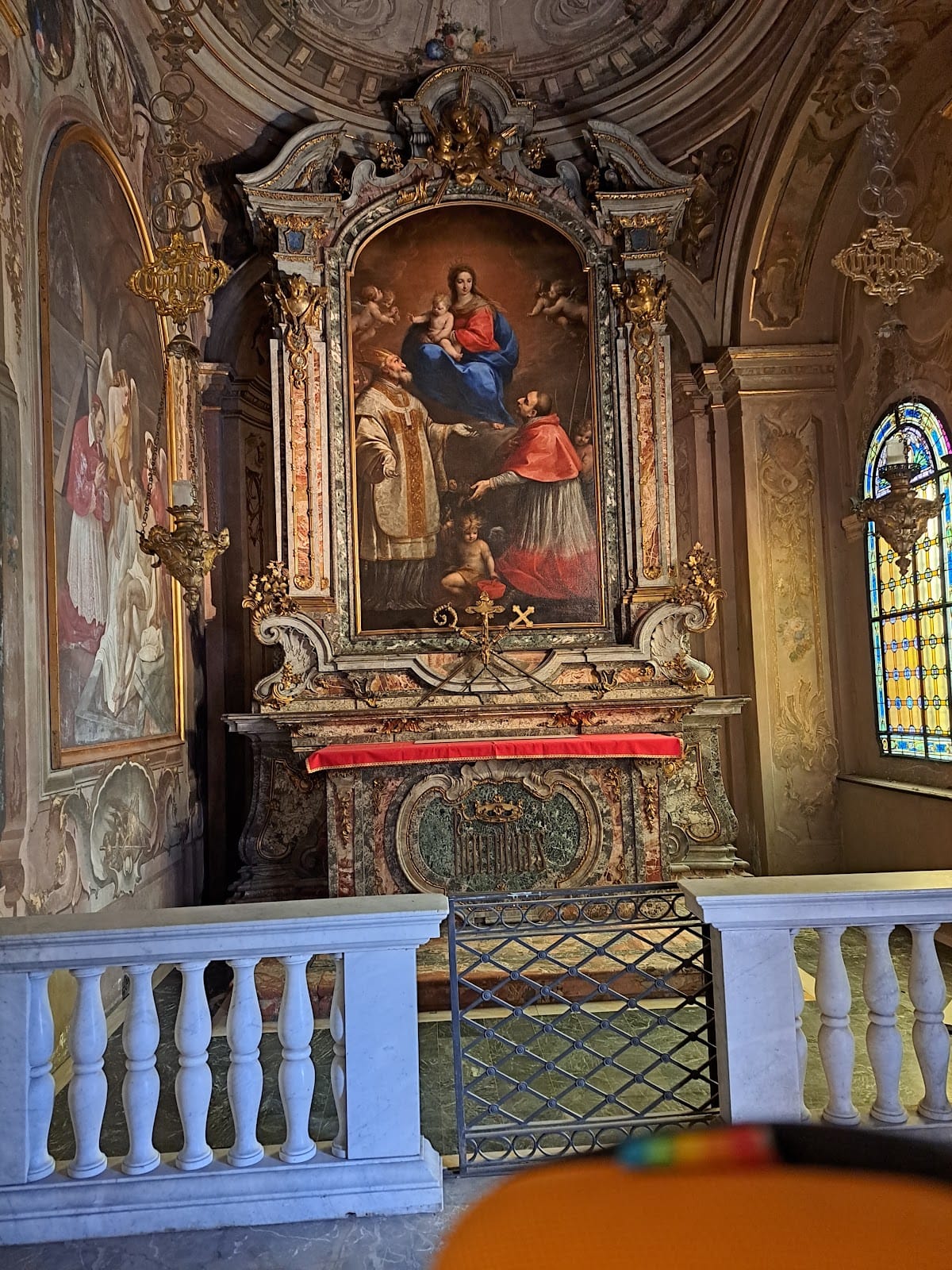
The atrium is attributed to Francesco Maria Richino and is closed by two chapels. Their decoration includes Carlo Bellosio’s frescoes Saint Charles at the Sepulchre and Saint Philip Neri Presented to Saint Charles. The atrium forms part of the Baroque reorganization of the church and remains connected to the upper building.
Paintings and sculptural groups
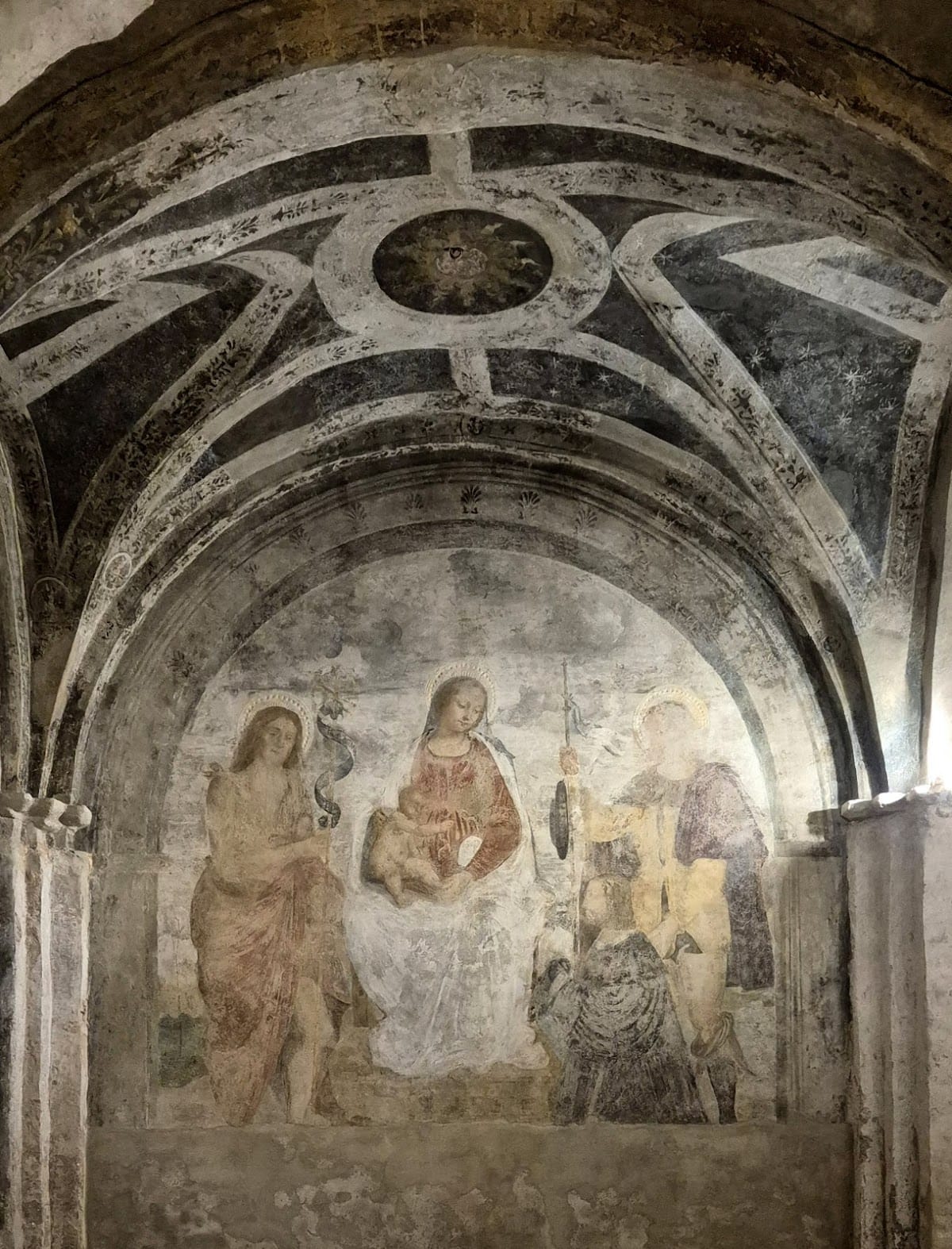
A fresco by Bramantino that once stood above the portal was detached and transferred inside the church. Two other works formerly held at San Sepolcro are now in the Ambrosian Picture Gallery: Bramantino’s Christ in Pity and Giampietrino’s Adoration of the Child with Saint Roch and Musical Angels.
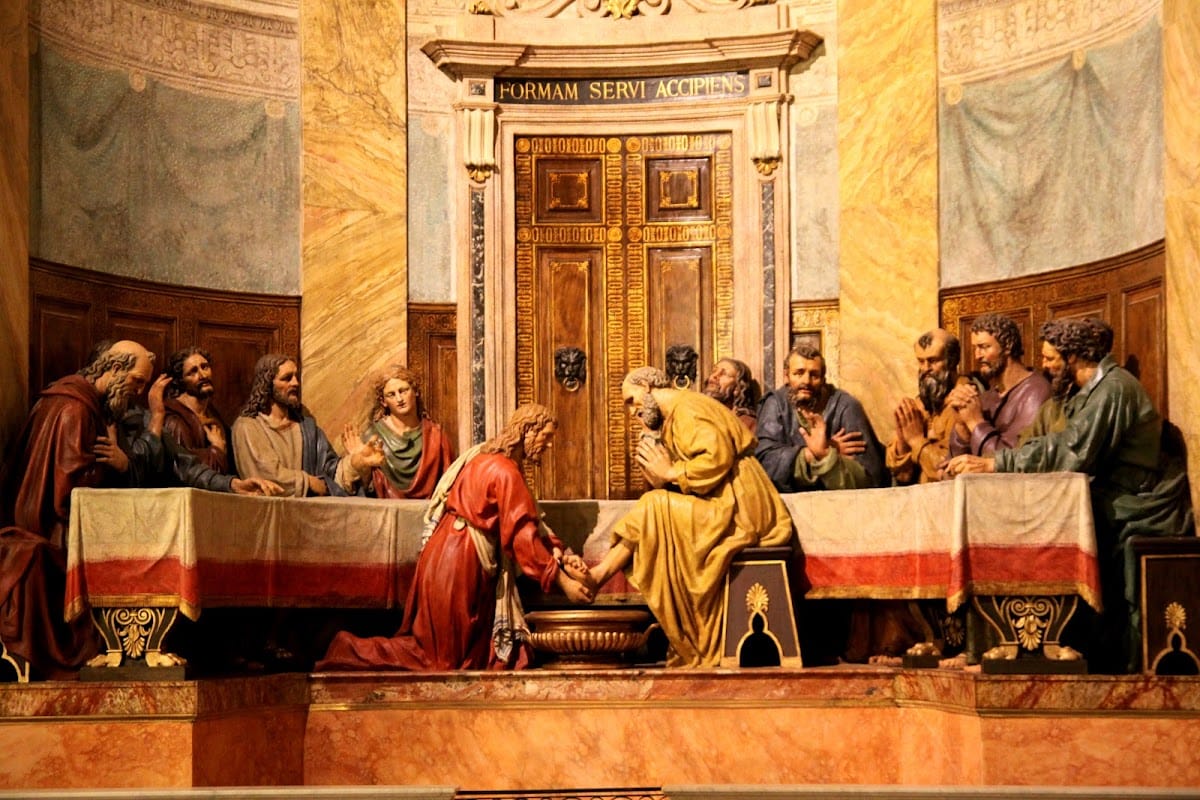
Two terracotta sculptural groups stand in the chapels beside the altar. The group on the left represents the Last Supper, while the group on the right is a triptych depicting the death of Christ. Together with the frescoes and surviving Baroque interior, they form part of the church’s principal upper-level decoration.
Sarcophagus
A sarcophagus stands in front of the apse. It may have been made by Campionesi masters during the first half of the fourteenth century. Its intended contents were relics from the Holy Land brought by Lombard crusaders, including earth from Jerusalem and some hairs of Mary Magdalene.
Lower church and Roman forum remains
Crypt and ancient paving
The underground crypt is entered from the left side of the main nave. Its floor is covered with marble slabs from the Augustan period, preserving evidence of the ancient paving of Milan’s Roman forum. The crypt occupies the point where the Cardo and Decumanus intersected. These were the principal north-south and east-west streets of a Roman city, whose crossing commonly formed its central urban point.
Palm sculpture and Leonardo’s map
In 1616, Cardinal Federico Borromeo commissioned Gian Andrea Biffi and Gerolamo Olivieri to create a copper-and-bronze palm for the intersection. The palm symbolizes “wisdom and regeneration” and stands at the point where the ancient streets meet. The crypt also contains an ancient book from the Ambrosian Library displaying the map Leonardo da Vinci drew when he visited the crypt.