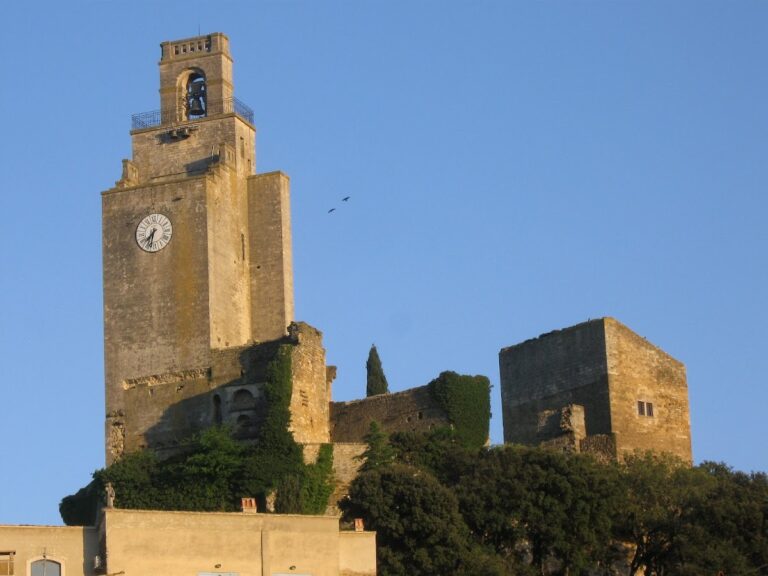
Bishops’ Palace of Bourg-Saint-Andéol: An Episcopal Residence in France


Site at a Glance
- Rating
- 4.5
- Popularity
- Very Low
- Country
- France
- Primary era
- Medieval
- External website
- Open
- Eras represented
- Medieval, Early Modern, Modern
- Civilizations
- French
- Site type
- Religious
- Remains
- Palace
On this page9 sections
History
Medieval origins
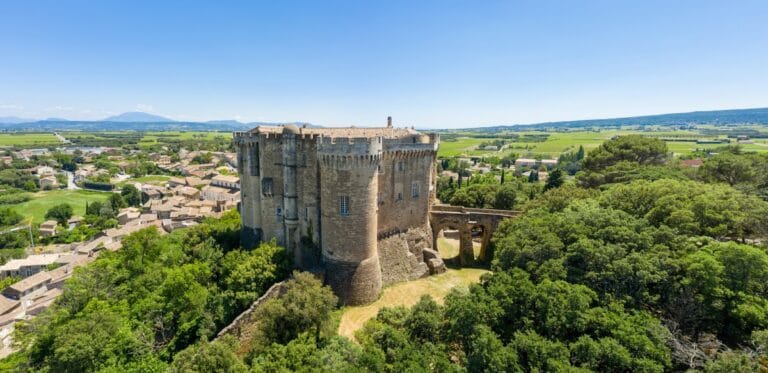
Bishops’ Palace of Bourg-Saint-Andéol is a medieval episcopal residence in France, developed in the Gothic period on Saint-Michel rock, where an earlier castrum, or fortified settlement, stood. The bishops of Viviers, who were the dominant lords of Bourg-Saint-Andéol, used the site as a private residence from the mid-thirteenth century and made it their principal residence by the end of the fourteenth century.
Around 1220, Guillaume II, bishop of Viviers, acquired half of the lordship of Bourg-Saint-Andéol through a purchase involving Pons de Montdragon and Louis Deleuzy. This acquisition strengthened the bishops’ authority at the site, which remained associated with their lordship for centuries. More than forty bishops succeeded one another at the palace.
Expansion and episcopal residence
Jean de Montchenu, bishop of Viviers, greatly enlarged the complex at the end of the fifteenth century, giving the castle the scale of a palace. Around 1500, Claude de Tournon continued the work of his predecessors, including building activity associated with the Poitiers-Valentinois, a noble family linked with the Dauphiné and the Rhône valley.
Louis-François de la Baume de Suze, bishop from 1621 to 1690, strongly shaped the palace’s present appearance. In 1637 he commissioned painted ceilings for his apartments. The Chapter Room also acquired a wider institutional role, hosting meetings of the Estates of Vivarais, the regional representative body that dealt with the affairs of the historic territory of Vivarais.
Cardinal Mazarin, the Italian-born French cardinal and statesman who served as chief minister during the minority of Louis XIV, stayed at the palace in August 1642. The room associated with that visit is now known as the Mazarin Room.
Seminary and civic uses
From 1729 to 1792, the palace housed a minor seminary linked with the Faculty of Arts of Valence. A minor seminary was a Catholic secondary school that also prepared boys for possible entry into the priesthood. The institution was noted for its philosophical studies.
During the French Revolution, the building was converted into a town hall and gendarmerie between 1792 and 1826. It also served as a barracks during the first wars of the French Republic. These uses brought the most serious mutilations to the palace.
School and protected monument
On 29 January 1858, the palace was sold to the Congregation of the Presentation of Mary. Under the congregation, it became a private school that continued operating for 140 years, until June 1998. The complex became privately owned in September 2000.
The entire former episcopal palace was classified as a historic monument in 1946. It is regarded as one of the most substantial and complex monuments in the Vivarais.
Remains
Courtyard and river-facing façade
The palace forms a complex of approximately 4,000 square metres arranged around an enclosed courtyard. Its courtyard of honour includes a former rose garden and beds containing aromatic and medicinal plants. Above the Rhône, a Gothic façade faces the river from an imposing terrace of about 400 square metres. Its appearance has been compared with that of the Petit Palais in Avignon.
Episcopal and institutional rooms
The surviving interior includes the large study hall of the former minor seminary and the former hall of the Estates of Vivarais. Painted timber ceilings from the late 1630s remain in the palace, including the ceiling of the bishop’s chamber. That chamber also contains a monumental fireplace, while a separate room preserves the name Mazarin Room.
Kitchen and chapel
The medieval kitchen contains immense fireplaces. A large nineteenth-century chapel was built in the Neo-Gothic style, a revival of medieval Gothic forms. It houses the René Margotton Museum, which displays sacred paintings and other works by René Margotton, a pupil of Fernand Léger, a major French modernist painter of the twentieth century.
Nearby sites