Frohburg Castle: A Medieval Hill Fortress in Switzerland


Site at a Glance
- Rating
- 4.8
- Popularity
- Very Low
- Country
- Switzerland
- Primary era
- Medieval
- Eras represented
- Medieval
- Civilizations
- Holy Roman Empire
- Site type
- Military
- Remains
- Castle
On this page9 sections
History
Frohburg Castle is a ruined medieval hill castle in Switzerland, on the territory of Trimbach, above the Erlimoos Pass and the Lower Hauenstein near Olten. Developed from about the tenth century to the beginning of the fourteenth century, it became the seat of the Counts of Frohburg and is among the largest medieval castle ruins in the Jura Mountains.
Earlier occupation and the Counts of Frohburg
The rocky ridge was occupied successively during the Neolithic, Bronze Age, and Roman periods. It was settled again in the tenth century by an important noble family from the Olten and Zofingen region. From the late eleventh century, this family appears in documentary records as the Counts of Frohburg, taking its name from the castle.
Until the fourteenth century, the family controlled a broad territory between the Aare and Rhine rivers, including the historical regions of Aargau, Buchsgau, and Sisgau. Frohburg served as the family’s seat and housed its court until about 1250. The castle’s retainers also cleared nearby woodland to create land for new settlements.
Decline, abandonment, and investigation
As different branches of the family established themselves in towns across the region, Frohburg passed from direct family residence to bailiff administration. A bailiff was an appointed official responsible for managing a lord’s territory or castle. The castle was sold to the Counts of Nidau, a medieval comital dynasty associated with the region, in 1307, and it was abandoned by about 1330.
The Counts of Frohburg lost their privileged position during the fourteenth century. When the family line ended around 1367, the castle probably no longer had permanent inhabitants. Its buildings then deteriorated, while people from nearby agricultural settlements reused the masonry as building stone.
Investigation of the site began before the middle of the twentieth century, followed by successive excavations during that century. Excavations from 1973 to 1977 produced extensive evidence for the castle’s settlement history, and the remains were restored during the same period. A detailed study later established Frohburg as the correct form of the name. The variant “Froburg” became widespread through an incorrect association with the Old High German word group fro, meaning “lord,” although the surrounding area continued to use “Frohburg” until the early twentieth century. The castle is classified as a Swiss heritage site of national significance and receives Switzerland’s highest level of heritage protection.
Remains
Ridge, walls, and defenses
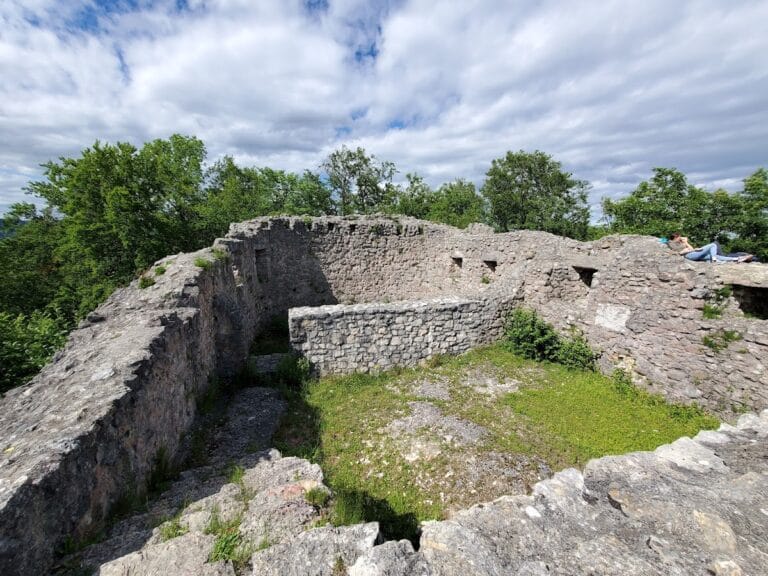
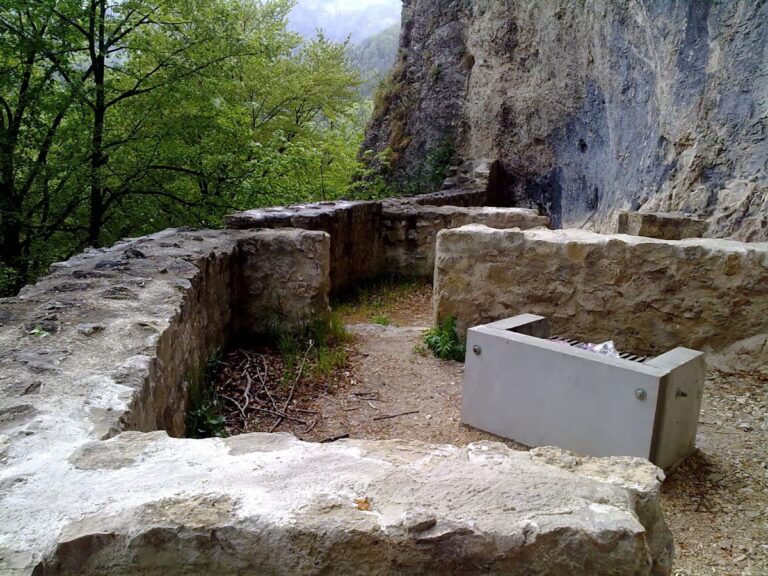
Frohburg occupies a long, high rocky ridge, or elongated plateau, in a commanding setting above the Erlimoos Pass and the Lower Hauenstein. The hilltop complex was enclosed by a masonry perimeter wall built before 1100. Restored sections of the southern wall survive within the wider ruin, allowing the castle’s defended outline to be understood.
A triangular advanced defensive work stood north of the main castle. Over successive building phases, the settlement expanded from a simple hall and wooden buildings into a more substantial complex with larger structures, towers, and a strengthened perimeter wall.
Residential and working areas
Count’s residence and service buildings
The built complex contained a count’s residence together with service buildings. Its earliest arrangement centered on a simple hall and timber buildings containing one or two rooms. Later construction enlarged the settlement and added more substantial structures, reflecting its development as the seat of a noble household and court.
Workshops and metal production
Workshops formed part of the castle complex. Archaeological evidence includes a small iron-smelting installation, where iron was extracted from ore by heating it in a furnace. This installation reflects the exploitation of iron as an important natural resource in the Jura. Bone-working was also practiced at the castle as a specialized craft.
Water cisterns
At least three cisterns served the complex. These constructed reservoirs collected and stored water, providing an important element of the castle’s physical infrastructure on its rocky ridge.
Nearby sites