Palais d’Antoniadis: A Nineteenth-Century Villa and Garden Estate in Alexandria
Site at a Glance
- Rating
- 4.2
- Popularity
- Low
- Country
- Egypt
- Primary era
- Modern
- External website
- Open
- Eras represented
- Classical, Modern
- Civilizations
- Egyptian, Ottoman, Ptolemaic
- Site type
- Domestic
- Remains
- Elite Residence
On this page14 sections
History
Palais d’Antoniadis is a nineteenth-century villa and garden estate in Alexandria, Egypt, commonly dated to around 1860 and associated with the city’s development under Muhammad Ali Pasha, the Ottoman governor who established a hereditary ruling dynasty in Egypt. Its gardens were shaped during the reign of his grandson, Khedive Ismail, and became a setting for elite gatherings, royal accommodation, and important political events.
Creation of the gardens and the Antoniadis family
In 1860, Khedive Ismail commissioned the French artist Paul Richard to create or develop the gardens as a miniature version of the Gardens of Versailles, the principal royal palace of the French monarchy near Paris. Ismail had visited Versailles and sought to reproduce its formal royal character in Alexandria. The grounds initially covered about 50 feddans and later expanded toward the area now occupied by Smoha.
Also around 1860, the property was acquired by Sir John Antoniadis, a wealthy Greek banker from Lemnos. He lived in the villa and used it for receptions and parties attended by Alexandria’s social elite. The gardens eventually took the Antoniadis name. John Antoniadis died in 1895, and his son Anthony inherited the estate. In 1918, Anthony donated the villa and gardens to the Municipality of Alexandria on the condition that they permanently retain the Antoniadis name.
Earlier associations and twentieth-century events
Some historians traditionally associate the gardens with the Ptolemaic period, when Egypt was ruled by the Greek-speaking Ptolemaic dynasty from 323 BC to 30 BC. They also connect the area with Eleusis, an ancient Alexandrian suburb sometimes described as the “Gardens of Paradise.” Important events involving Ptolemaic kings are associated with the wider area. Before the property was acquired by Muhammad Ali Pasha in the nineteenth century, it was known as the Basterieh Gardens.
During the twentieth century, the villa accommodated visiting royalty and dignitaries, including the kings of Greece, Belgium, France, Italy, and Albania. Zog I of Albania, who ruled until Italy invaded and occupied Albania in 1939, and Queen Geraldine stayed there after leaving their country. Princess Fawzia, daughter of King Fuad I of Egypt, also stayed at the villa with her husband Mohammad Reza Pahlavi during the early months of their marriage. Pahlavi later became the last shah of Iran.
The estate hosted several notable political and civic occasions. A tree was planted at the entrance to commemorate the 1936 Anglo-Egyptian Treaty. The villa also hosted the signing ceremony for the 1936 Egyptian-British agreement, the preparatory meeting for the establishment of the Arab League in 1944, and the first meeting of the Egyptian Olympic Committee.
Reorganization and modern preservation
After the 1952 Egyptian Revolution, part of the original grounds was incorporated into expansions of the Nouzha park and zoo. The villa experienced general neglect from about 1970 onward, although the gardens remained broadly well maintained.
In 2004, the villa and its front garden, covering about 2 feddans, were transferred to the Bibliotheca Alexandrina for development as a cultural centre and for the proposed Alexandria and Mediterranean Studies Center. The wider Antoniadis, Nouzha, and Flower gardens remained under the Ministry of Agriculture and were administered by the Horticultural Research Institute under a 1986 presidential decree. The villa has remained under restoration and has not opened for public activities or visits.
Remains
The estate stands near the Mahmoudia Canal at Alexandria’s southern entrance and forms part of a broader green zone of approximately 48 hectares. This zone includes the Antoniadis Garden, Flower Garden, zoo, botanical garden, and Nouzha or Nouzaba Garden. The villa and gardens combine French and English traditions with Arab-Islamic, Greek, Italian, geometric, and informal landscape designs.
Villa and archaeological remains
The villa
The villa has a lower level measuring 434 square metres, a ground floor of 1,085 square metres, an upper floor of 860 square metres, and a roof area of 480 square metres. Together, these areas give a reported total of 2,859 square metres. The ground and upper floors each contain 15 rooms. The building forms the architectural centre of the estate and is surrounded by the surviving front garden.
The underground tomb
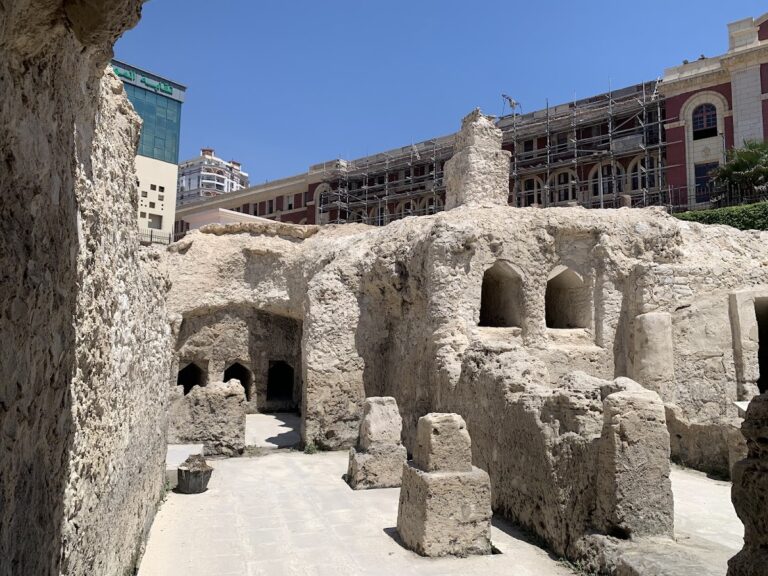
A tomb beneath the villa is approached by a deep staircase of 44 steps leading to an open landing. It is believed to date from the first century BC. The tomb consists of an open courtyard surrounded by rooms containing funerary objects and a funerary bed. Its chamber includes a painted representation of Agathodaimon, a Greco-Egyptian protective deity commonly shown as a serpent. The funerary bed is treated as a low-relief façade rather than simply as functional furniture. The serpent image and the garden setting have given rise to the popular name “Tomb of Adam and Eve.”
The cistern
A cistern is also among the archaeological remains associated with the villa.
Gardens and sculpture
Antoniadis Garden
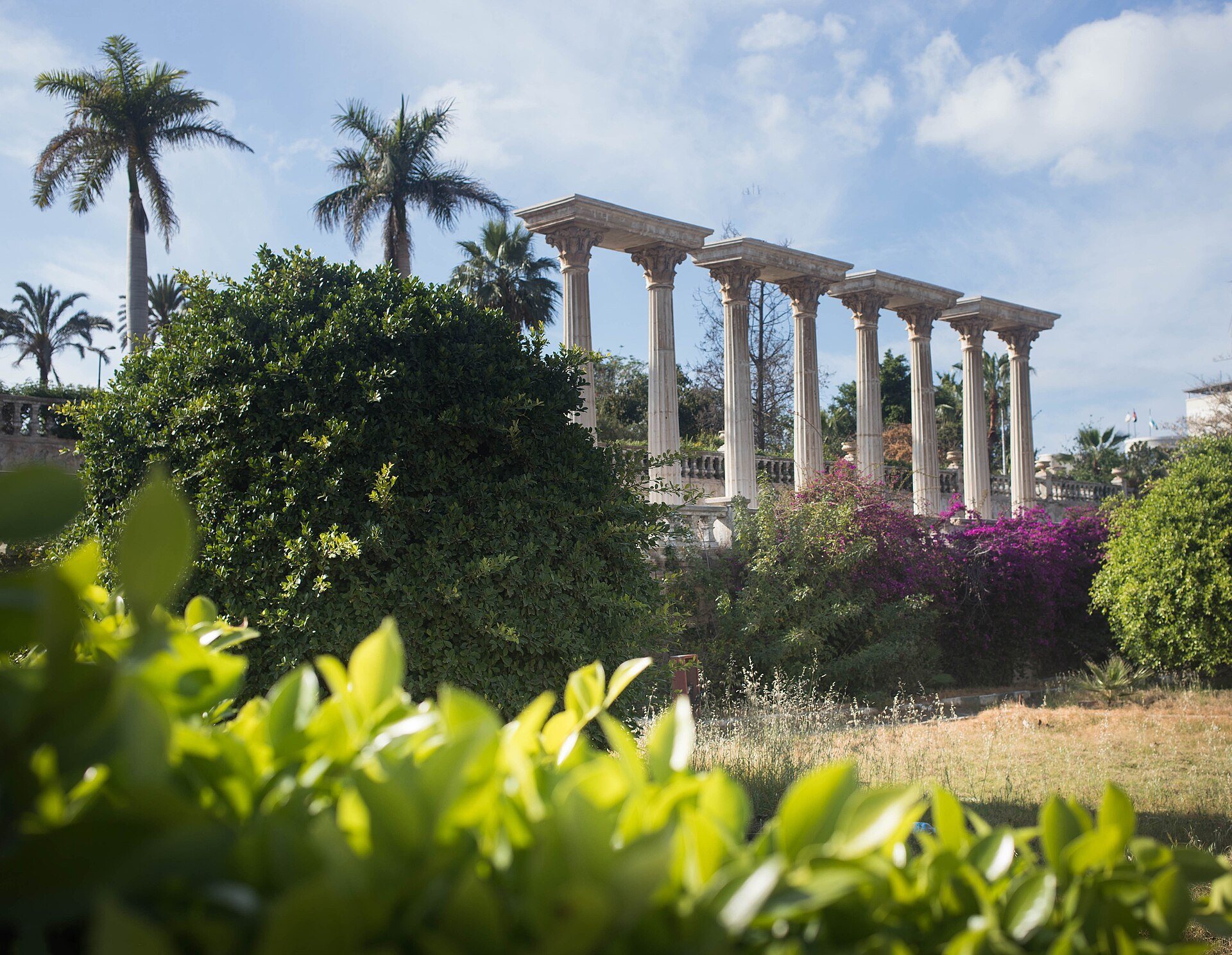
The Antoniadis Garden covers approximately 45 feddans and functions as a botanical garden with rare and long-established plant collections. Its tropical vegetation and historic plantings form part of the estate’s landscape. Botanical researchers continue plant development and exchange with botanical gardens in other countries. The gardens were also used to display John Antoniadis’s collection of Greek-style marble monuments.
Rose Garden
The Rose Garden was designed by a French engineer and covers about 5 feddans. It contains a fountain with a marble statue at its centre, together with numerous rare varieties of roses and other flowers.
Garden of Famous Men
The Garden of Famous Men contains life-size statues of Vasco da Gama, Christopher Columbus, Ferdinand Magellan, and Nelson. Other marble sculptures throughout the gardens include Venus holding a large mirror, statues representing the four seasons, and marble lions. The mirror is positioned to reflect the morning sunlight toward the villa’s southern windows.
Nouzha Garden and Antoniadis Theatre
The wider garden complex includes the Nouzha Garden and the Antoniadis Theatre. During a period of substantial garden development, the theatre hosted television evening events and celebrations of Alexandria’s national day.