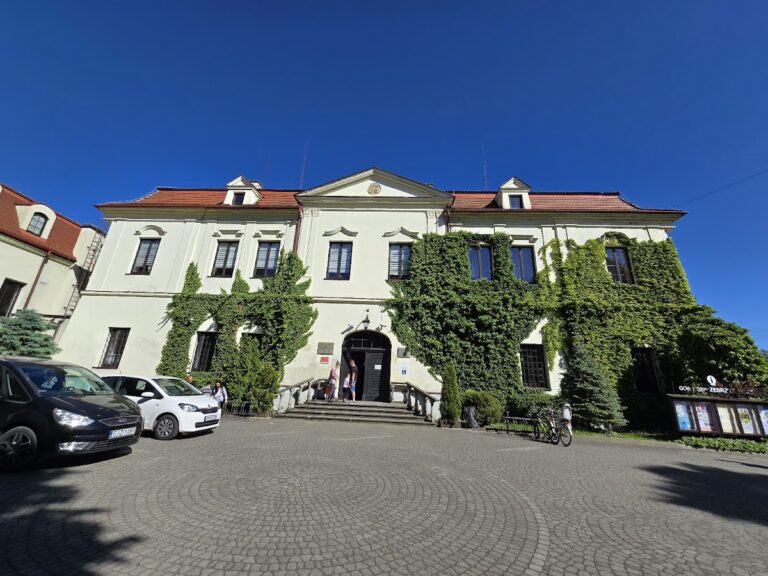
Castle in Wodzisław Śląski: From Medieval Stronghold to Classicist Palace


Site at a Glance
- Rating
- 4.7
- Popularity
- Low
- Country
- Poland
- Primary era
- Early Modern
- External website
- Open
- Eras represented
- Early Modern, Modern
- Civilizations
- Habsburg, Holy Roman Empire
- Site type
- Domestic
- Remains
- Elite Residence
On this page11 sections
History
Castle in Wodzisław Śląski is a medieval castle site and eighteenth-century palace in Poland, originating around 1257 under Duke Władysław of Opole and Racibórz and culminating in a residence shaped by French classicizing Baroque and emerging Classicism. It developed at the beginning of the town’s existence and later became the seat of the Wodzisław Museum.
Origins and the Medieval Castle
Before the castle was established, a defensive settlement probably stood at Old Wodzisław, also known as Grodzisko. The settlement was destroyed by the Tatars in 1241. The castle probably followed around 1257, when Duke Władysław of Opole and Racibórz founded it during the early development of the town.
The earliest suspected part of the castle is an earth mound in the Municipal Park, roughly 40 metres south of the palace. A wooden residential and defensive tower probably stood there. Robber knights burned the tower during the second half of the fifteenth century.
Duke Jan IV probably rebuilt the castle after moving to Wodzisław. A Silesian duke whose territories had included the Duchy of Krnov, Jan IV settled there after losing that duchy and spent the last nine years of his life in Wodzisław, until his death in 1483.
Sixteenth- and Seventeenth-Century Transformations
In 1502, King Władysław II Jagiellończyk granted the castle, the town, and the surrounding estates to his chancellor Jan Schellenberg as a reward for loyal service. The castle entered its most prosperous period during the sixteenth century.
By then, the complex included a gate, an armoury, and a multi-storey main building with chambers, bedrooms, a chancery, and a representative room. A kitchen, two stables, a woodshed, and a smithy stood around the principal building. A moat enclosed the complex, and a bridge provided access across it.
The Hungarian nobleman Jerzy Plawecki, owner of Plawca and Niedzica, bought the castle in 1602. Military operations associated with the Thirty Years’ War, a European conflict fought from 1618 to 1648, culminated locally in its destruction by Swedish forces in 1648. The castle was rebuilt, but it did not recover its earlier prosperity.
At the end of the seventeenth century, ownership passed to Georg Szelepcsényi, the Primate of Hungary, the country’s leading Catholic prelate, and then to Emperor Leopold I. In 1685, Leopold pledged the confiscated Wodzisław estates to his friend Prince Ferdinand Joseph von Dietrichstein for 75,000 gulden. The Dietrichsteins formally took possession in 1696 after paying a further 75,000 gulden. They belonged to a noble family of the Habsburg realms and became owners of the Wodzisław State Estate, a territorial lordship centred on the town and its surrounding lands.
The Dietrichstein Palace
The Dietrichsteins decided to replace the old castle with a new residence. Construction of the Dietrichstein Palace conventionally dates to 1742–1747, while the principal building work took place in 1744–1747. Count Guidobald Joseph von Dietrichstein, Ferdinand Joseph’s grandson, commissioned the project. The design was probably by the Moravian architect Anton Grimm.
The old castle was demolished and gardens were laid out on its site. Some of its stone may have been reused in the palace, although this remains uncertain. The new residence was intended to express the prestige of the Dietrichstein family and was probably the first Classicist building in the Polish lands. Classicism favoured symmetry, balanced proportions, restrained decoration, and forms associated with ancient Greece and Rome, while the palace also retained the compositional character of French classicizing Baroque.
The old castle continued to serve ceremonial purposes while the palace was being built. On 4 November 1743, Guidobald Joseph von Dietrichstein married Maria Gabriela Henckel von Donnersmarck there. In 1745, Wodzisław and almost all of Silesia became part of Prussia. A ceremony attended by local nobility and clergy took place at the castle in connection with the Peace of Dresden, the settlement that ended the Second Silesian War between Prussia and Austria and confirmed Prussian control over Silesia.
Municipal Use and the Museum
The Dietrichsteins retained the palace until 1772. It then changed owners every few years. During the town’s great fire in 1822, when the palace belonged to Ernest von Strachwitz, the roof and first floor burned. The building was renovated four years later.
From 1860 to 1881, Ernest Brauns allowed part of the palace to accommodate the municipal authorities. After his death in 1881, the entire building served as the seat of the magistrate, the town’s municipal governing authority, until 1974. The municipal authorities purchased the palace in 1906 and adapted it for offices and officials’ apartments. During the Second Polish Republic, the Polish state that existed from 1918 to 1939, and during the Second World War, the building also housed police headquarters.
The Wodzisław Museum was founded in 1971 from a regional chamber operated by the Society of Friends of the Wodzisław Region. It occupies the palace and presents the history of Wodzisław and its region. Its collections include archaeological, ethnographic, and historical objects from the district and surrounding area.
Comprehensive revitalization began in September 2018. On 19 August 2019, a cornice broke away and about 50 metres of scaffolding collapsed on the principal facade. Two construction workers were injured, the street and forecourt were blocked, and three parked cars were damaged. The building was officially returned to use on 30 July 2022. The palace had entered Poland’s register of monuments on 30 December 1966.
Remains
Palace and Former Castle Site
Former Castle Site
The former castle stood within a complex enclosed by a moat and reached by a bridge. After its demolition, the site was converted into palace gardens. The earth mound in the Municipal Park, approximately 40 metres south of the palace, represents the earliest suspected location associated with the castle and probably supported a wooden residential and defensive tower.
Palace Exterior
The surviving palace is a free-standing, two-storey masonry building with plastered walls and an elongated rectangular plan measuring approximately 52.8 by 17.3–17.4 metres. Its design combines French classicizing Baroque with Classicist qualities. The principal facade is symmetrical and 15 bays wide, with a slightly projecting three-bay entrance section. A cornice divides the ground floor from the upper storey, while the windows have surrounds and entablatures above them.
The entrance projection ends in a triangular pediment containing a cartouche with the arms of Guidobald von Dietrichstein and Maria Gabriela Henckel von Donnersmarck. Its semicircular portal is framed by paired pilasters that support a broken entablature. The park facade is 11 bays wide, and its projection is divided by fluted lesenes and topped by a pediment with an oculus.
Roof and Interior Arrangement
The tiled roof combines hipped and gabled forms. During the 2018–2022 reconstruction, its structure was altered and recreated as a broken Polish-type roof with dormer windows known as lukarnes and “ox eyes.” The work made two attic storeys usable.
The ground floor functions as the museum level and contains permanent exhibitions. The first floor now includes a representative hall, a concert hall for conferences and concerts attended by approximately 100–150 people, and rooms for temporary exhibitions about the Wodzisław region. The next floor contains administrative rooms, the SOWA Science and Technology Centre, which focuses on interactive learning and technology, and a multimedia room. The top floor provides museum workshop rooms, including spaces for archaeological work. The modernized building has threshold-free doors, a lift, and adapted toilets for people with disabilities.
Museum Exhibitions
The permanent exhibitions cover the prehistory of the Rybnik–Wodzisław region, the early medieval fortified settlement of the Golęszyce at Lubomia, and everyday life in a medieval town as presented through Wodzisław. Other displays address the “Wodzisław Witch,” a nineteenth-century bourgeois drawing room, the history of Silesian craftsmanship, and Wodzisław in the twentieth century.