Castle of Monteagudo: An Islamic Frontier Fortress in Spain


Site at a Glance
- Rating
- 4.1
- Popularity
- Low
- Country
- Spain
- Primary era
- Medieval
- Eras represented
- Medieval, Modern
- Civilizations
- Taifa Kingdoms, Taifa of Murcia
- Site type
- Military
- Remains
- Castle
On this page10 sections
History
Castle of Monteagudo is an Islamic-period fortress in Spain, built between the eleventh and twelfth centuries as part of the military landscape of Murcia. Rising above the northern edge of the Segura plain, it became a frontier stronghold, a royal residence and estate, and later a Castilian fortress facing the Kingdom of Valencia.
Islamic origins and the rule of Ibn Mardanis
The earliest documentary references place the fortification around 1078–1079, although its construction is generally dated to the eleventh or twelfth century. Monteagudo gained importance after Orihuela was incorporated into the taifa of Denia during the first half of the eleventh century. A taifa was an independent or semi-independent Muslim kingdom formed after the fragmentation of the Umayyad caliphate. Monteagudo then guarded the northeastern frontier of the first Muslim kingdom of Murcia. Abderramán Ibn Tahir, regarded as Murcia’s first Muslim king, was imprisoned at the fortress after he was dethroned.
The castle acquired its overall arrangement during the twelfth-century rule of Ibn Mardanis, also known as the Wolf King. He led Murcia’s resistance to the Almohads, a North African dynasty that expanded across much of Muslim Iberia. The fortress formed part of a wider complex with the Castillejo of Monteagudo, a nearby recreational palace known as Qasr Ibn Sad, and the fortress of Larache. Together, these sites supported Murcia while it remained a centre of resistance to Almohad expansion.
Ibn Mardanis suffered a major defeat against the Almohads in 1165 and was forced to abandon Monteagudo. The fortress was subsequently plundered. Shortly before the Christian conquest, the poet Hazim al-Qartayanni praised its high profile above the plain of the Segura valley in his Qasida maqsura.
Castilian control and the frontier
Murcia entered the protection of the Crown of Castile in 1243 through the Treaty of Alcaraz, an agreement that established Castilian authority before the kingdom’s final Christian conquest. Alfonso X, known as Alfonso the Wise, established a Murcian residence at Monteagudo and visited it in 1257. Its position outside Murcia and its suitability as a residence led him to prefer it to the city’s principal citadel, while Murcia itself remained predominantly Muslim until the definitive conquest in 1266.
The precise location of Alfonso X’s residence in 1257 remains uncertain. Excavations in 2018 on the flat ground beside the Castillejo revealed a building phase from the late twelfth or early thirteenth century that remained in use after the Treaty of Alcaraz. This evidence suggests that the palace complex may have housed Alfonso and his court rather than the castle itself.
During the second half of the thirteenth century, Monteagudo Castle, the Castillejo and Larache made up the principal elements of the Real de Monteagudo. A real was a royal estate or domain. It was the most important royal grant made during the distribution of Murcia’s irrigated territory. Alfonso X granted the estate to his wife, Violante of Aragon, and it later passed to Maria de Molina.
In 1304, conflict between Castile and Aragon over Murcia led to the incorporation of the Vinalopo Valley and part of the lower Segura basin into the Kingdom of Valencia, an Aragonese territory. Monteagudo consequently became a principal Castilian frontier fortress facing the Aragonese Governorate of Orihuela. It also guarded the Royal Road between Murcia and Orihuela.
Later military and archaeological history
The fortress took part in several military actions during the later Middle Ages and retained military importance in the sixteenth century. Philip II’s topographical surveys included Monteagudo among the fortifications of the Spanish monarchy. Its strategic value later declined as warfare along the Castile-Aragon frontier diminished. After the Christian conquest, the site also came under the control of the Spanish royal household and housed people associated with the king.
Archaeological work has traced occupation of the hill back to the Bronze Age, around 2000 BC. Excavations recovered Bronze Age burial urns and pottery fragments, together with cultural remains associated with Iberian and Roman occupation. Historians have proposed that a Roman town once stood at the foot of Monteagudo, but that settlement is thought to have disappeared during the wars between the Byzantines and the Visigoths.
Restoration and archaeological excavation have shaped the modern understanding of the fortress. Castle of Monteagudo was declared a National Monument and an Asset of Cultural Interest in 1931.
Remains
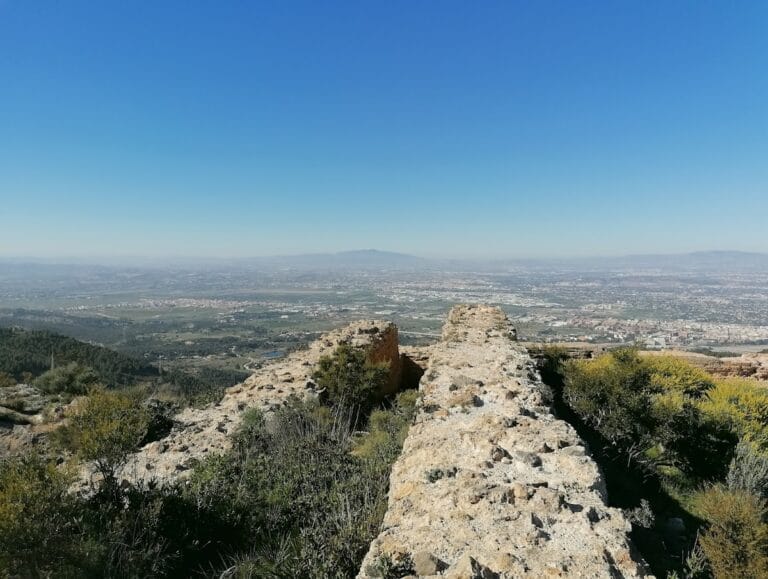
The castle occupies the summit of a prominent limestone spur that rises to approximately 149 metres above sea level. From this position at the northern edge of the Segura plain, the fortress overlooks the Huerta of Murcia and the Segura valley. Its defences are arranged in two concentric walled enclosures built mainly with high-quality rammed mortar, formed in successive sections using moulds about 80 centimetres high. Brick appears in some parts of the walls and their bases.
The two fortified enclosures
Upper enclosure
The upper enclosure occupies the highest part of the rocky spur and follows an approximately rectangular plan measuring about 50 by 25 metres. Closely spaced cubic towers reinforce its walls as structural supports adapted to the uneven ground. At the corners, the towers are set at inward angles rather than arranged as conventional projecting corner towers. Inside, the enclosure was divided between a parade ground and a northern sector containing rooms and ancillary spaces. The entrance to the northern sector is partly destroyed but retains a prominent opening with a horseshoe arch, whose curve extends beyond a semicircle and is characteristic of Islamic architectural traditions.
Lower enclosure
The lower enclosure extended mainly across the northeastern part of the hill. Its surrounding wall was strengthened by closely placed towers, while access passed through bent entrances and corridors overlooked by several defensive structures. One tower was associated with a natural shaft used to obtain water for the garrison. Springs, storage areas and other rooms were also connected with this lower part of the fortress.
The summit monument
A 14-metre-high monument to the Sacred Heart of Jesus now stands on the summit above the valley. Nicolás Martínez designed the present statue in 1951. It replaced an earlier sculptural group erected in 1926 by Anastasio Martínez Hernández with the patronage of Murcia’s mayor, Francisco Martínez García. That earlier monument was destroyed in 1936 during the Spanish Civil War, and the replacement was financed through contributions from members of Murcia’s upper society. The current statue remains an important object of local devotion. A legal attempt to remove it from the summit was rejected by the High Court of Justice of Madrid, which held that it formed part of Murcia’s cultural tradition as well as serving as a religious symbol.
Road beneath the fortress
The old Monteagudo road runs below the fortress and connects routes leading toward Alicante and Castile, reinforcing the site’s historical relationship with movement across the Murcia frontier.