Palace of Anna Vasa in Brodnica: A Renaissance Royal Residence in Poland


Site at a Glance
- Rating
- 4.6
- Popularity
- Low
- Country
- Poland
- Primary era
- Early Modern
- External website
- Open
- Eras represented
- Medieval, Early Modern
- Civilizations
- Kingdom of Poland, Polish–Lithuanian Commonwealth, Teutonic Order
- Site type
- Domestic
- Remains
- Palace
On this page6 sections
History
The Palace of Anna Vasa in Brodnica is a late-Renaissance palace in Poland, commissioned before 1564 by Rafał Działyński, the royal administrative official who governed the Brodnica estate. Its construction followed the fire of 1550, which damaged the Teutonic castle, and incorporated surviving walls and buildings from the castle’s outer bailey. The palace therefore continued a site associated with the fourteenth-century castle built during the rule of the Teutonic Order, a medieval religious-military order that controlled territories around the southeastern Baltic.
From Teutonic castle to Renaissance residence
Działyński’s palace replaced the damaged medieval setting with a residence in the Renaissance style, more specifically its later Renaissance form. In the first half of the seventeenth century, the building was remodeled into a more modern residence. This work was initiated by Anna Vasa and was influenced by Scandinavian palaces, presumably recalling buildings she had known in Sweden. A further expansion took place between 1678 and 1698, and the palace was subsequently rebuilt in the Baroque style, a seventeenth- and eighteenth-century form known for dynamic shapes, elaborate decoration, and theatrical spatial effects.
Anna Vasa’s residence and intellectual circle
In 1605, King Sigismund III Vasa granted the palace and the Brodnica estate to his sister, Princess Anna Vasa. She assumed the Brodnica starosty, an office responsible for governing a royal territory or estate in the Polish-Lithuanian Commonwealth, and lived at the palace until her death. Her Lutheran faith, a Protestant Christian tradition based on the teachings of Martin Luther, contributed to her departure from the royal court in Krakow, where religious tensions were frequent.
Under Anna, Brodnica became a religiously tolerant intellectual center. She hosted and supported scholars and writers, corresponded extensively with learned figures, and pursued particular interests in religion and botany. Szymon Syreniusz, a professor at the Krakow Academy, dedicated the first Polish herbal to her. Published in 1613, the work was made possible in part by Anna’s financial support.
Anna died in Brodnica on 26 February 1625 after a long illness. Her body remained there for eleven years before her ceremonial burial in Toruń. The palace continued to be associated with members of the royal and aristocratic elite, including Constance of Habsburg, Anna Catherine Constance Vasa, Cecilia Renata of Austria, and Maria Casimira d’Arquien. Franciszek Bieliński, grand marshal of the Crown from 1742 and Crown court marshal, and Andrzej Hieronim Zamoyski, grand chancellor of the Crown, also lived there.
Later uses and destruction
Napoleon Bonaparte may have stayed in the palace for two days while passing through Brodnica in early 1807, although this attribution remains uncertain. During the interwar period, the building housed a commercial secondary school, a public school, a music school, and other educational institutions.
In January 1945, during the Second World War, Soviet soldiers set fire to the palace, and the building burned completely. It was reconstructed between 1960 and 1970 for the District Cultural Center and a library. After the cultural center moved to a new facility in 1986, the reconstructed palace became the seat of the Regional Museum in Brodnica. It now houses the Ignacy Łyskowski Municipal and District Public Library and the Civil Registry Office wedding hall. The building is protected as an architectural monument under registration number A/476/147.
Remains
Reconstructed palace and castle fabric
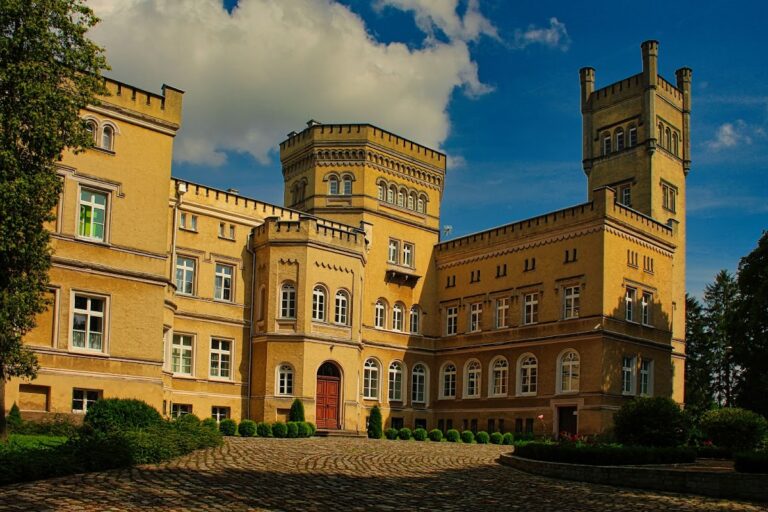
The surviving building is a postwar reconstruction of a late-Renaissance palace that had incorporated remnants of an earlier Gothic castle complex. Fragments of medieval masonry and buildings from the former outer bailey formed part of the site’s physical foundation. The earlier castle fabric is associated with the fourteenth century and the period of Teutonic rule, while the palace itself originated before 1564 and was remodeled in the first half of the seventeenth century.
The residence was expanded between 1678 and 1698 and later given a Baroque reconstruction, producing a building with several historical layers. Its complete destruction by fire in 1945 means that the present structure incorporates the reconstruction carried out from 1960 to 1970. The palace’s physical character consequently combines the memory of the Gothic castle complex, the Renaissance residence commissioned by Działyński, later Baroque alterations, and the rebuilt form used by civic and cultural institutions today.
Nearby sites