Palace in Nowizna: A Historic Estate Complex in Poland


Site at a Glance
- Rating
- 4.6
- Popularity
- Low
- Country
- Poland
- Primary era
- Early Modern
- Eras represented
- Early Modern, Modern
- Civilizations
- German, Habsburg, Holy Roman Empire
- Site type
- Domestic
- Remains
- Elite Residence
On this page11 sections
History
The Palace in Nowizna is a historic estate complex in Poland, founded as a castle for the Schellendorf noble family in the sixteenth century and represented today by a building described as a seventeenth-century construction. Its later form reflects repeated expansions, including Neo-Gothic work in the nineteenth century, a revival style inspired by medieval Gothic architecture.
Foundation and early owners
The earliest castle at Nowizna was commissioned in 1565 by the Schellendorf family. Bernhard von Schelndorf, lord of Nowizna and Mościsko, died in 1593. Ownership then passed through members of the same family, including Niclas von Schelndorf in 1602 and Friedrich von Schelndorf.
The von Czettritz family later held the estate. Friedrich von Czettritz died in 1657, while Ernst, Sigmund, Hans, and Ernst Albrecht von Czettritz were recorded at Nowizna in 1677. Charlotte von Gellhorn was associated with the property in 1770, after which it passed to Christian Friedrich, Count of Stolberg-Wernigerode, and then to Ferdinand von Stolberg-Wernigerode.
Nineteenth-century expansion
During the eighteenth and nineteenth centuries, the estate changed hands among the von Czettritz, von Gellhorn, and Stolberg-Wernigerode families. In 1870 it belonged to Count Friedrich Wilhelm von Perponcher-Sedlnitzky, a royal court marshal in Berlin and former envoy in The Hague. The palace was named Wilhelmsburg after him.
Under Wilhelm von Perponcher-Sedlnitzky, Neo-Gothic estate and service buildings were added. His son Alexander von Perponcher-Sedlnitzky, who was married to Countess Róża Zofia Żeleńska de Zelonka, continued the estate’s expansion in the early twentieth century. Wilhelm and Alexander were recorded as owners in 1890.
War, postwar use, and restoration
Before the end of the Second World War, library holdings from Breslau, the historical German name for the present-day Polish city of Wrocław, were evacuated to the palace. After the Red Army occupied the building, the holdings were destroyed. The palace was looted and later used as housing.
In 1945 and 1946 the palace was occupied by the Soviet Army. It was subsequently used by a local village head and by the municipal cooperative Samopomoc Chłopska. The building deteriorated before being privatized and carefully restored. A new owner recorded from 2007 onward has undertaken further renovation.
The palace and park remain a historic complex. The park dates from 1820. The palace entered the register of immovable monuments of the Lower Silesian Voivodeship on 8 November 1980, followed by the park on 18 September 1981.
Remains
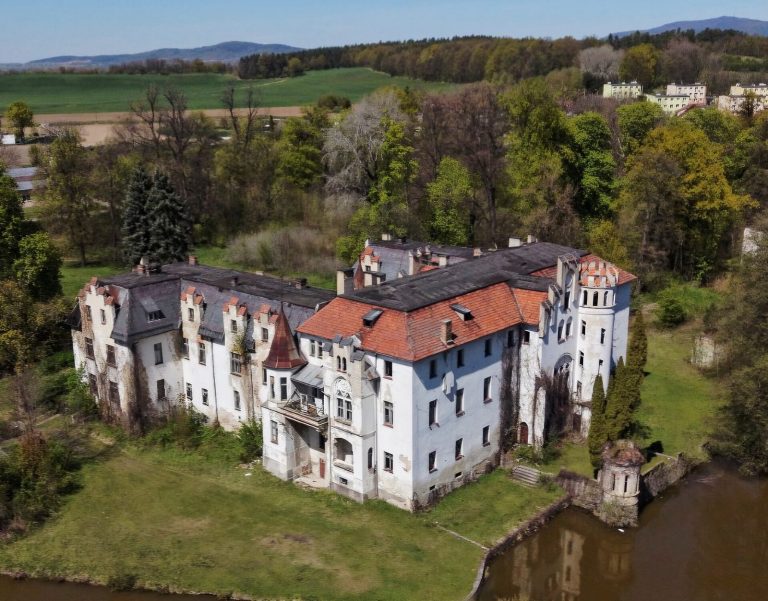
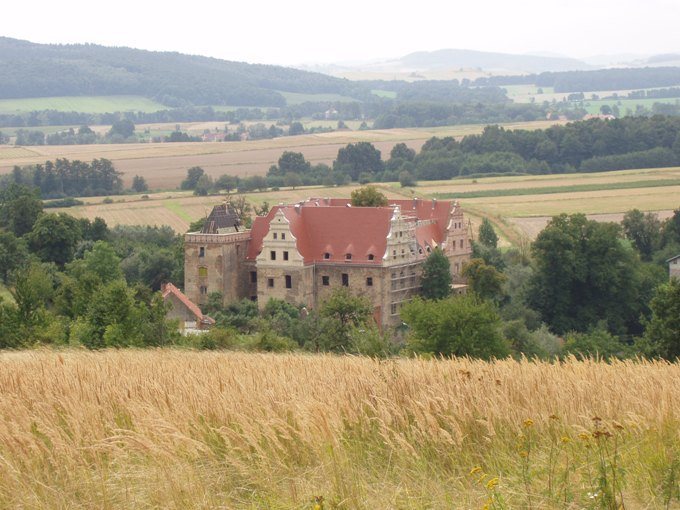
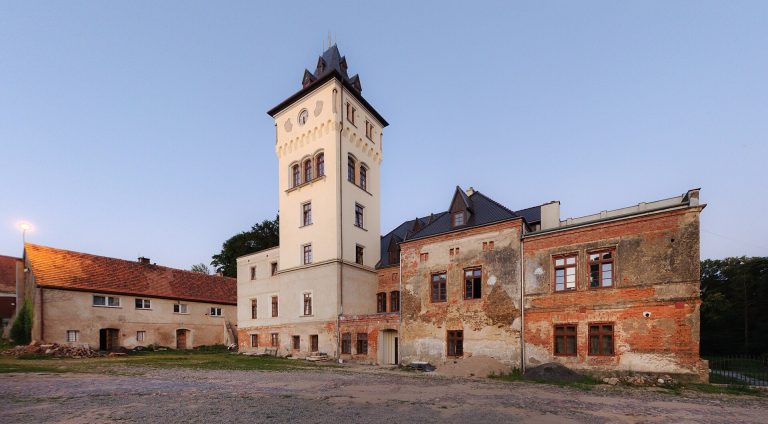
The surviving complex centers on a two-storey palace with a mansard roof, whose lower roof slope is steeper than the upper one, and dormers, which are windows projecting from the roof. Its building core contains sixteenth-century vaulted rooms, while later additions extend around it. The palace stands with associated estate and service buildings, including a granary, within a park dating from 1820.
Palace structure and entrance
Main palace
The palace’s sixteenth-century core is enclosed within a building expanded during the nineteenth and twentieth centuries. Three turret-like additions surround the core, and a tower-like projecting section, or avant-corps, extends from the main wall. A flat-roofed side annex forms another later addition.
Corner structures and porch
Two forward-set corner structures flank the main building. The left structure has a tower roof, while the right has a Renaissance gable facing the front and a gabled roof. The central entrance lies within a porch. Above it, the pediment carries a cartouche, an ornamental framed panel, with the von Perponcher-Sedlnitzky coat of arms. Two vases on pedestals flank the entrance.
Heraldic and memorial features
Family coats of arms
The front wall of the left corner structure bears the coat of arms of the Gellhorn family, which owned the palace in the seventeenth and eighteenth centuries. The right corner structure carries the coat of arms of Barbara von Nostitz, the wife of Friedrich von Schelndorf. The pediment of the estate granary displays the coats of arms of Perponcher-Sedlnitzky and Ciołek.
Bernhard von Schellendorff’s epitaph
The palace contains a replica of Bernhard von Schellendorff’s epitaph, a commemorative monument honoring the deceased. The original came from the Church of the Sacred Heart of Jesus in Nowizna. Its inscription records his death in 1593, identifies him as lord of Nowizna and Mościsko and of other estates whose names are partly illegible, and states that he would rise again on the Day of Judgment.