Palace in Ciszyca: A Historic Residence in Poland


Site at a Glance
- Rating
- 3.6
- Popularity
- Very Low
- Country
- Poland
- Primary era
- Early Modern
- Eras represented
- Early Modern, Modern
- Civilizations
- Holy Roman Empire, Kingdom of Prussia
- Site type
- Domestic
- Remains
- Elite Residence
On this page12 sections
History
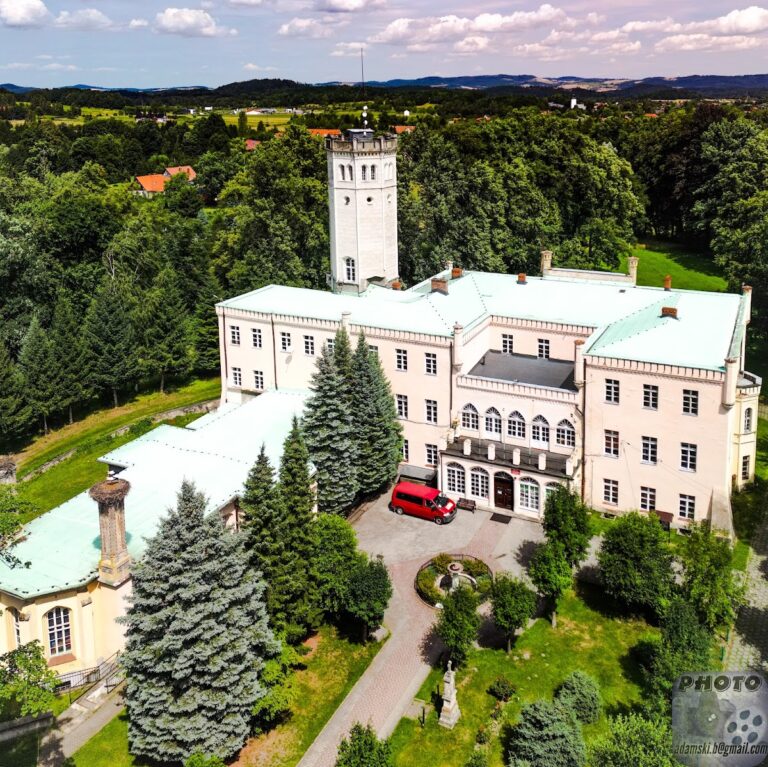
Palace in Ciszyca is a historic residence in Poland, located in the municipality of Mysłakowice in the northeastern Jelenia Góra Valley, at the foot of Radziwiłówka hill. Its early development began in the 1790s in the Empire style, a late form of Neoclassicism known for monumental classical ornament, and the building was remodelled in the Classical style after 1800.
Early ownership and development
The first known owner of the estate was Count Malzan. In 1790, Karl Georg von Hoym, a Silesian statesman and provincial minister, acquired the property. The palace and its surrounding estate were developed during the following decade, then given a Classical remodelling after the turn of the nineteenth century.
The Radziwiłł residence
After leasing the manor for three years, Prince Antoni Henryk Radziwiłł purchased Ciszyca in 1825. A Polish aristocrat and statesman, he served as governor of the Grand Duchy of Posen from 1815 to 1833. During his ownership, the interiors were renovated under the influence of Karl Friedrich Schinkel, the leading Prussian architect and designer whose work shaped nineteenth-century Classical architecture and interiors.
Ciszyca was also connected with the Prussian royal family. Prince Wilhelm of Prussia, brother of the reigning king, and his wife visited the estate. Following Antoni Radziwiłł’s death in 1833 and the death of his wife, Louise of Prussia, the property passed to their daughter Eliza. She had been engaged in her youth to Prince Wilhelm and lived at Ciszyca until her death in 1834.
Later family ownership
The estate then passed to Eliza’s sister Wanda, who was married to Prince Adam Czartoryski. The descendants of Wanda and Adam Czartoryski, members of prominent aristocratic families of the Polish-Lithuanian political tradition, retained Ciszyca until family ownership ended during the 1920s.
Baron von Stein-Äcker acquired the estate in the 1920s and renovated the palace. During the 1930s, it belonged to Solly Edelmann. In 1938, the estate was used as the setting for a film about the romance between Eliza Radziwiłł and Prince Wilhelm.
Twentieth-century changes
After the territory was transferred to Poland in 1945, the palace became a holiday home. It has been privately owned since 1990. Palace in Ciszyca is entered in the heritage register under number 652/J, with registration dated 7 August 1980.
Remains
The residence is a simple two-storey building on a rectangular plan, covered by a hipped mansard roof with dormer windows. Its southeast and southwest elevations each contain seven window axes, meaning seven vertical alignments of openings, while the side elevations have five. A flat strip cornice runs horizontally between the floors. The building stands within a landscape garden extending toward Radziwiłówka hill.
Palace buildings
Main palace
The principal facade has a slightly projecting three-axis central risalit, a section of wall that extends a little beyond the main facade. Its upper part carries Empire-style ornament and a cornice topped by a block frieze. A terrace formerly supported a balcony on four Doric columns. Decorative rendered window sills once enriched the facades, which are now covered with roughcast render. Inside, faceted ceiling panels and parts of the early nineteenth-century woodwork survive, including windows and doors.
Service building
A two-storey service building adjoins the palace on the northwest side. Its ground floor is built of masonry, while the upper floor uses timber framing, giving the secondary structure a different construction from the main residence.
Garden and hill features
Landscape garden
The landscape garden was laid out to enhance walks toward Radziwiłówka hill. It is now neglected, but several historic trees remain. They include an American tulip tree approximately 18 metres tall and around 250 years old, Weymouth pines more than 200 years old, two European beeches, and a pedunculate oak of a conical variety.
Grotto and viewing tower
An artificial grotto stands halfway up Radziwiłówka hill. At the summit, remains of a viewing tower survive, extending the designed landscape beyond the immediate grounds of the palace.