Our Lady’s Church: A Gothic Parish Church in Frankenberg, Germany
Site at a Glance
- Rating
- 4.6
- Popularity
- Low
- Country
- Germany
- Primary era
- Medieval
- External website
- Open
- Eras represented
- Medieval
- Civilizations
- Holy Roman Empire
- Site type
- Religious
- Remains
- Church
On this page10 sections
History
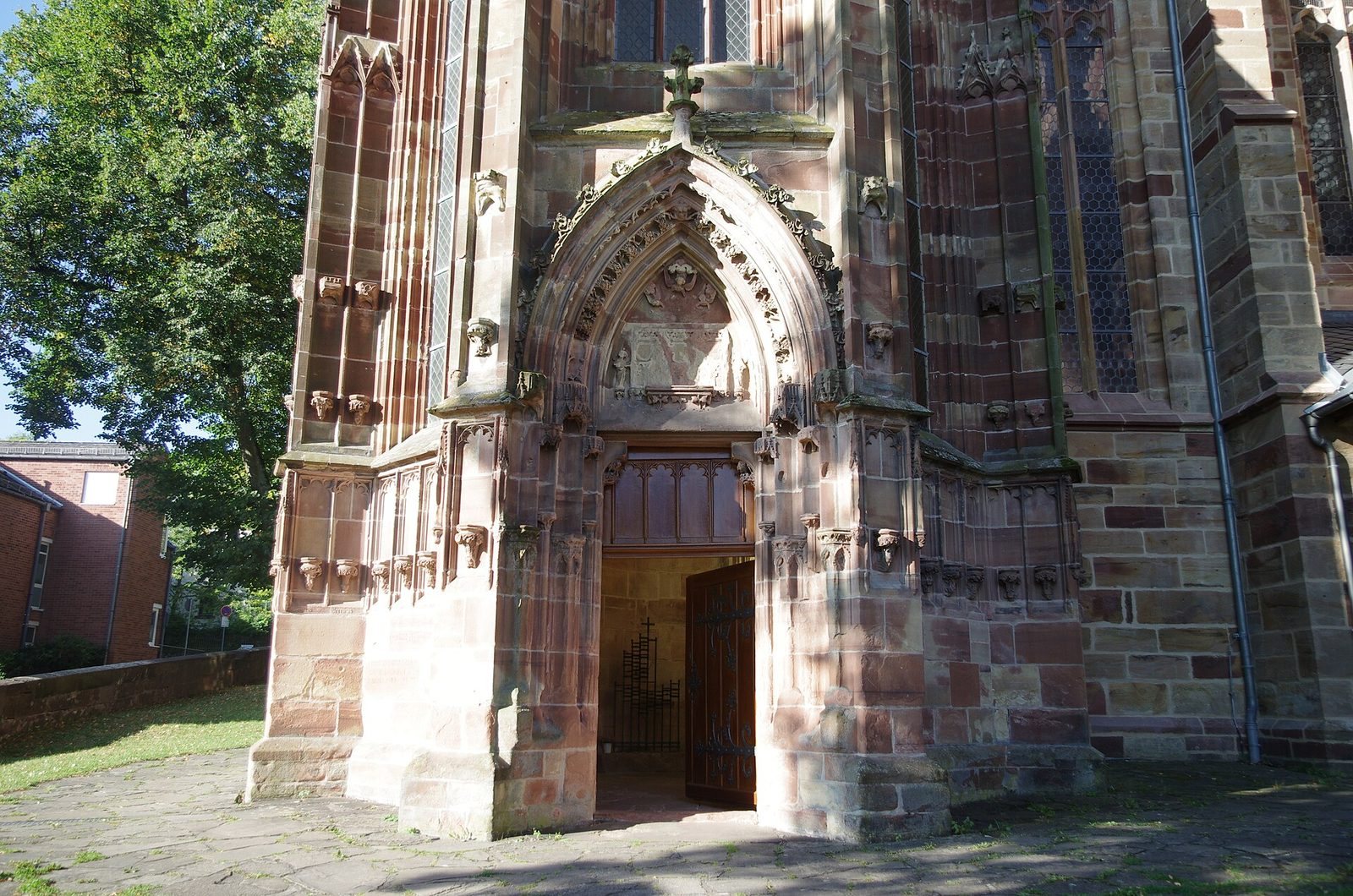
Our Lady’s Church is a Gothic three-nave church in Frankenberg, Germany, built in 1286 and modeled on the Church of St. Elisabeth in nearby Marburg. Its foundation tradition links it to Landgrave Heinrich I of Hesse, the grandson of Saint Elisabeth of Thuringia, a thirteenth-century Christian princess known for her charitable religious life. A memorial stone at the entrance states that Heinrich laid the foundation stone in April 1286, and the church was dedicated to Mary, the Mother of God.
Foundation and medieval development
The church is believed to have been built by the same workshop that constructed the Marburg church, after the entire building team moved to Frankenberg at Heinrich’s request. The attached Chapel of Mary, associated with Tyle von Frankenberg, was probably completed around 1380. Together, the church and chapel formed a major medieval religious complex in the town.
The fire of 1476 and rebuilding
In 1476, a devastating fire destroyed the church’s original furnishings. It began in the small tower above the choir, where the lead roof melted, and then spread through the choir, the Chapel of Mary, and the main tower. Seven bells were destroyed, including a particularly renowned bell. Melted lead and solder severely damaged the stained-glass windows, while burning material fell through openings in the vault onto the altars, pews, organ, and clock. Young men helped fight the flames with holy water.
After the disaster, Landgrave Heinrich III appealed for donations throughout Hesse to support reconstruction. The vaults were painted in 1478, and their guild symbols point to the contribution of local guilds. These decorations remain an important reminder of the rebuilding that followed the fire.
Confessional changes
Following the Reformation in Hesse, the church became Protestant. When Frankenberg passed to Hesse-Kassel during the division of the Landgraviate of Hesse-Marburg in 1604, Landgrave Moritz enforced a strict prohibition on religious images in keeping with his Reformed beliefs. In 1606, numerous sculptures and other Christian artworks were destroyed.
In 1624, Marburg and Frankenberg became part of Hesse-Darmstadt, and the church consequently became Lutheran again. Lutheran and Reformed churches both emerged from the Protestant Reformation but developed different doctrines and forms of worship, including different approaches to religious images. The church remained Lutheran after Frankenberg returned to Hesse-Kassel. From 1662, a Reformed congregation began forming at the Hospital Church.
Later preservation and the organ
Some sculptures spared in 1606 are preserved in the district local-history museum at St. George’s Monastery. The museum also houses carved beam heads made by Philipp Soldan for the church gallery, which was removed in the mid-nineteenth century. In the twentieth century, an earlier Seuffert organ from the dissolved Grafschaft Monastery was replaced by a large instrument built in 1970 and 1971 by the Frankenberg firm Wolfgang Böttner.
Remains
Church structure and chapel
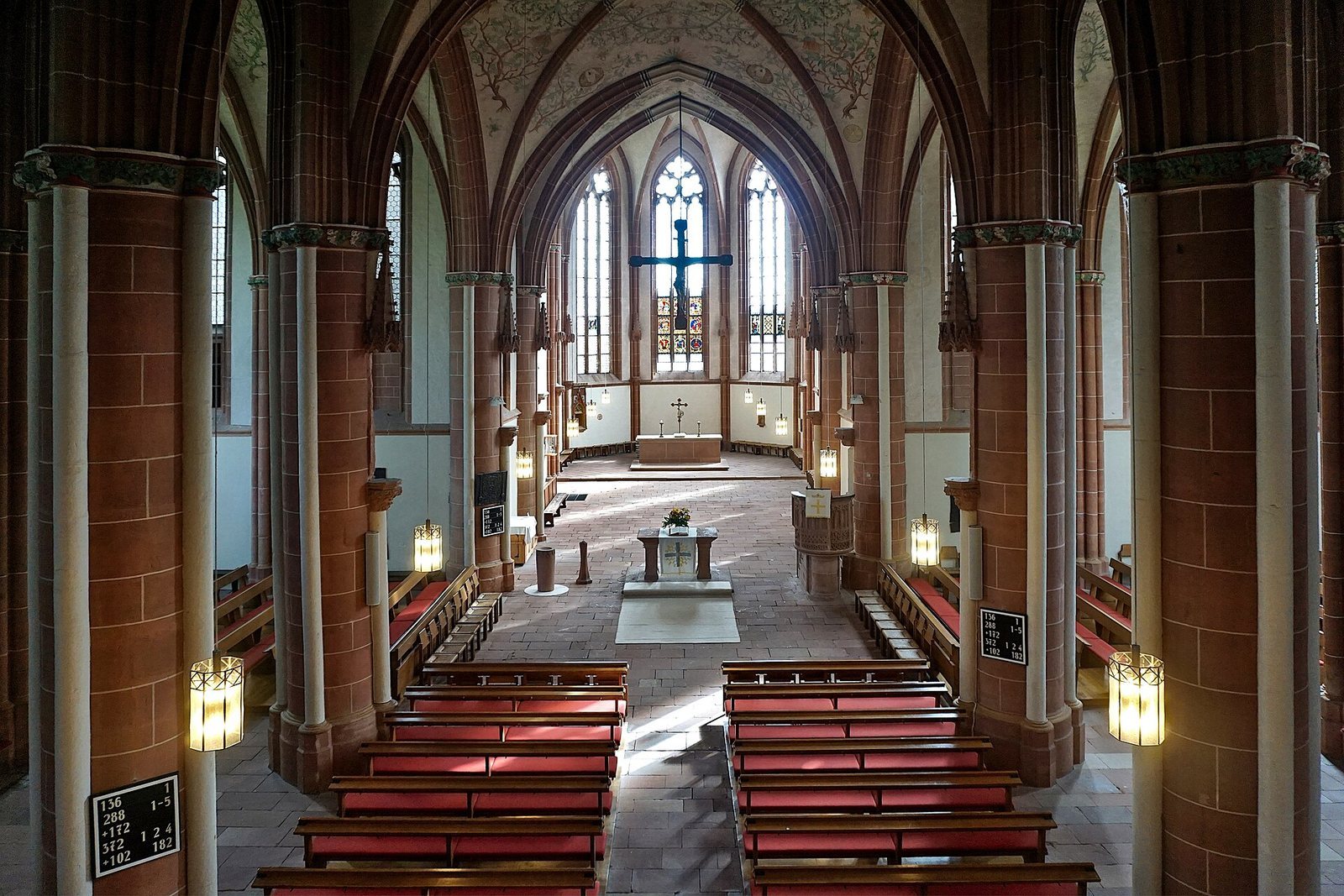
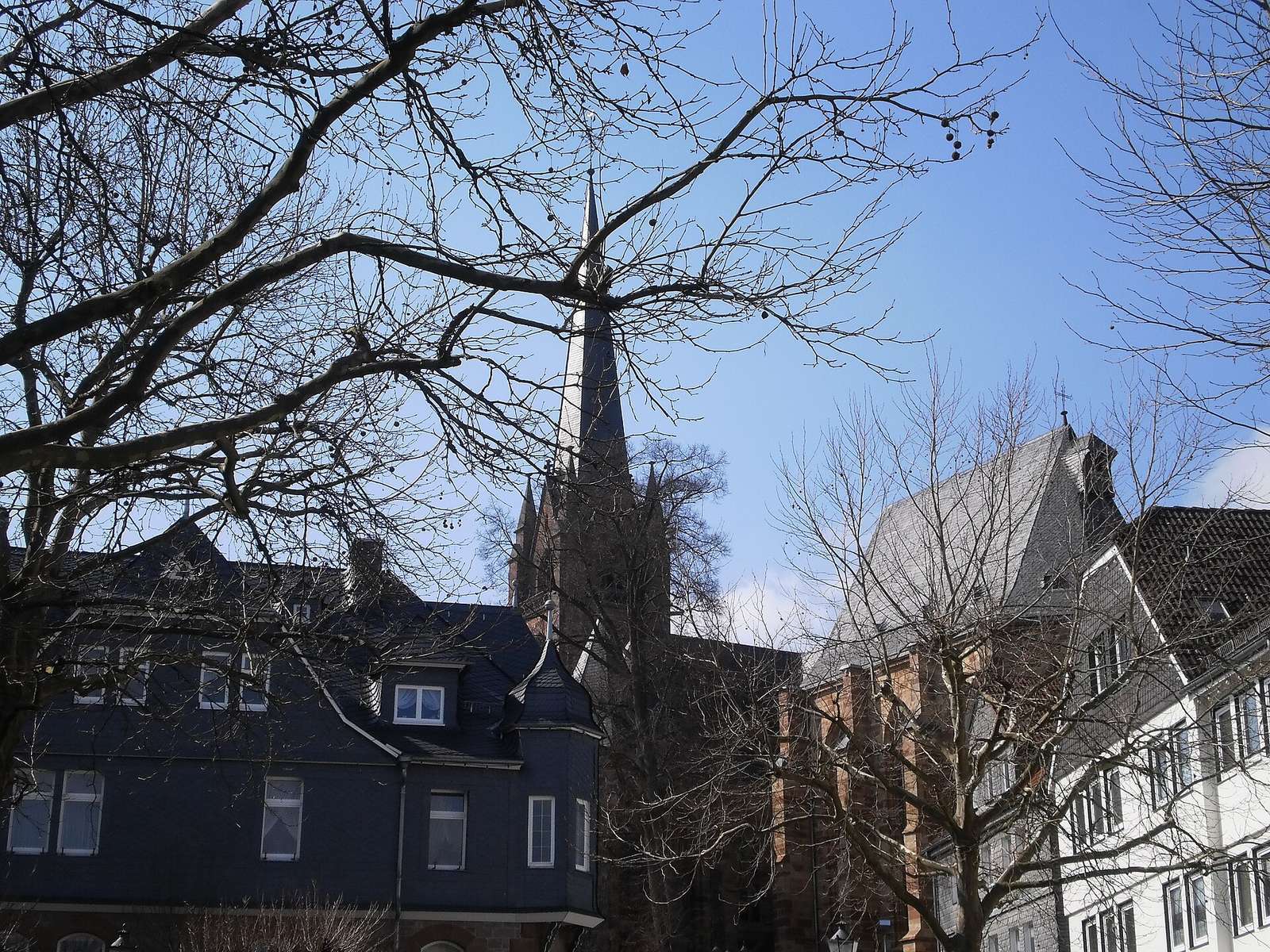
Our Lady’s Church has three naves and measures 60.40 metres in length and 17.40 metres in overall width. Its tower rises 61.30 metres. The attached Chapel of Mary contains a stone altar wall 6.50 metres high, forming a distinct architectural element alongside the main church.
Vaults and interior decoration
The vaults carry painted green foliage and brightly coloured flowers. Individual vault sections also contain guild symbols, while a small image of Mary with the Child survives in one vault spandrel. Later layers covered the paintings until restoration work in 1957 uncovered them again.
Choir furnishings
The choir contains Gothic stained-glass panels from the mid-fourteenth century, a relief-like representation of the story of Gethsemane, a sacrament house, and a stone pulpit dated 1554. A sacrament house is a fixed architectural receptacle for the consecrated Eucharistic elements.
Organ and preserved carvings
The present organ is a slider-chest instrument with 41 stops distributed across three manuals and a pedal. Its stop action is electric, and it contains 2,950 pipes. The carved beam heads made by Philipp Soldan originally formed part of the church gallery. After the gallery’s removal in the mid-nineteenth century, they were preserved at the district local-history museum in St. George’s Monastery, alongside sculptures saved from the 1606 destruction.