Burg Lichtenfels: A Hilltop Castle in Germany

Site at a Glance
- Rating
- 4.3
- Popularity
- Very Low
- Country
- Germany
- Primary era
- Medieval
- Eras represented
- Medieval
- Civilizations
- Holy Roman Empire
- Site type
- Military
- Remains
- Castle
On this page5 sections
History
Burg Lichtenfels is a restored hilltop castle in Germany, founded in 1189 by Witukind von Spiegel zum Desenberg, the abbot of Corvey, a major Benedictine abbey and ecclesiastical principality in medieval northwestern Germany. The fortification was built to protect Corvey’s lands, but it was destroyed soon afterward. Between 1223 and 1230, Abbot Hermann I von Holte ordered its reconstruction.
Transfer to Waldeck
On 21 July 1267, Corvey pledged Burg Lichtenfels and other possessions to Count Adolf I of Waldeck. In this context, a pledge meant that control of property was transferred temporarily as security for a debt or political obligation. After prolonged feuds, Corvey permanently conceded the castle to Count Otto I of Waldeck in 1297.
The Nymmes family was among the castle’s Burgmann families. A Burgmann was a knight or castle official responsible for service and defense, often in return for rights or property. The Nymmes family held Burg Lichtenfels and the territory between the Orke, Hof Treisbach, and the castle as pledged property, and this territory also passed to Waldeck. From 1413, a branch of the von Dalwigk family, vassals of the counts of Waldeck, held the castle as a long-standing seat.
Settlement and destruction
During the Middle Ages, a valley settlement with a church belonged to the castle. It was known as Eisenbeck in the fourteenth century and at the end of the eighteenth century, while the form Ensenbecke was used in 1598. The present village of Dalwigksthal was established only in 1851.
The archbishops of Cologne, acting as dukes of Westphalia, repeatedly asserted claims to the nearby settlements of Münden, Neukirchen, and Rhadern. Legal disputes and fighting during the sixteenth and seventeenth centuries devastated the surrounding lands and probably caused Burg Lichtenfels to be destroyed again at the beginning of the seventeenth century. The castle was partially rebuilt in 1631.
Modern restoration and use
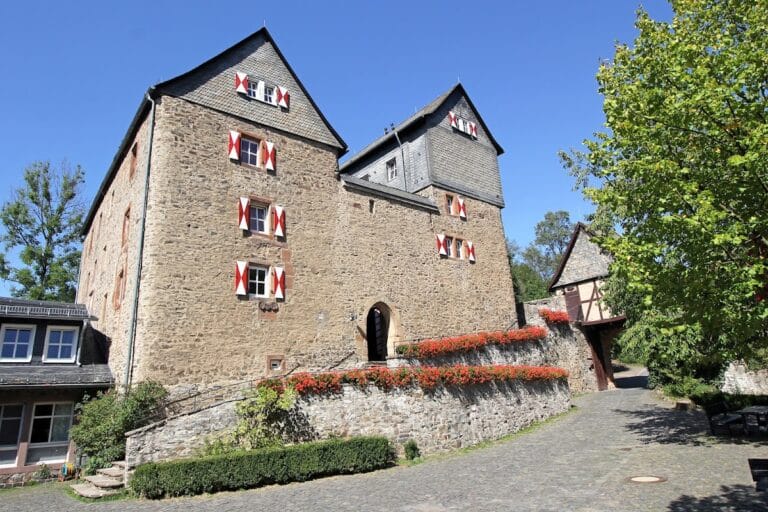
Burg Lichtenfels underwent comprehensive rebuilding between 1908 and 1914. In the 1960s, the fully renovated castle served as a recreation home operated by Anker-Werke of Bielefeld. At the end of the 1980s, the entrepreneur Tan Siekmann, founder of Biodata, and his parents bought the castle and carried out another comprehensive restoration after further repairs were needed. The building later served for a time as Biodata’s headquarters, until the company went bankrupt in 2001. Since 2004, it has been the residence of the von Siekmann family and the headquarters of Safe-com, a company led by Tan Siekmann.
Remains
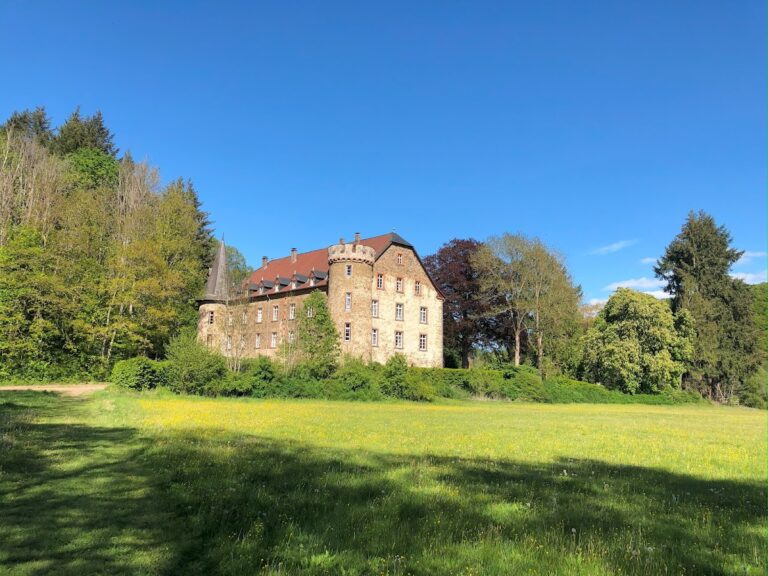
Burg Lichtenfels is a Höhenburg, or hilltop castle, positioned at 383 metres above sea level on a mountain spur about 700 metres east-southeast of Dalwigksthal. The spur lies on the northeastern extension of the 432.4-metre Eisenberg. From this elevated position, the castle overlooks the wooded, winding valley of the Orke, a western tributary of the Eder. At Dalwigksthal, the Orke is joined by the Wilde Aa, and the castle stands above the point where the Orke enters the area known as the Örksche Schweiz, also called the Waldeckische Schweiz.
The castle is situated in the municipality of Lichtenfels in Hesse’s Waldeck-Frankenberg district. It is preserved in restored form, with the castle or substantial parts of it surviving. Historical forms of its name include Lechtenflens and Lechtenflins.