Church of the Immaculate Conception of the Blessed Virgin Mary in Mechowo: A Gothic Parish Church in Poland
Site at a Glance
- Rating
- 4.7
- Popularity
- Very Low
- Country
- Poland
- Primary era
- Medieval
- Eras represented
- Medieval, Early Modern
- Civilizations
- Duchy of Pomerania, Holy Roman Empire
- Site type
- Religious
- Remains
- Church
On this page9 sections
History
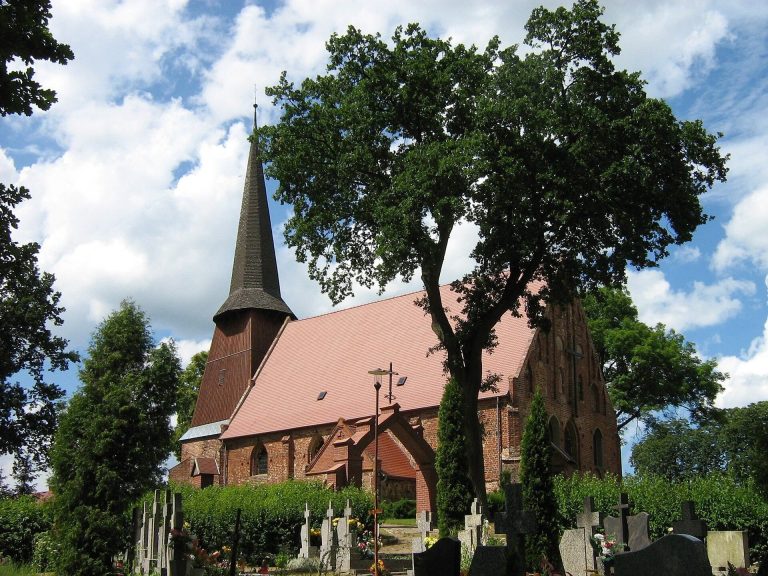
The Church of the Immaculate Conception of the Blessed Virgin Mary in Mechowo is a historic parish church in Mechowo, Poland, built by the local Christian community in the Gothic period during the second half of the fifteenth century. Its dedication refers to the Roman Catholic doctrine that Mary was conceived free from original sin, concerning Mary’s conception rather than the conception of Jesus. The church was entered in Poland’s register of historic monuments as number 426 on 10 December 1963.
Medieval foundation and later additions
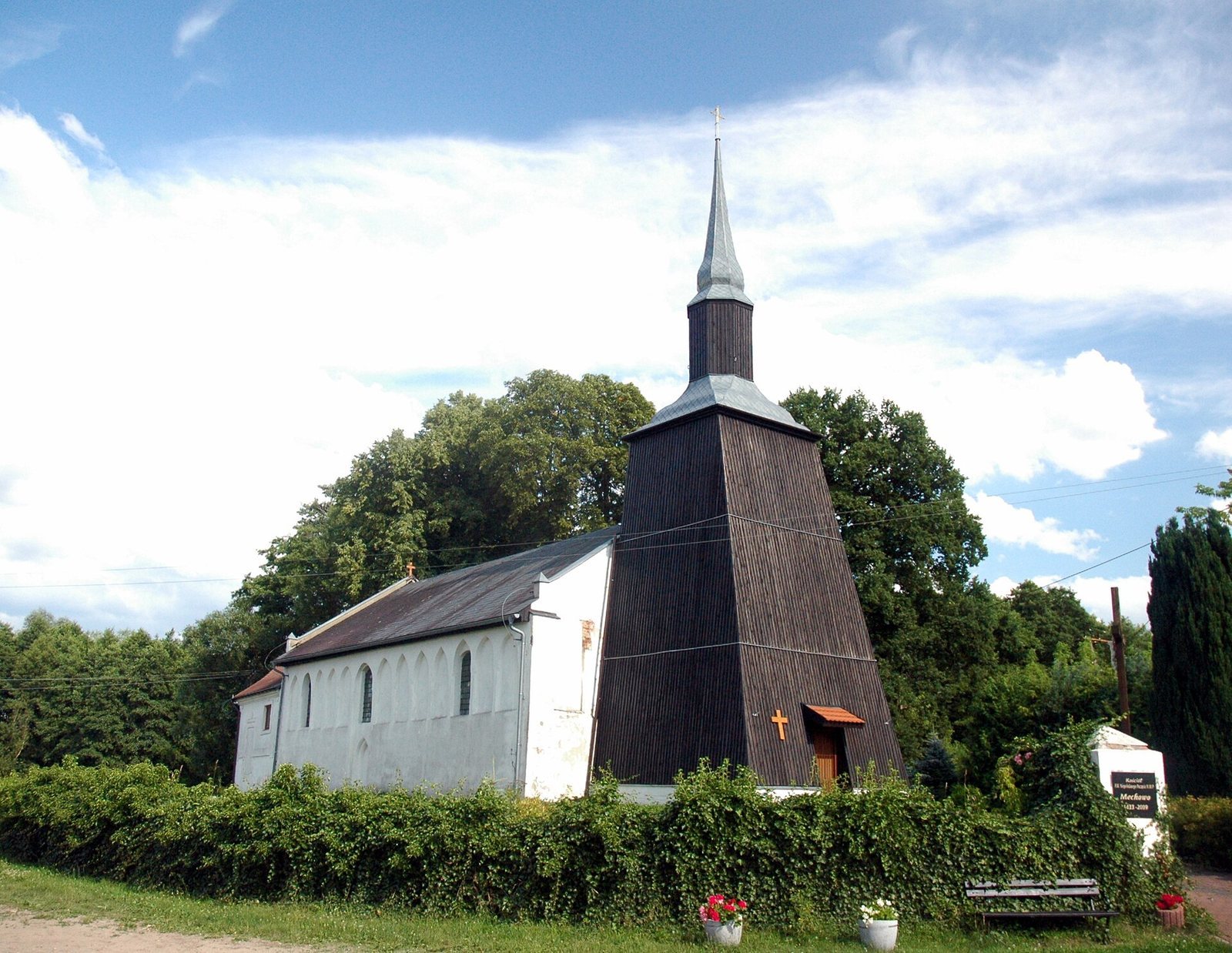
The original church had a rectangular plan. A wooden tower was attached to its western wall in 1647, adding a prominent vertical feature to the medieval building. A rebuilding design prepared in 1777 proposed a rectangular chapel on the eastern side. The chapel first contained a patron’s gallery, a reserved viewing area for the church patron and the patron’s family, linked to the nave by a large arch. That opening is now bricked up. Another interpretation identifies the eastern addition as a family tomb built for the von Grapen family.
Renovation and parish history
The church underwent extensive renovation in 1906 and 1907. Until the end of the Second World War, wooden memorial plaques commemorating Mechowo residents who had died in the Napoleonic Wars and the First World War hung on the interior walls. They were removed after 1945 and have not survived.
After the Second World War, Catholics took over the church, and it was consecrated on 20 June 1946. The former patron’s-gallery chapel was then converted into a sacristy. From 1946, the church served as a filial church of the parish in Golczewo. A separate parish was canonically established in Mechowo on 22 June 1985. The church remains dedicated to the Immaculate Conception of the Blessed Virgin Mary and belongs to the Roman Catholic Church.
Remains
Site and exterior
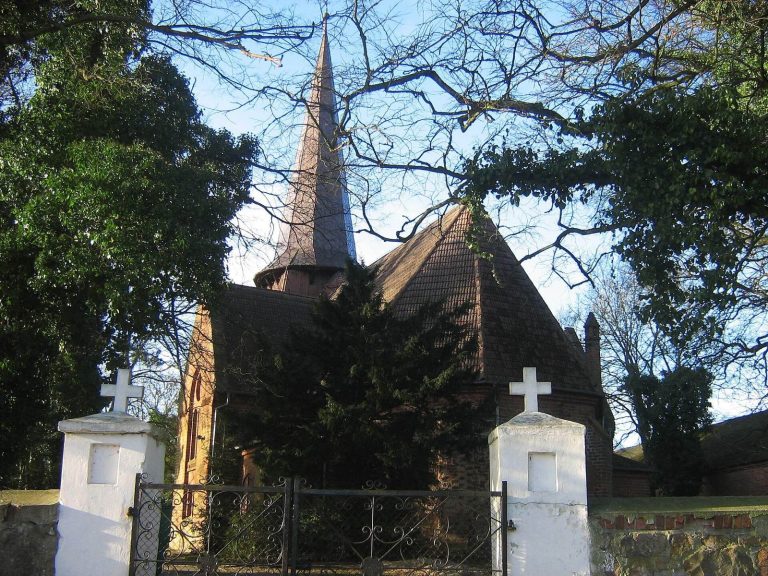
The church stands on a small glacial-moraine rise, a ridge formed from material deposited by a retreating glacier, which descends toward the Wołcza River. Its rectangular body is built on stone foundations from stone and brick and is now completely plastered. The building has Gothic forms with Baroque elements. A sacristy adjoins the eastern wall. The body is covered by a gabled roof, while the western tower narrows upward and carries an octagonal bell turret with a conical roof. The bell tower is a compact structure, and its position preserves the historic connection between the tower and the western end of the church.
Interior and furnishings
Altar
The altar and pulpit were produced in a Pomeranian workshop at the beginning of the eighteenth century. The two-story altar, dated to either 1700 or 1709, has a columned design and rich acanthus ornament, a classical plant-based motif used widely in Baroque art. Its central painting shows the Crucifixion with Mary, Saint John, and Saint Mary Magdalene. Saints Peter and Paul stand at the sides. The upper section contains a painting of the Entombment, while the predella, the lower part of an altarpiece beneath its principal image, shows the Last Supper. Angel figures and the four Evangelists, Matthew, Mark, Luke, and John, complete the decoration.
Pulpit
The pulpit dates from 1712 and was funded by the church’s patrons from the von Grapen family, the municipal administrators, and the pastor Michael Steinhörel. A pillar supports its body, and stairs lead to the entrance. The ornamental doors once carried an inscription that was painted over after 1945. The surviving pulpit body, backboard, stairs, and gate are decorated with figures of the four Evangelists and further acanthus ornament.
Gallery, windows, and graves
The interior has a beam ceiling. At the western end, a choir organ gallery stands beside a pointed-arch portal leading to the tower. The gallery dates from the second half of the seventeenth century, while the chandeliers date from the nineteenth century. The windows retain early-eighteenth-century stained glass showing the coats of arms of landed families. Fourteen stained-glass windows were formerly installed in the southern windows, and eight survive, including one bearing the von Grapen coat of arms and the inscription “Charlotta. Juliana. Grapen. 1706.”
Outside, behind the von Grapen family tomb, are three graves. One is marked by a cast-iron cross dedicated to Elisabeth von Flemming, who was born on 29 August 1875 and died on 9 August 1876.