Our Lady of the Gate of Dawn Church in Tołkiny: A Medieval Church Serving a Catholic Parish
Site at a Glance
- Popularity
- Very Low
- Country
- Poland
- Primary era
- Medieval
- Eras represented
- Medieval, Early Modern, Modern
- Civilizations
- Duchy of Prussia, Kingdom of Poland, Kingdom of Prussia, Teutonic Order
- Site type
- Religious
- Remains
- Church
On this page11 sections
History
Our Lady of the Gate of Dawn Church is a late-fourteenth-century church in Tołkiny, Poland, whose history reflects the region’s shift from Lutheran to Catholic worship. It served a Lutheran congregation from 1525 until 1945 and later entered Catholic use.
Lutheran worship and parish organization
A church stood at Tołkiny before the Reformation. Lutheranism, a Protestant tradition associated with the sixteenth-century Reformation, took hold in Tołkiny and neighboring Schönfließ. On 11 June 1528, both churches were assigned to the parish at Lamgarben (Garbno). From 1603, they shared a pastor and remained under one pastoral office at Schönfließ until 1945.
Until 1945, the church belonged to the Rastenburg church district and the East Prussia church province of the Evangelical Church of the Old Prussian Union, a Protestant church body in Prussia. In 1925, the wider congregation had 1,520 members, including 360 in the Tolksdorf parish district. The manor owner held church patronage, rights relating to the church and its clergy.
Catholic use and the postwar transition
Before 1945, relatively few Catholics lived in Tolksdorf. A decree placed the village in the Rößel parish of the Diocese of Warmia on 14 April 1860. After a parish was established at Korschen in the early twentieth century, the village was transferred to it.
Flight and expulsion during the war’s aftermath brought the Lutheran congregation in Tołkiny to an end. After 1945, the church passed to Catholics, and the congregation grew rapidly as Polish residents settled in the village. The building was adapted for Catholic worship and received its present dedication. Today it is a Catholic branch church of the Garbno parish, within the Kętrzyn I (West) deanery, an administrative grouping of parishes, and the Archdiocese of Warmia.
A memorial in the church honors Heinrich, Count of Dohna-Schlobitten, also known as Count of Dohna-Tolksdorf. A German nobleman who took part in resistance to Nazism, he was executed on 14 September 1944. His children arranged for the memorial, which Archbishop Edmund Piszcz inaugurated in July 1994.
Remains
Building and exterior
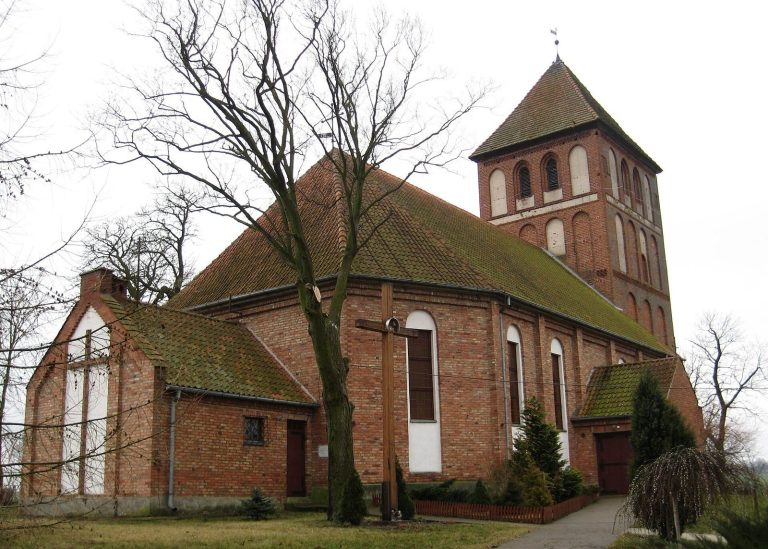
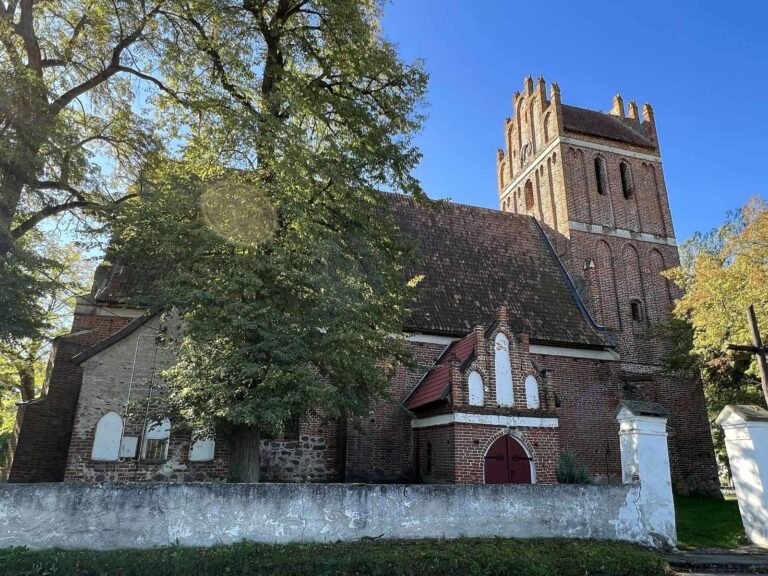
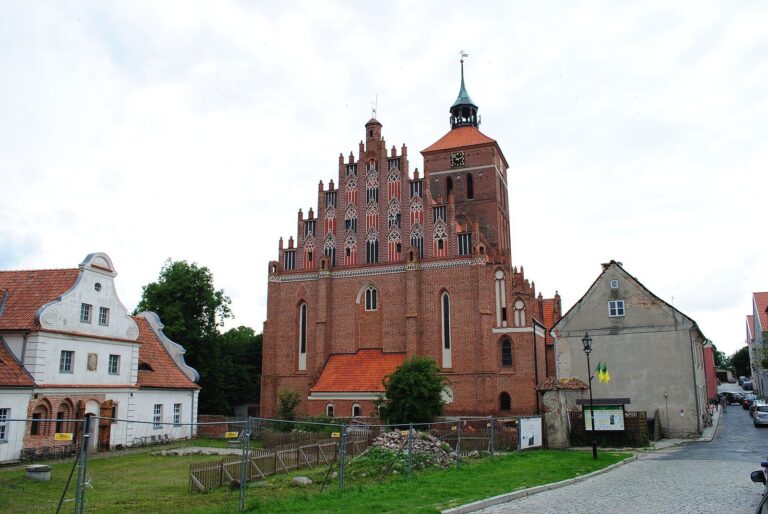
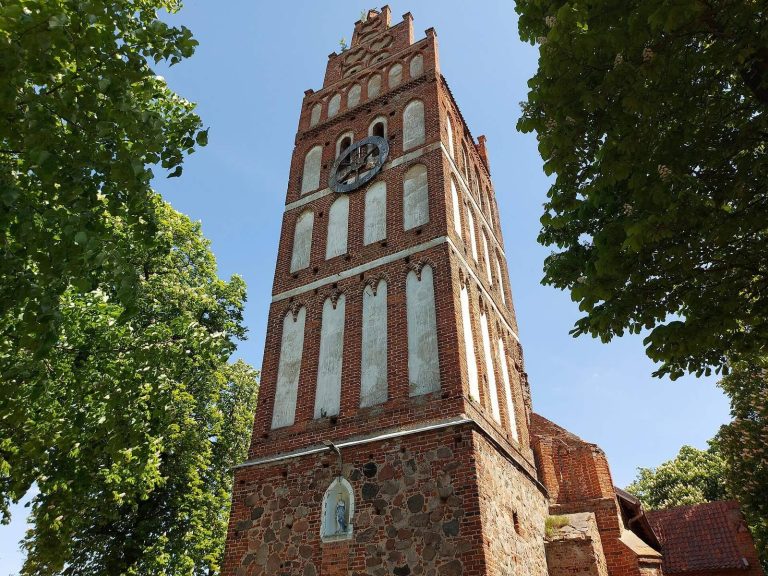
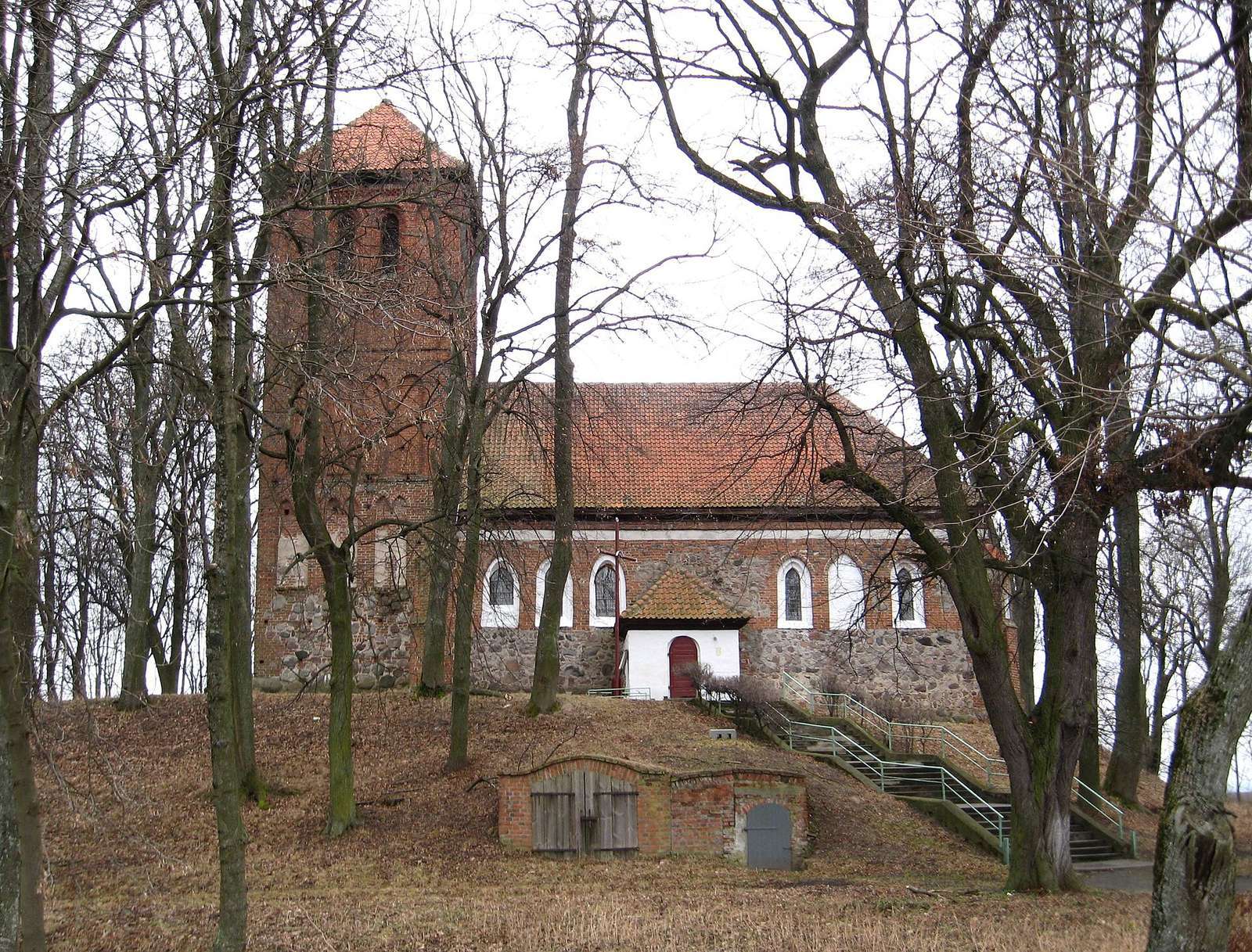
Standing on a hill in the northwest of the village, the church has a rectangular, fortress-like form built of fieldstone and brick. A sacristy, a room for preparing services and keeping liturgical objects, was added on the north side around 1400. The projecting west tower was completed around 1500. Its upper stories, marked by round-arched brick panels, replaced an earlier timber structure in the nineteenth century.
Interior fittings
Ceiling and wall decoration
The interior has a flat wooden ceiling, and traces of earlier painted decoration remain on the walls.
Altar and altarpiece
The altar bears the dates 1604 and 1607, and a mark records its restoration by Michel Großmann in 1675. Some of its carved woodwork predates the Reformation and includes a representation of the Trinity, the Christian belief in one God as Father, Son, and Holy Spirit. Its Gothic-style altarpiece, an altar decoration with hinged wings, has paintings by Valentinus Helendorf and Gregorius on its movable panels.
Pulpit, pews, and angels
The simple pulpit and parts of the pews date to the seventeenth century. Two communion angels, figures associated with the Eucharist, date to about 1750.
Font and memorial plaque
A fifteenth-century granite baptismal font stands in the entrance vestibule. A memorial plaque is mounted on an interior wall.
Bells
The church has three bells.