Ottobeuren Abbey: A Benedictine Monastery in Germany
Site at a Glance
- Popularity
- High
- Country
- Germany
- Primary era
- Early Modern
- Eras represented
- Early Modern, Modern
- Civilizations
- German, Holy Roman Empire
- Site type
- Religious
- Remains
- Monastery
On this page12 sections
History
Ottobeuren Abbey is a Benedictine monastery in Germany, founded in 764 by the noble Silach. Its first abbot was Toto, and the community dedicated the abbey to Saints Alexander of Rome and Theodore Tiro. In 960, Bishop Ulrich of Augsburg obtained relics of Theodore for the monastery. Emperor Otto I granted it privileges and exemption from imperial burdens in 972. Ottobeuren held the status of an imperial abbey, a monastery directly subject to the emperor and allowed substantial self-government, and was an imperial abbey by 1299.
Foundation and medieval reforms
The abbey took part in Benedictine reforms that spread through the region during the eleventh and twelfth centuries. Abbot Adalbert, who led Ottobeuren from 1050 to 1069, also headed St Emmeram in Regensburg. William, abbot at Ottobeuren from 1069 to 1091, later led Hirsau Abbey. Reform at Ottobeuren first drew on the practice of St Blasien. Under Rupert I, abbot from 1102 to 1145, the community adopted the Hirsau–St Georgen reform, a Benedictine movement linked to those two monasteries. Ottobeuren’s influence reached Ellwangen and Marienberg in South Tyrol; five monks from Ottobeuren successively became abbots at Marienberg.
From the late eleventh century into the early twelfth, the abbey’s buildings were reconstructed. The work included a chapel dedicated to St Nicholas and a convent for noblewomen. The renewed complex was consecrated in 1126. A later church, with a chapel to St Michael at its western end, was consecrated in 1204. Fires damaged the abbey in 1153 and again in 1217.
Ottobeuren maintained closer ties with the papacy and royalty during the twelfth century. The community later suffered a marked decline: by the fourteenth and fifteenth centuries, its numbers and resources had fallen sharply. When Johann Schedler became abbot in 1416, only around six to eight monks remained, and annual income was at most 46 silver marks.
Renewal, education, and conflict
A recovery began under Abbot Leonhard Wiedemann, who led the abbey from 1508 to 1546. In 1509 he established a printing workshop and a study house for Swabian Benedictines. The Protestant Reformation, a sixteenth-century challenge to Roman Catholic authority that led to the formation of Protestant churches, did not reach Ottobeuren. The study house, however, closed during the Thirty Years’ War, a major European conflict shaped by religious and political disputes.
Benedictine humanist Nikolaus Ellenbog promoted a plan for a university. In 1543, several Swabian Benedictine abbeys founded the institution under Kempten Abbey’s leadership. It moved to Elchingen Abbey the following year as the University of Elchingen, but the Schmalkaldic War, a conflict between the emperor and the Protestant Schmalkaldic League, brought it to an end in 1545. The former university later became part of the University of Dillingen.
In 1553, the church was altered from its Gothic form: builders removed the western chapel of St Michael and enlarged the monks’ choir. The revised church was consecrated in 1558 in Renaissance style. The Thirty Years’ War brought further destruction, devastating the abbey’s buildings between 1630 and 1635. Plans for a Baroque church, in the ornate European style associated especially with the seventeenth and eighteenth centuries, emerged in 1682, with initial construction work around 1686.
Imperial independence and Baroque rebuilding
The abbey’s imperial status was confirmed by the Imperial Chamber Court, the Holy Roman Empire’s supreme judicial tribunal, in 1624. Ottobeuren did not belong to the Swabian Circle, one of the Empire’s regional administrative groupings. In 1710, Abbot Rupert II Neß paid the bishop of Augsburg 30,000 gulden to give up his protective jurisdiction over the abbey. This restored Ottobeuren’s full independence within the Empire and began its most prosperous period.
Rupert II directed the construction of the present monastery from 1711 to 1725 and began work on the present church in 1737. His successor, Abbot Anselm Erb, brought the church project to completion in 1766. At secularization, the transfer of church property and institutions to secular authority, the abbey was dissolved in 1802. It had ruled 27 villages with about 10,000 inhabitants across roughly 270 square kilometres. Bavaria annexed the territory by 1803, while 18 monks remained at Ottobeuren.
Restoration of monastic life
In the mid-1830s, monastic life resumed at Ottobeuren as a priory of St Stephen’s Abbey in Augsburg. Since 1893, Ottobeuren has belonged to the Bavarian Benedictine Congregation, a federation of Benedictine monasteries. It regained independent abbey status in 1918 after a private donation from Theodor von Cramer-Klett. Pope Pius XI granted the church the honorary title of minor basilica in 1926. From 1960 to 1964, the Bavarian government funded repairs to the complex’s exterior and interior. The monastery housed the Collegium Rupertinum, a boys’ boarding school for pupils in grades 5–10, from 1946 to 1975. In 2025, fourteen monks lived at the abbey under Prior-Administrator Christoph Maria Kuen.
Remains
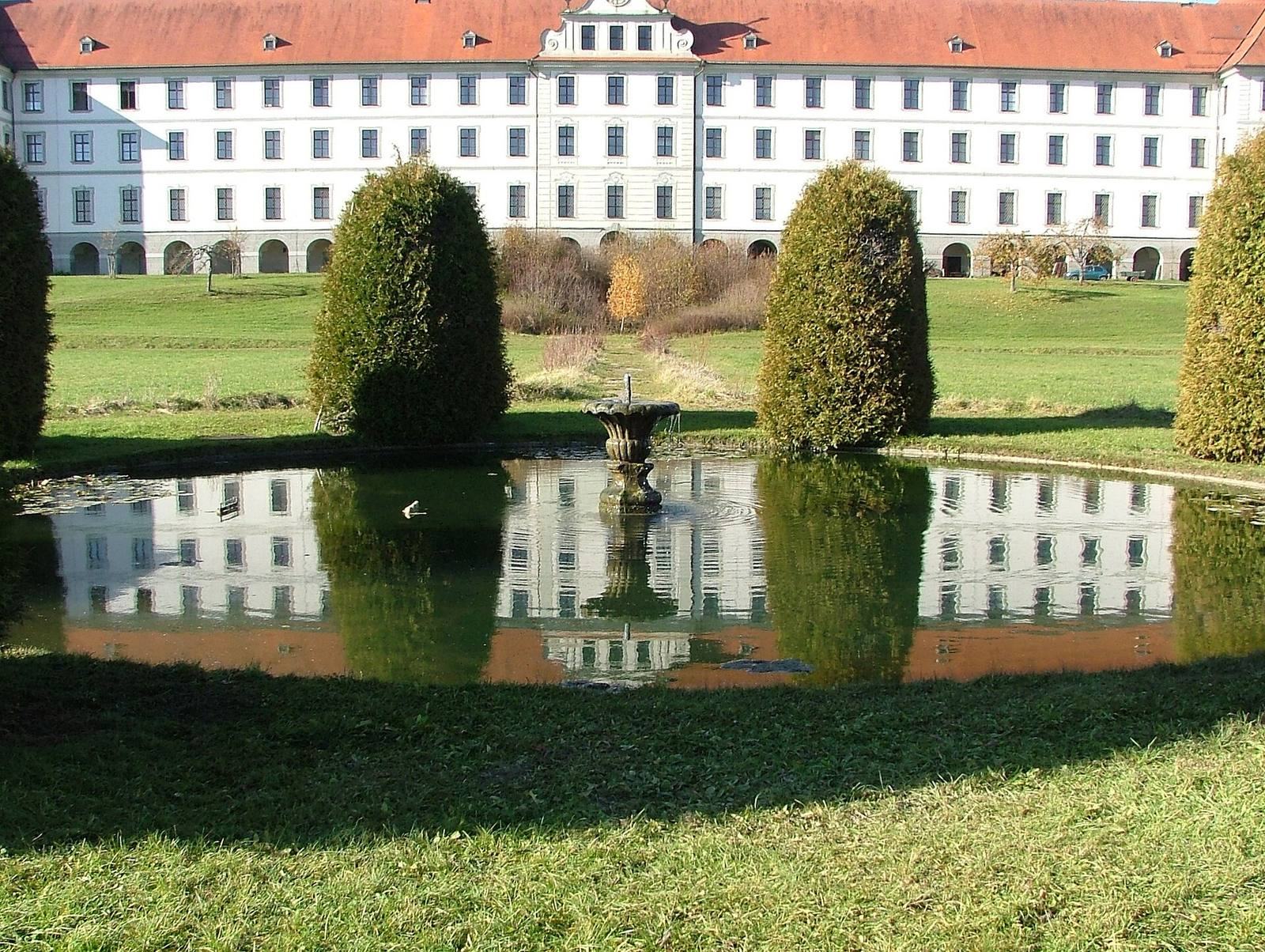
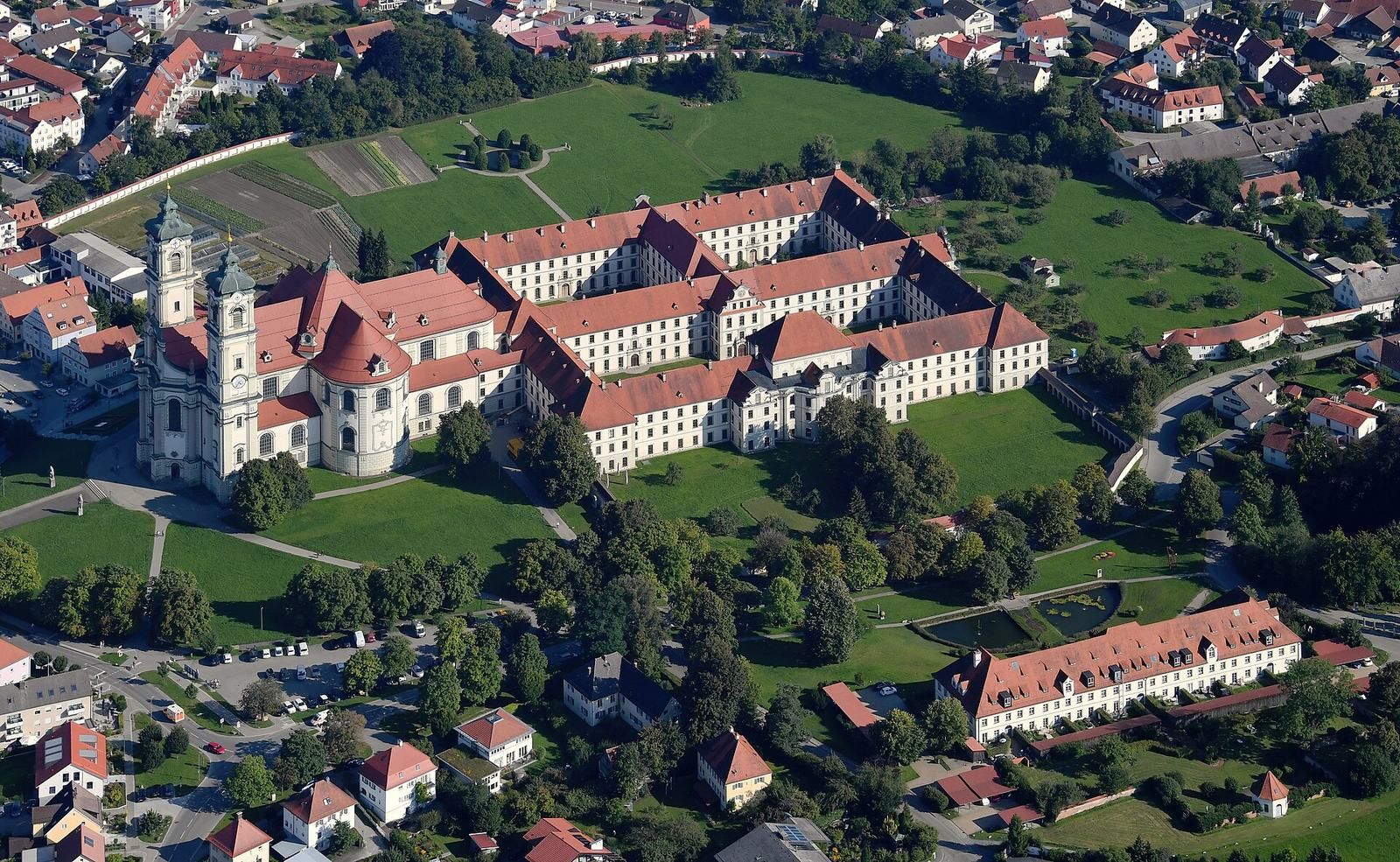
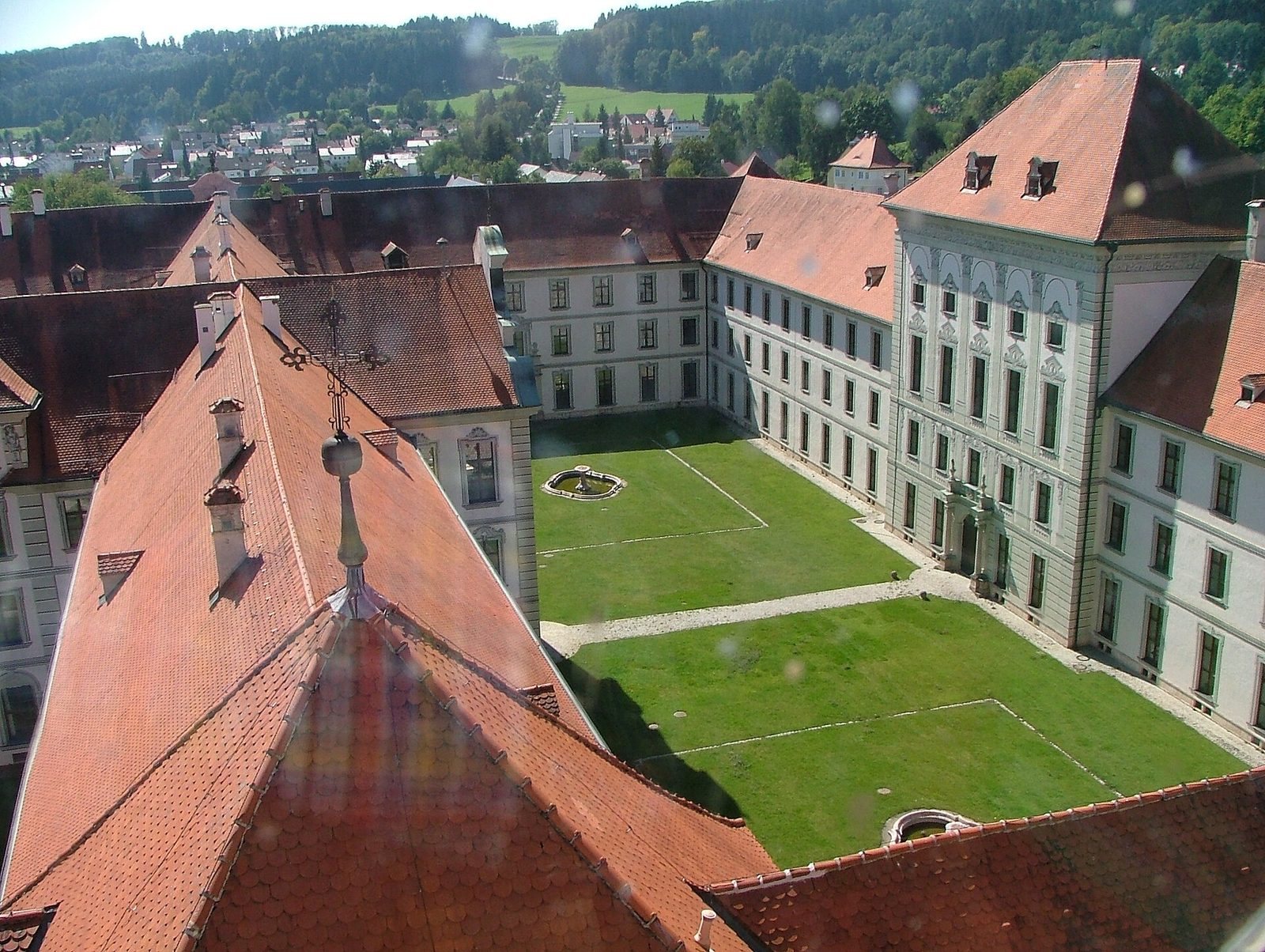
The surviving Baroque complex is arranged as a cross-shaped plan within a quadrilateral measuring 142 by 128 metres. Its buildings have 33 by 29 window axes, the vertical lines along which the windows are arranged. The monastery includes the church, large reception halls, and a library, forming a broad architectural ensemble.
Monastery buildings and halls
The monastery’s richly furnished rooms include the Imperial Hall and other grand halls, as well as a more intimate theater hall. Their decoration reflects the wealth and political standing the abbey attained. The theater hall also preserves a link to the monastery’s Baroque cultural life.
Basilica of Saints Alexander and Theodore
Plan and decoration
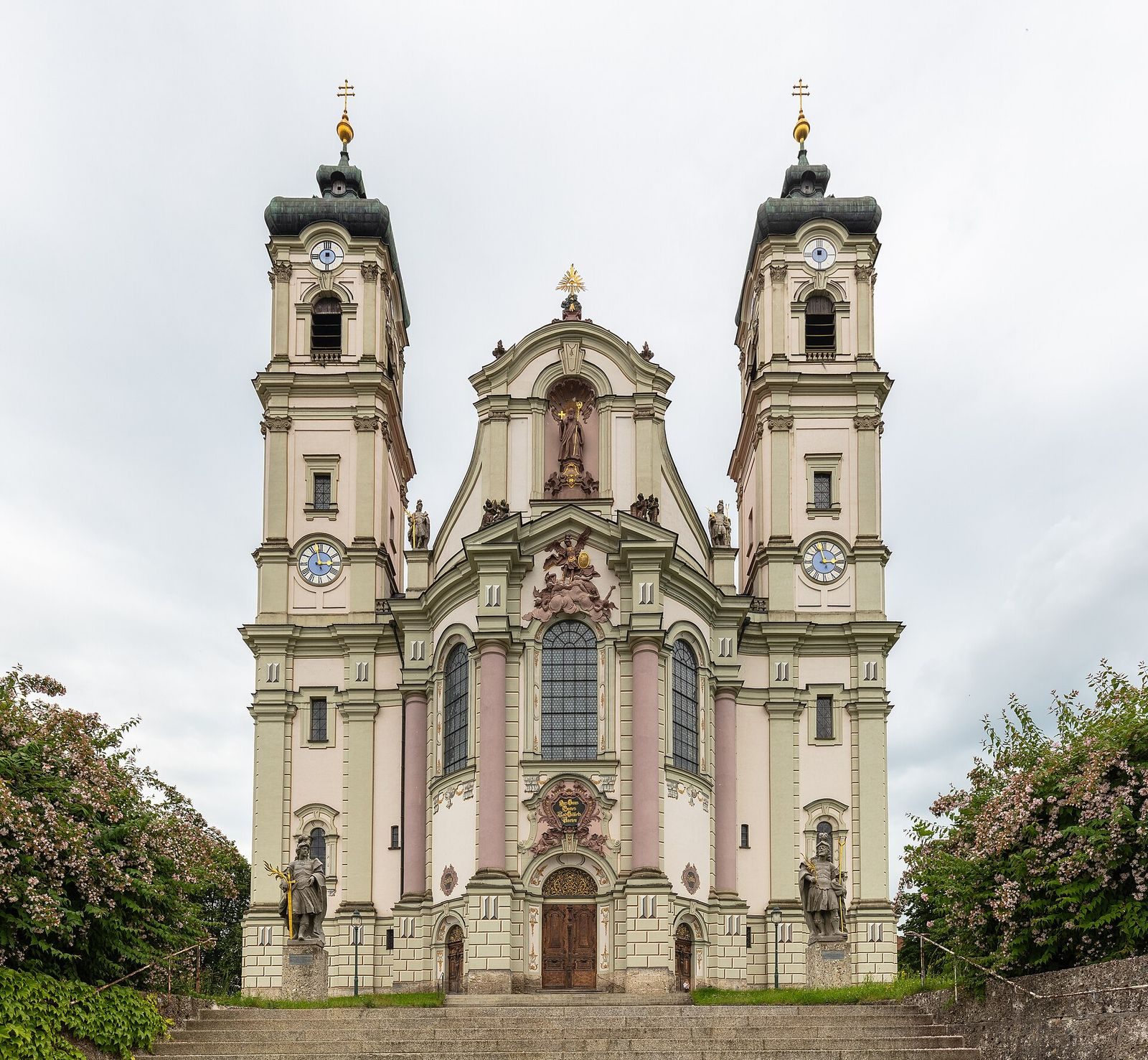
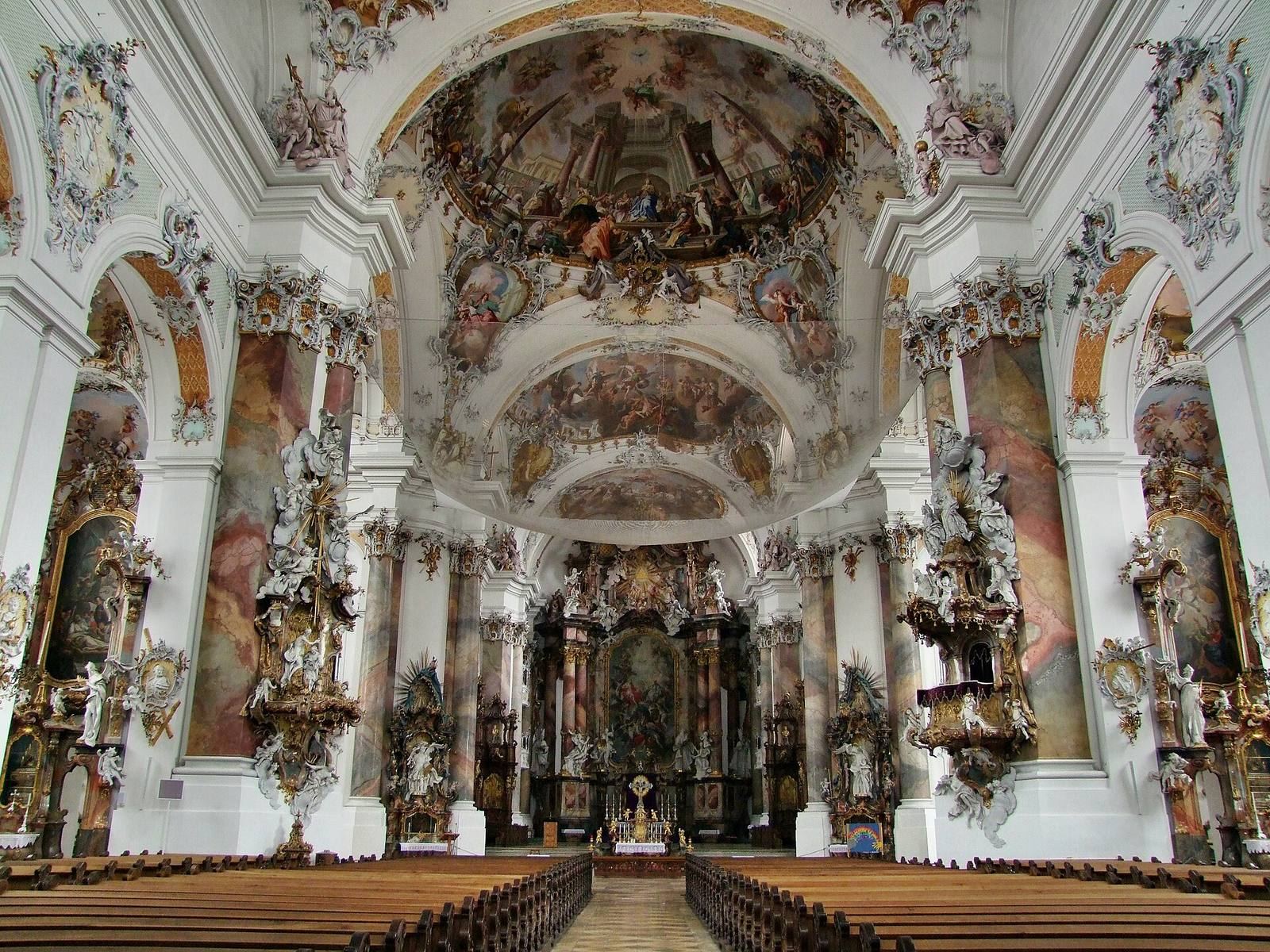
The abbey church is a late-Baroque building set on an unusual north–south axis, determined by its position within the wider complex. Its plan forms a Latin cross, with a long nave, a choir, and a transept with rounded ends. The nave measures 89 metres in length and 36 metres in height; the transept is 58 metres long and 18 metres wide. The two façade towers rise 82 metres. Four substantial pillars support the crossing. The church’s architects included Christoph Vogt, Simpert Kraemer, Johann Effner, and Johann Michael Fischer. Dome and ceiling paintings, altarpieces by Tyrolean painters Johann Jakob and Franz Anton Zeiller, and carved and stucco work enrich the interior. Johann Joseph Christian made figures and reliefs for the choir stalls, with additional stucco work by Johann Michael Feuchtmayer the Younger. Martin Hermann produced the stalls’ woodwork.
Altars and crosses
Altars at the bases of the four crossing pillars contain the bones of four saints from the Roman catacombs, acquired by the abbey in the seventeenth century. At the entrance to the choir, the Holy Cross altar holds a Romanesque crucifix dating to about 1220. The altar of St Michael carries the Coventry Cross, installed in 1964 as a symbol of Anglo-German reconciliation.
Organs
Two Baroque choir organs built by Karl Joseph Riepp survive almost unchanged. The four-keyboard Trinity Organ has 47 stops, each controlling a set of pipes, and follows a classical French arrangement. The two-keyboard Holy Spirit Organ has 27 stops. Riepp’s side organs, associated with the Epistle and Gospel readings, date to 1766 and 1762 respectively. A third organ, built by Steinmeyer in 1957, stands on a rear gallery and was revised by Klais in 2002. Together, the church’s organs have 100 stops across five keyboards.
Library
The abbey library began with the monastery’s foundation and was rebuilt in the eighteenth century. Its unified Baroque interior combines ceiling paintings by Elias Zobel with stucco ceilings by Johann Baptist Zimmermann. The collection includes medieval manuscripts, hundreds of incunables, books printed in Europe before 1501, and about 15,000 folios bound in pigskin.