Orta Cami: The Principal Friday Mosque of the Crimean Khanate


Site at a Glance
- Rating
- 4.7
- Popularity
- Low
- Country
- Ukraine
- Primary era
- Modern
- Eras represented
- Early Modern, Modern
- Civilizations
- Crimean Khanate, Ottoman, Russian
- Site type
- Religious
- Remains
- Mosque
On this page5 sections
History
Orta Cami is a mosque in Bakhchysarai, Ukraine, whose construction is placed between the second half of the sixteenth century and the beginning of the seventeenth century. It belongs to Islam and the Sunni tradition. During the seventeenth and eighteenth centuries, it served as the principal Friday-prayer mosque of the Crimean Khanate, a Muslim Tatar state that ruled Crimea and nearby territories until its annexation by the Russian Empire.
Origins and role in the khanate
The mosque’s exact construction date remains uncertain. An investigation in the 1880s assigned it to the late fifteenth century, but that dating was questioned because Bakhchysarai was not established until construction began in 1532 under Sahib I Giray, a khan associated with the city’s foundation. A later estimate places Orta Cami in the second half of the sixteenth century or the beginning of the seventeenth.
The earliest known reference to the mosque dates from 1674, when a judicial register of the Crimean Khanate described it as a ma’ale mosque, meaning the principal mosque of an urban district or quarter. It also appears in documents from 1701 and 1710. As the central mosque of the khanate’s capital, it hosted Jumu’ah, the obligatory communal Friday prayer in Islam, accompanied by a sermon.
Destruction and restoration
In 1736, during the Russo-Turkish War, Russian forces commanded by Field Marshal Burkhard Christoph Münnich captured and burned Bakhchysarai. The attack seriously damaged Orta Cami. Restoration and completion took place between 1737 and 1743 during the reigns of the brothers Mengli II Giray and Selamet II Giray. Mengli was associated with resistance to invasions and reconstruction after the war, while Selamet was remembered as a restorer of the khanate. Both rulers were also regarded as benefactors, theologians, and writers.
After Catherine II annexed the Crimean Khanate in 1783–1784 and the territory entered the Russian Empire, Orta Cami continued to operate without a stated alteration. A major rebuilding in 1861 gave the mosque the architectural appearance it retains today.
Closure and return to Muslim use
The 1927 Crimean earthquake severely damaged the mosque. Local Muslims gathered funds for repairs despite the heavy financial burden. In 1929, during the Soviet anti-religious campaign, Orta Cami was closed. The building was converted to cultural and educational uses, including a community cultural center and cinema, and later remained vacant for many years.
In July 2001, the Bakhchysarai district council returned the building for Muslim use to the Mustafa-Jami community of Bakhchysarai. Restoration and reconstruction began in 2012 and continued into 2013. The Umerov family, including Enver Umerov and his sons Aslan and Rustem, initiated and financed the work as part of an effort to restore Crimea’s cultural and historical heritage. Mufti Emirali Ablayev directed the restoration. The historically reconstructed mosque formally reopened in August 2013 after its prolonged period of inactivity.
Remains
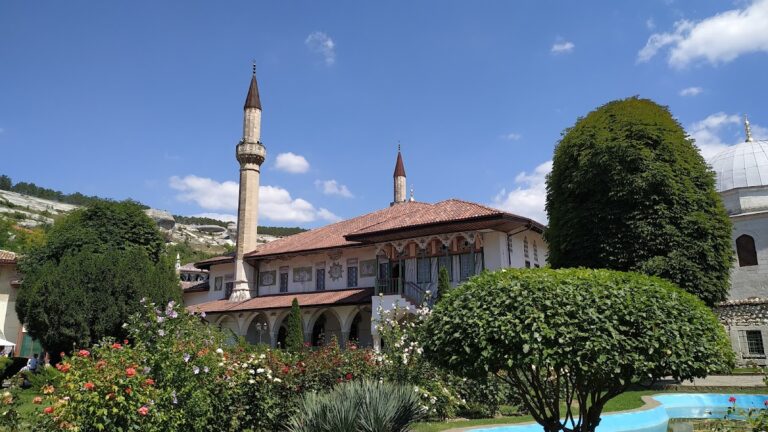
Orta Cami stands in the old town of Bakhchysarai on Lenina Street. The mosque is built primarily of limestone, and its present form reflects the major rebuilding of 1861. Its surviving architectural composition includes a single minaret and the main mosque building.
The original minaret, along with several small buildings that once stood beside the mosque, had been completely destroyed before reconstruction began at the end of 2012. The minaret and those associated buildings were rebuilt during the restoration. Inside the mosque, a gold-framed Quran from a Damascus edition is preserved. During the reopening ceremony in August 2013, Mustafa Jemilev presented it to the Umerov family, and it remains part of Orta Cami’s preserved contents.