Church of the Nativity of Saint John the Baptist: A Baroque Parish Church in Přibyslav
Site at a Glance
- Rating
- 4.6
- Popularity
- Very Low
- Country
- Czechia
- Primary era
- Early Modern
- External website
- Open
- Eras represented
- Medieval, Early Modern
- Civilizations
- Habsburg, Holy Roman Empire, Kingdom of Bohemia
- Site type
- Religious
- Remains
- Church
On this page10 sections
History
The Church of the Nativity of Saint John the Baptist is a Roman Catholic church in Přibyslav, Czechia, rebuilt in the Baroque period from 1750. A church had stood on the site by about 1265, making the location part of Přibyslav’s history since the Middle Ages. The present building was commissioned by Karel Maxmilián of Dietrichstein, the estate owner, and was consecrated in 1753.
Medieval Origins and the Hussite Wars
The first church on the site was smaller and Gothic. It was severely damaged by the forces of Jan Žižka during the Hussite Wars, the fifteenth-century conflicts between the reformist Hussite movement and its opponents. The earlier building was eventually replaced by the present church, while the adjacent Gothic tower survived as a separate part of the site.
The Baroque Reconstruction
Construction of the new church began when its foundation stone was laid on 1 April 1750. The building took the place of the original church and received a Baroque design. A fire that spread through Přibyslav in 1767 damaged the church roof, which was repaired during the same year. The heat also destroyed the bells and clock mechanism in the neighboring tower.
Later Alterations and Religious Use
New organs were acquired in 1890 for 2,860 gulden, using money from the endowment of the Šenfeld church. A. Sucharda restored the interior in 1891. Later work replaced the original wooden floor with stone paving and exposed fragments of the earlier Gothic masonry and paving, together with several tomb slabs. After the Second Vatican Council, the Baroque grille between the presbytery, the area around the main altar reserved for clergy, and the rest of the church was removed.
Archaeological investigation accompanied damp-proofing work and examined excavation trenches and the former graves around the church. A sacristy extension was begun in 2002, when the former cemetery wall was also repaired. The church and adjacent tower are protected together as a cultural monument. The church belongs to the Diocese of Hradec Králové, the Havlíčkův Brod Vicariate, and the parish of Přibyslav.
Devotional Additions
The cemetery chapel, originally an ossuary used to house human bones, was reconstructed and reconsecrated in the 1990s. In 1998, Roman Podrázský, an academic sculptor and Přibyslav native, created a Marian column near the church. A Marian column is a devotional monument bearing an image or statue of the Virgin Mary. This column is described as the only one consecrated during the twentieth century within the territory of the present-day Czech Republic.
Remains
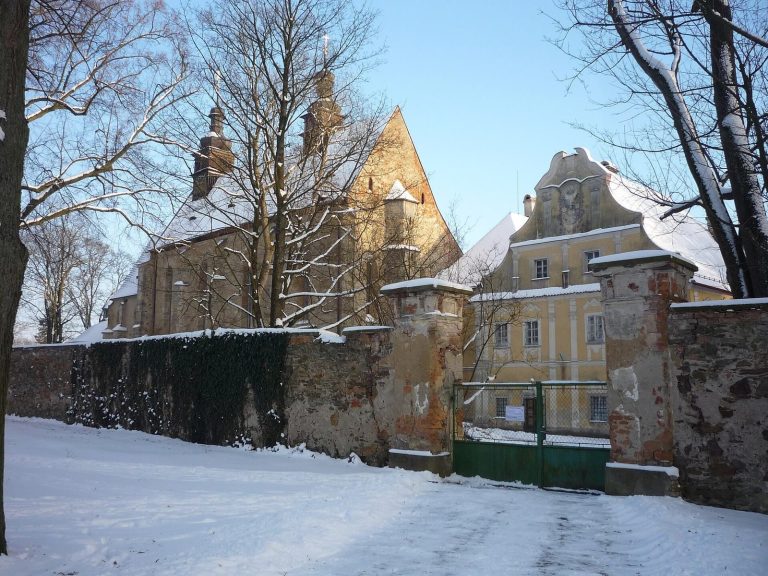
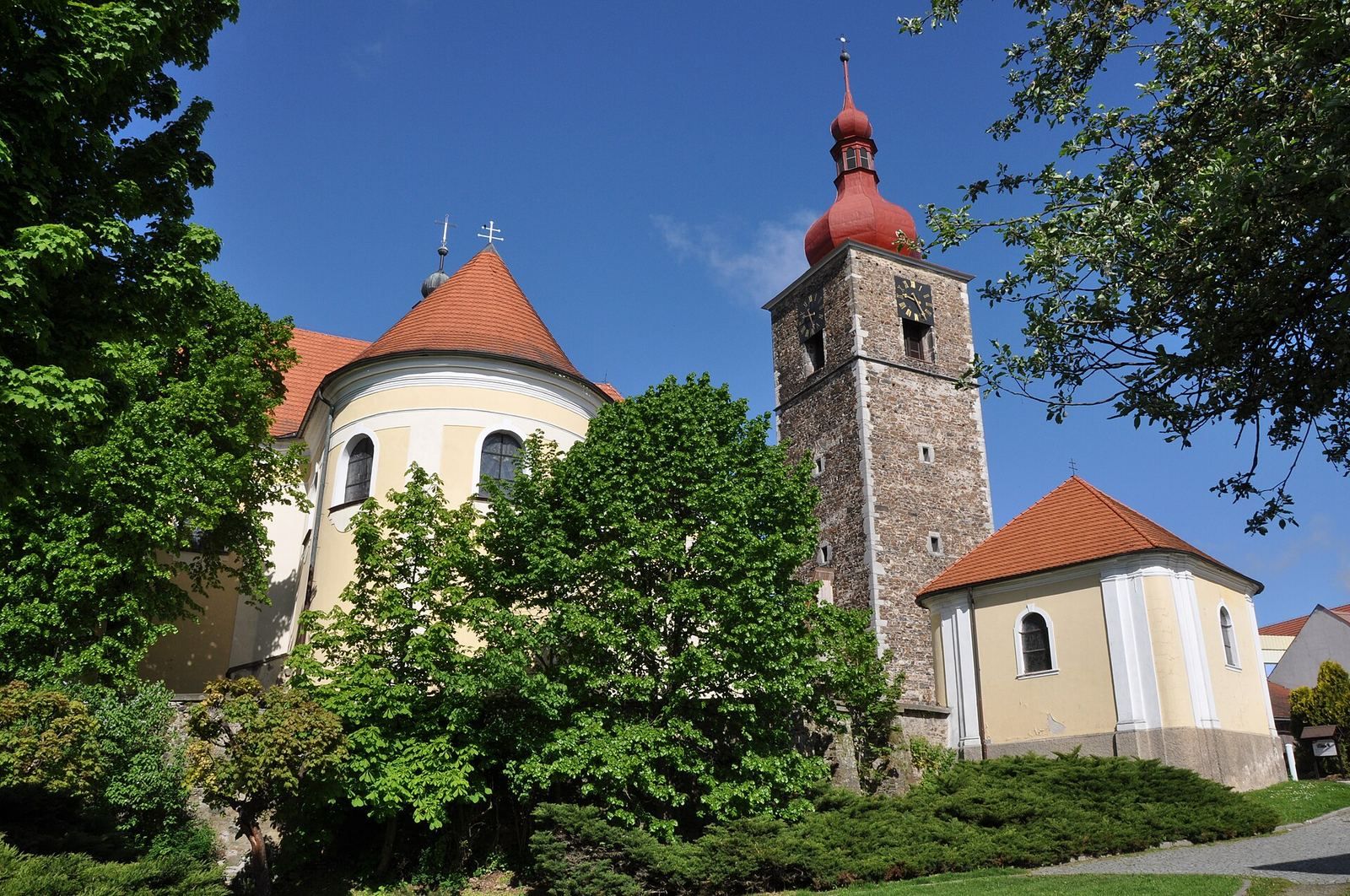
The surviving complex consists of a Baroque church with a transept, gabled roof, and sanctus turret, together with an adjoining Gothic tower and remnants of the former cemetery. The sanctus turret is a small roof turret traditionally used for a bell associated with the Eucharistic liturgy. Two altars stand in each of the church’s longitudinal and transverse sections. The ceiling carries the Dietrichstein family coat of arms, including prominent vine-pruning knives.
The Church
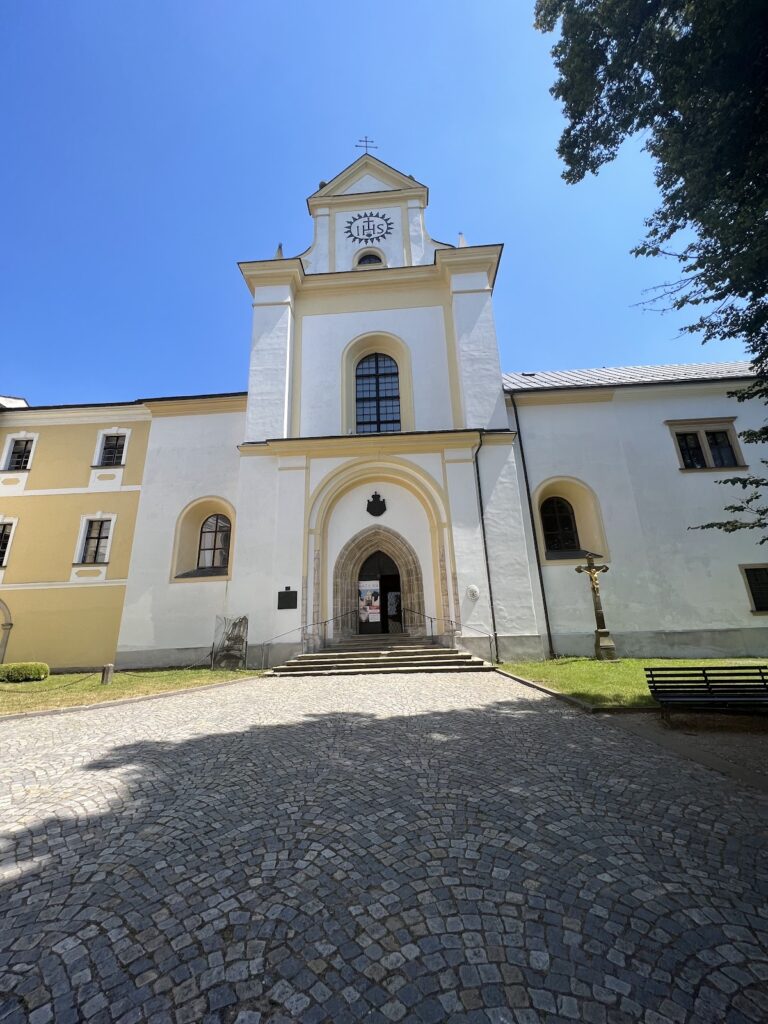
The western facade is arranged with niches containing statues of Saint John of Nepomuk and Saint John the Baptist. A statue of the Immaculate Virgin stands on the gable. The Immaculate Virgin is a Catholic title for Mary referring to the doctrine that she was preserved from original sin. Inside, the church’s Baroque form, transept, altars, and decorated ceiling preserve the principal architectural character of the eighteenth-century rebuilding.
The Gothic Tower
The adjacent Gothic tower once formed part of Přibyslav’s castle fortifications. Its first recorded mention dates from 1497, while the date of its completion is unknown. It rises 30.96 metres, and its entrance is positioned 7 metres above ground level. Wooden stairs lead to the entrance and could be removed quickly during an enemy threat. A deliberately narrow passage to the second floor could be barricaded or sealed with brick if attackers entered.
The tower was whitewashed and plastered in 1600. Lightning set fire to its shingle roof and roof timbers in 1604, destroying the interior stairs and floors. A temporary covering remained until 1681, after which the tower received a domed roof topped by a star rather than a cross. The star identified it as part of the town’s defensive system rather than as a church structure.
The 1767 fire damaged the tower again and melted its bells. It was temporarily covered, while the town borrowed small bells from neighboring villages. When attempts to obtain financial support from the estate owners failed, Přibyslav financed repairs itself in 1803. Nearly 6 metres of damaged upper masonry were dismantled, removing the watchman’s quarters. The same upper section contained the tower clock, which was placed temporarily in the upper part of an elongated Gothic window and remains there. Clock faces were later added to windows facing the other three cardinal directions.
Two bells were installed in 1994. Maria weighs 395 kilograms, and Jan weighs 293 kilograms. Together they continue the tower’s bell-bearing function after the earlier bells were destroyed.
The Former Cemetery and Chapel
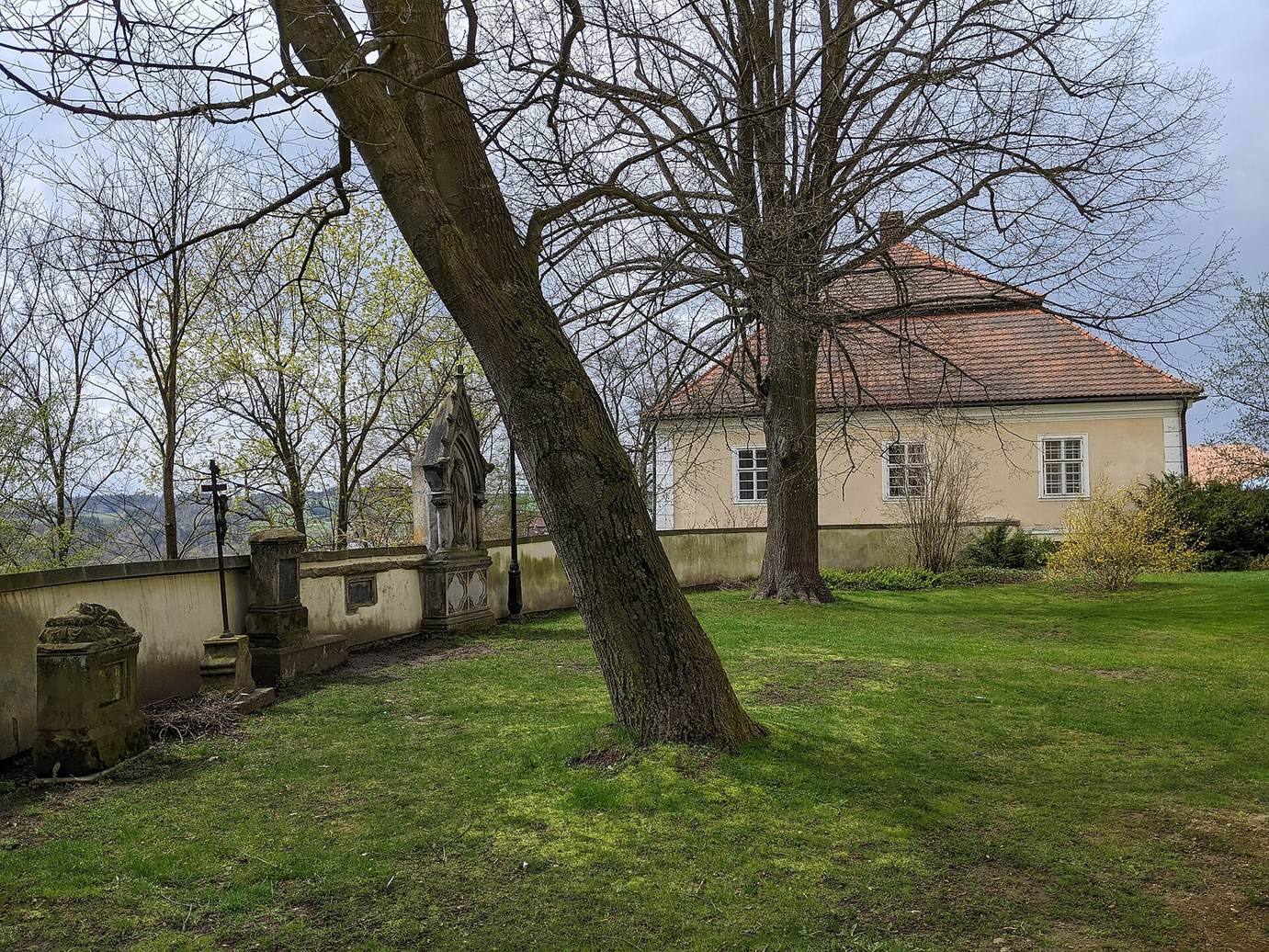
The former cemetery around the church is represented by surviving tombstones and monuments. To the left of the main entrance stands a statue of Christ by the sculptor Josef Max. The only maintained grave is that of the parish priest Jan Brůžek, who was a teacher of Karel Havlíček Borovský.
The cemetery chapel retains the memory of its original purpose as an ossuary. Its reconstruction in the 1990s was followed by reconsecration, preserving the small building as part of the church complex.
The Marian Column
Near the church stands the Marian column made by Roman Podrázský in 1998. Its statue of the Virgin Mary gives the monument its devotional character and adds a late twentieth-century feature to the historic church grounds.