Roman Aqueduct of Sexi: Water Supply for Ancient Almuñécar
Site at a Glance
- Popularity
- Medium
- Country
- Spain
- Primary era
- Classical
- Eras represented
- Classical
- Civilizations
- Roman
- Site type
- Infrastructure
- Remains
- Aqueduct
On this page16 sections
History
The Roman Aqueduct of Sexi supplied water to Almuñécar, Spain, whose ancient name was Sexi. The Romans built it in the first century AD, during the Early Roman Empire, to serve the city.
Part of the watercourse was later reused for irrigation across the fertile Sexi plain. This continued use helped preserve many sections beyond the urban area.
Protection and study
The aqueduct was declared a Historic-Artistic Monument in 1931. It is listed in Spain as an Asset of Cultural Interest in the monument category.
Engineer and historian Carlos Fernández Casado published the first study of its route and remains in 1949. He proposed that a pressurized pipe carried water through the low ground beneath the hills of ancient Almuñécar. A degree project in the 1980s recorded the remains then visible, and archaeologist Federico Molina Fajardo proposed a revised route in 2000 using evidence from excavations in Almuñécar. An excavation at El Convento in June 2008 revealed another stretch of the channel.
Remains
The aqueduct extended for about 7 km, from the Angosturas area to water-storage facilities in the city. Its channel followed the contours of the land, sometimes running near the surface and elsewhere several metres below ground. Arched supports carried it across depressions. The system included vaulted channels, meaning channels covered by arched roofs, and a short tunnel between the Río Verde and Río Seco basins.
Water capture and channel route
Water capture
An underground infiltration gallery, a passage that collects groundwater, drew water from the Río Verde aquifer and brought it to the surface at Fuente de los Granados. The gallery’s starting point is disputed. From the spring, water flowed along a channel.
Channel near Los Fonollá
About 200 m of Roman channel can be traced near the Los Fonollá estate. At the beginning of this stretch, roughly 30 m of the channel is cut into rock. Its vaulted interior measures 0.40 m across at the base and between 0.80 and 1.00 m from floor to roof.
El Convento channel
At El Convento in Torrecuevas, a 75 m stretch of covered channel survives. Its interior is 1.00 m high, and its base measures between 0.36 and 0.40 m across.
Route toward the basin divide
A 3.5 m tunnel cuts through the ridge separating the Río Verde and Río Seco basins. After crossing the Suspiro del Moro road, the channel runs above the Torrecuevas arches. Beyond them, most of its route toward the basin divide lies beneath farmland and recent buildings. Visible sections include a stretch above an arch that may have been rebuilt, a four-arch structure on Juan Salado’s land, and a section beside a 4 m-deep inspection shaft.
Raised arch structures
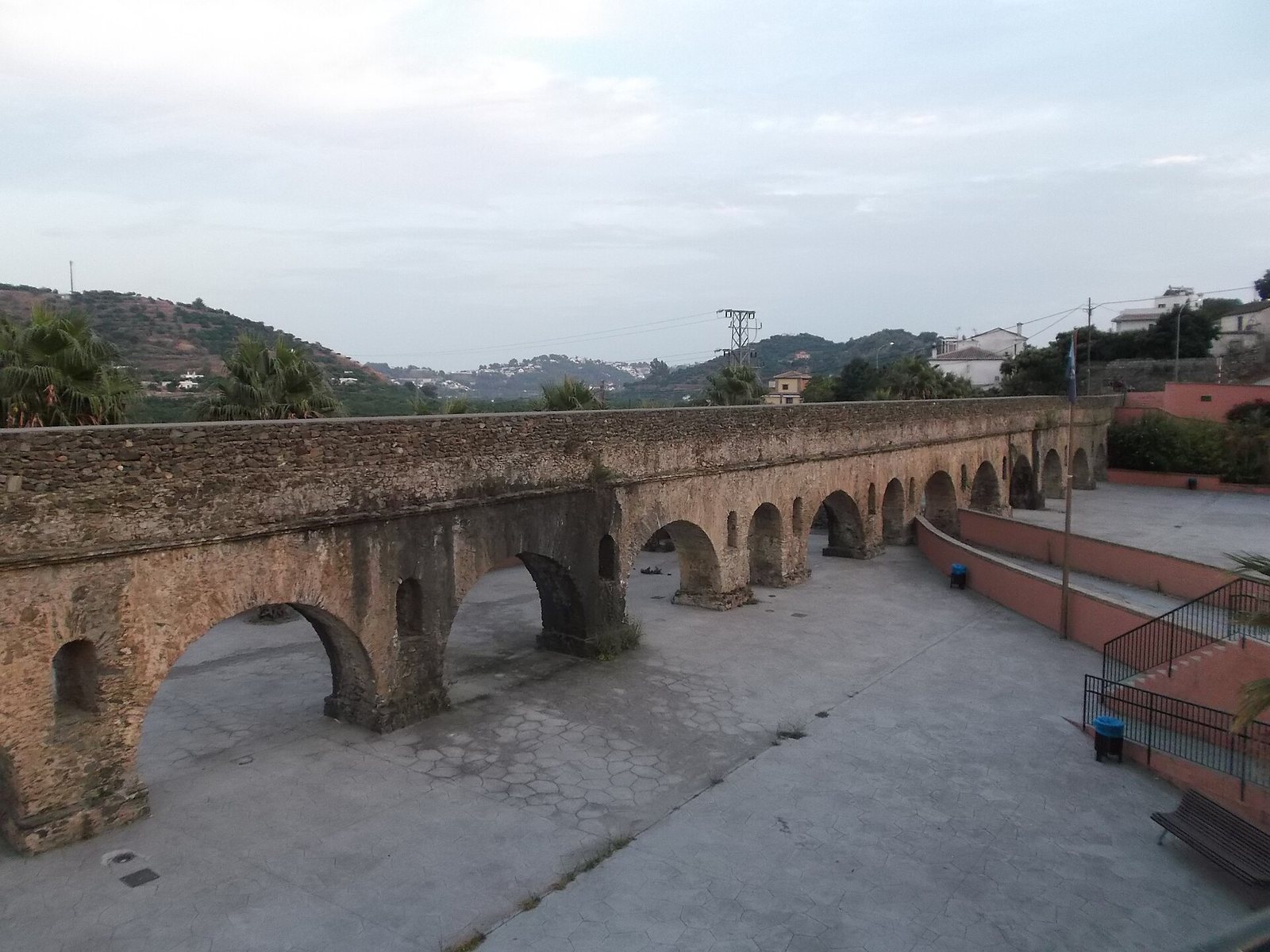
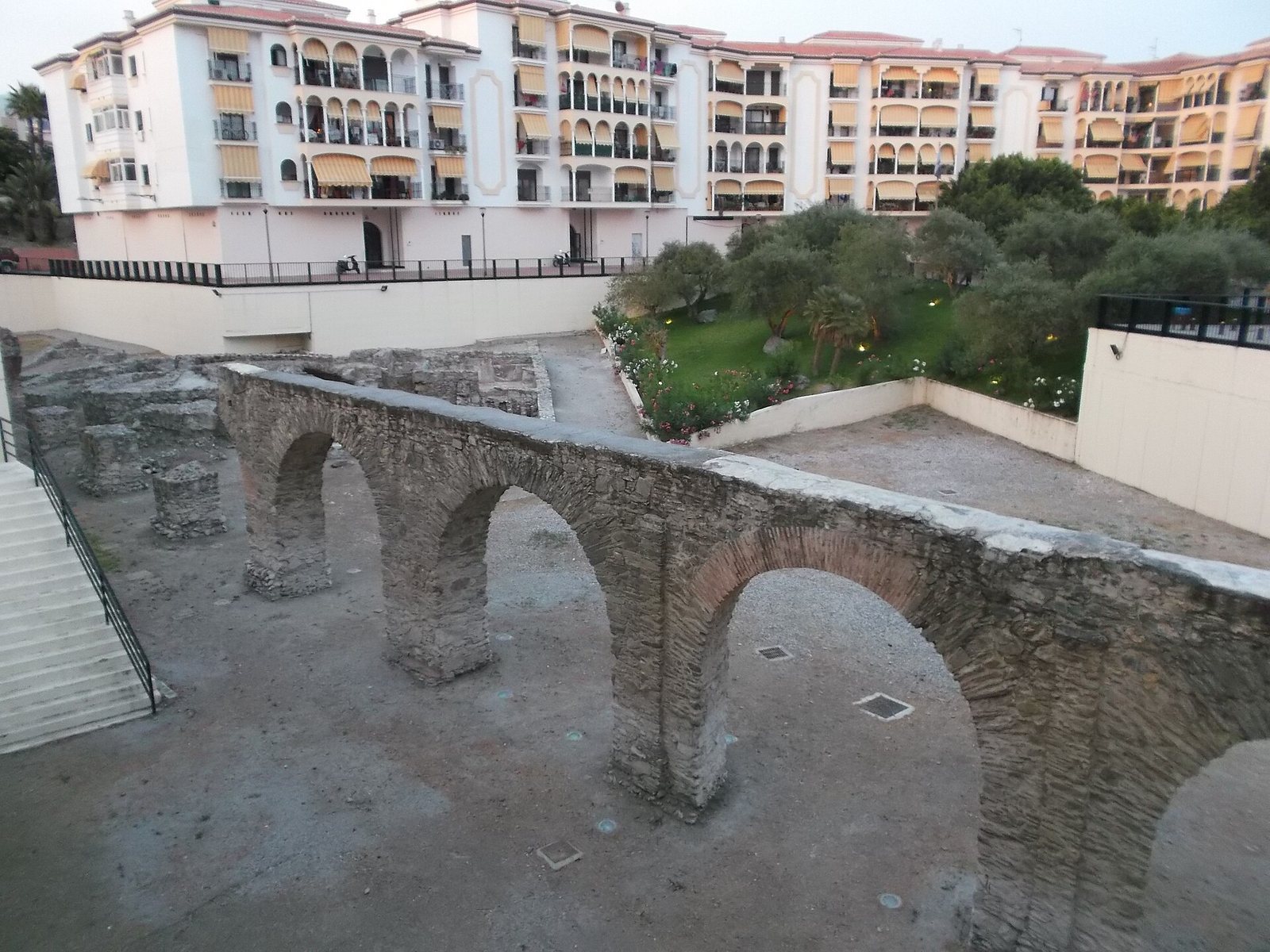
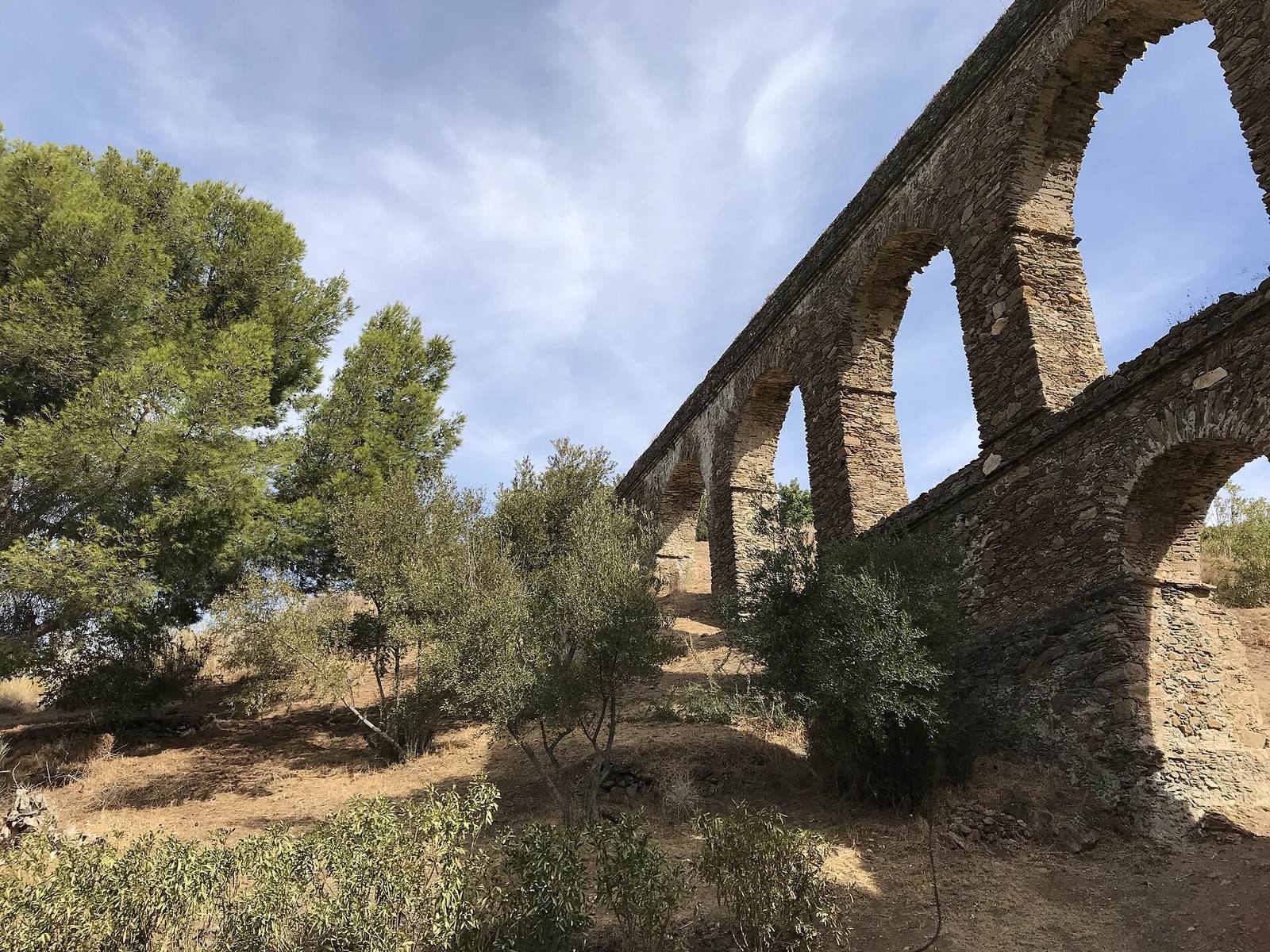
Four principal structures with rows of arches, Torrecuevas and Aqueducts I, II, and III, formed a connected system arranged downstream along the Río Seco. The main arches span 4.90 m, while the narrower arches span 2.80 m. The square supports measure 1.80 m on each side. Where a support rises more than 5 m, a lower connecting section links parts of the structure. Small arches built into the supports are a distinctive feature. The design has been compared with the arcades at Baelo Claudia, an ancient Roman city in southern Spain.
Torrecuevas aqueduct
The Torrecuevas structure is 130 m long and built of rough schist stonework. It has 17 arches of the standard span, with a smaller arch at each end.
Aqueduct I
Aqueduct I has one level, with four main arches and two narrower ones.
Aqueduct II
Aqueduct II has nine main arches and two narrower arches. Its tallest section includes three reinforcing arches between the supports. The structure has two levels only in its middle section.
Aqueduct III
Aqueduct III is 90 m long and 17.50 m high. It has two levels, with nine main arches and two smaller ones.
Terminal water works
Inverted siphon
The terminal section included an inverted siphon, a pressurized pipe that descends through low ground and rises again. Made of ceramic pipes, it extended for about 1 km. A device may have been fitted at its end to reduce the water pressure. Excavations at La Carrera uncovered the siphon’s low central section, known as its venter.
Cuevas de Siete Palacios
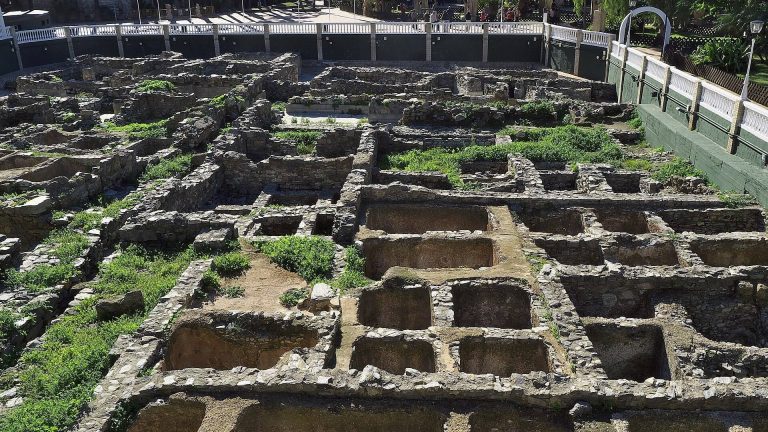
The structure at Cuevas de Siete Palacios is a vaulted hall with seven lengthwise sections, associated with the terminal water-storage system. It was once identified as the aqueduct’s water-distribution building, but excavation found no water-resistant mortar there, and that identification was rejected.