Oratorio di San Celso: A Former Catholic Oratory in Rome
Site at a Glance
- Popularity
- Low
- Country
- Italy
- Primary era
- Early Modern
- Eras represented
- Early Modern
- Civilizations
- Papal States
- Site type
- Religious
- Remains
- Chapel
On this page6 sections
History
Foundation and confraternity
The Oratorio di San Celso is a former Roman Catholic oratory and church in Rome’s Rione Ponte, a traditional district of the city in Italy. Built in 1561 for the Confraternity of the Most Holy Sacrament, it was dedicated to Saint Celsus, revered in Catholic tradition as a Christian martyr. The confraternity’s work included bringing the Eucharist, the Christian sacrament commemorating the Last Supper, to people unable to attend worship. In 1566, the group joined with the Confraternity of the Holy Name of God. The oratory was also known as San Celsino and was associated with the parish of San Giovanni Battista dei Fiorentini in the Diocese of Rome, a church jurisdiction overseen by a bishop.
Restoration and later use
Cardinal Niccolò Coscia arranged a restoration in 1725, and the oratory was reconsecrated on 29 September that year. The confraternity continued to use the building as its seat until 1984, when it was transferred to Caritas, the Diocese of Rome’s charitable organization, to serve as a charity center. Caritas left in 1993; the building was subsequently abandoned and deconsecrated. The façade was restored during the 1990s.
Remains
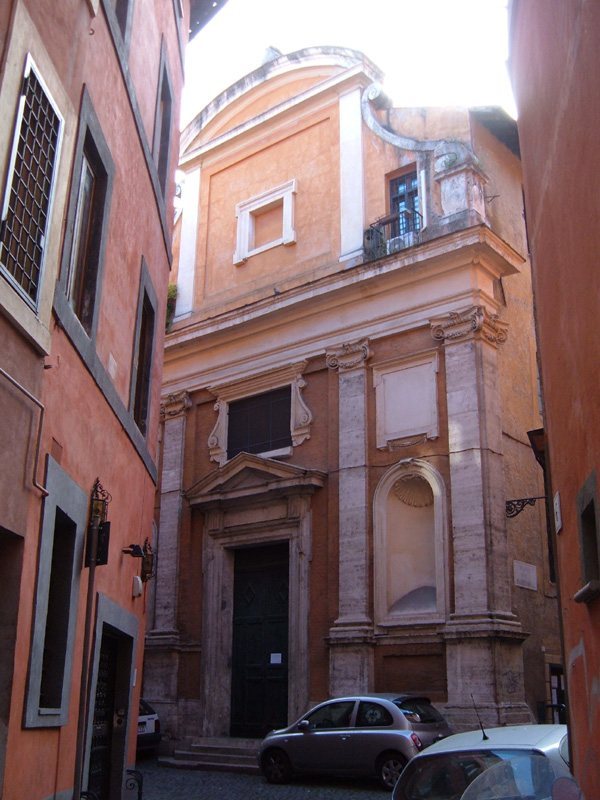
The oratory stands on Vicolo di San Celso beside the church of Santi Celso e Giuliano. Its façade has two levels, while the interior contains a single altar.
Façade
Four Ionic pilasters, flattened column-like features with scroll-shaped capitals, rise from tall bases across the lower level. Shell motifs decorate niches on either side of the entrance. Above them, a blind window, a decorative window-shaped feature without an opening, is flanked by volutes, or spiral-shaped ornaments.
Interior
The former altarpiece showed Christ speaking with Peter at the Last Supper. Made in 1725, it was a copy of a seventeenth-century original; a wooden crucifix now occupies its place. A ceiling fresco, a painting made on wet plaster, depicts the Assumption of the Virgin Mary. An inscription to the right of the high altar, the church’s principal altar, commemorates the oratory’s consecration.