Oratorio dei Bianchi: A Roman Catholic Oratory in Fosdinovo
Site at a Glance
- Popularity
- Very Low
- Country
- Italy
- Primary era
- Early Modern
- Eras represented
- Early Modern, Modern
- Civilizations
- French, Holy Roman Empire, Italian
- Site type
- Religious
- Remains
- Chapel
On this page15 sections
History
Foundation and confraternity
The Oratorio dei Bianchi is a Roman Catholic oratory, or chapel for prayer, in Fosdinovo, Italy. Dedicated to the Annunciation, the Christian account in which the angel Gabriel tells Mary she will bear Jesus, it began as a building erected in 1468 by the Franciscan confraternity of the Disciplinati. A confraternity is a lay religious association. The oratory was intended to be Fosdinovo’s second sacred building after the church of San Remigio, and the initiative came from Giovanni da Milano, a friar in the Catholic Franciscan order. The first building stood beside San Remigio, at the site now called Camposanto Vecchio. A fourteenth-century statue of the Annunciation was moved there from the church.
The association, also known as the Battuti and later the Bianchi, provided religious rites and burial for its members. During the final three days of Carnival and on Sundays in Lent, members gathered to recite psalms and practise self-flagellation as penance. In its early years, men and women travelled between towns singing the Stabat Mater, a hymn on Mary’s grief at the crucifixion, and calling, “Peace and mercy!” Members included Malaspina marquises, rulers of the territory of Fosdinovo, and prominent local families. The confraternity still exists; its membership is now male, and its canonical clothing consists of a white tunic and a blue rochet, a short garment worn over a tunic.
Fire and rebuilding
A fire on the night of All Souls’ Day in 1501 destroyed the first oratory and also affected the cathedral’s parish archive. The statue of the Annunciation survived. The faithful regarded its survival as a miracle, and the later oratory was built in the statue’s honor.
The present building was constructed on a different site on Via Roma between 1648 and 1653, during the marquisate of Giacomo, also known as Jacopo, Malaspina. Its vault was built in 1651. In 1653, permission was sought to demolish the old church and transfer its graves and bones to the new site. Painter Domenico Utens worked in the oratory from that year, but his works have since been lost or destroyed.
Devotional use and later history
A visitation by the vicar general, a senior cleric who assists a bishop, in 1670 recorded altars established by members of the Malaspina family and other local benefactors. The altar of St Francis Xavier was founded under Giacomo II Malaspina and had an early painting by Camillo Pucci, showing the saint baptizing an Indian woman. Pucci made it while studying at the Academy of Florence. Bernardino Domenichelli founded the altar of St Joseph; Dr Carlo Benedettini established the altar of St Charles, now dedicated to St Anthony; and Sebastiano Milattieri founded the altar of St Sebastian. The altar of the Holy Relics is now dedicated to Our Lady of Sorrows, while Marchesa Maria Grimaldi-Malaspina commissioned the altar of St Dominic. Apart from the changes to the St Charles and Holy Relics altars, the others have kept their original positions and dedications.
Bishop Giovanni Battista Spinola of Luni-Sarzana consecrated the oratory in 1673. The church vault was repaired after the 1920 earthquake, and the Annunciation statue was restored in 1982 by Veronica Ahtman of the Fine Arts authorities in Pisa. A later restoration returned the building to use in 2002. The annual Peace Vigil, begun in 2015, has been the oratory’s only use since 2017.
Remains
Exterior and layout
Plan and construction
The oratory has a longitudinal basilica plan, meaning a church layout extending along a main axis, and ends in a square apse, the terminal space at the end of the building. Its walls are made of rough, unsquared stone. The main body has a barrel vault, a continuous arched ceiling, with raised lunettes, curved sections around windows, corresponding to three windows on each side. A separate vault over the apse has similar curved sections aligned with one window on each side. The roof structure uses timber beams and rafters, with flat terracotta tiles beneath an outer covering of flat and curved tiles.
Marble façade and piazza
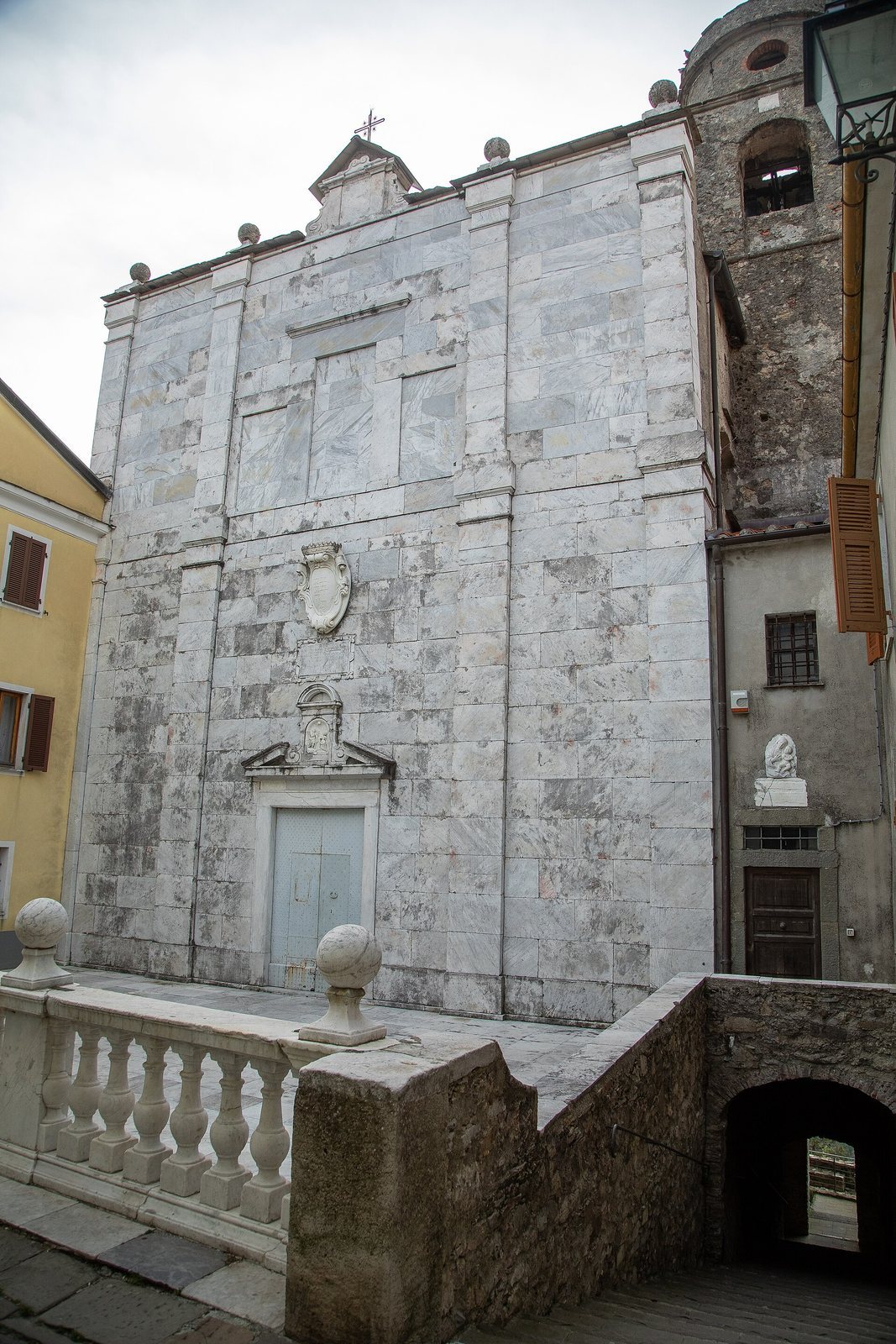
The façade is faced with white Carrara marble and bears the Malaspina coat of arms. A carved plaque commemorates Pasquale Malaspina’s donation of the church. The Carrara-marble piazza in front separates the building from Via Roma. Giò Pietro Carli built the piazza in 1655; marble blocks were laid there in 1697, and Giuseppe Serchioli of Bedizzano made the enclosing marble balustrade, a railing supported by a row of posts, in 1698. The façade was completed in 1666 by Giulio Pasciuti, a master craftsman from Bedizzano. Its 550 marble pieces cost 3,329 lire.
Bell tower
The bell tower adjoins the church and rises above the sacristy, a room used to prepare for services and store religious objects. Built in 1658, it has a square lower plan and stands about 19 metres above the church floor. Its upper part is cylindrical, with a spherical vault and a roof covered in slate slabs.
Interior
Vaults and floor
In the main body, the raised curved sections of the barrel vault frame the windows. The apse has its own vault, with corresponding sections around its two windows. The present floor dates from the twentieth century and combines square white-marble and Bardiglio tiles; Bardiglio is grey marble. Older marble flooring survives in niches and near thresholds. The church floor was paved with white Carrara marble and Bardiglio in 1690.
Altars
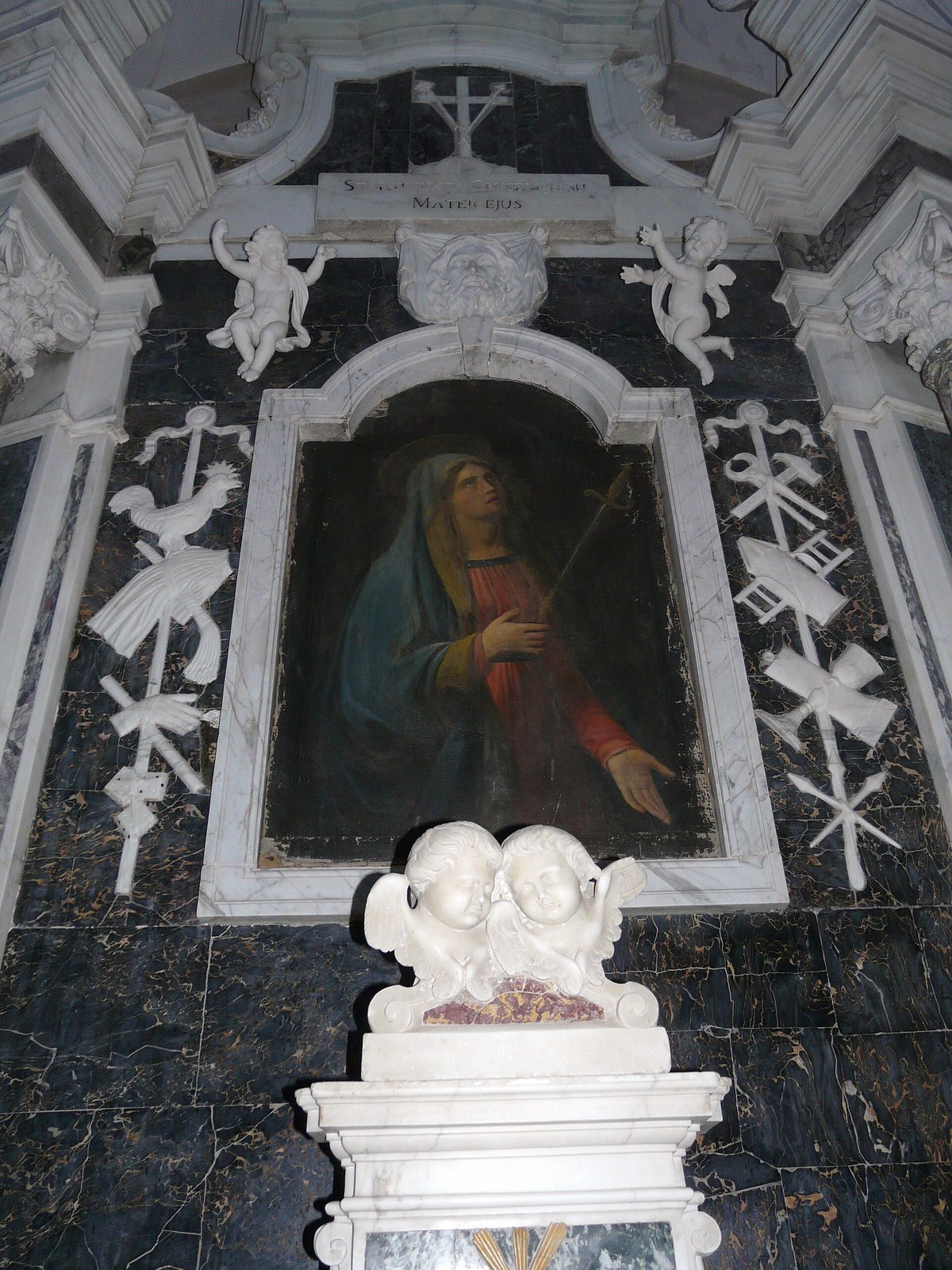
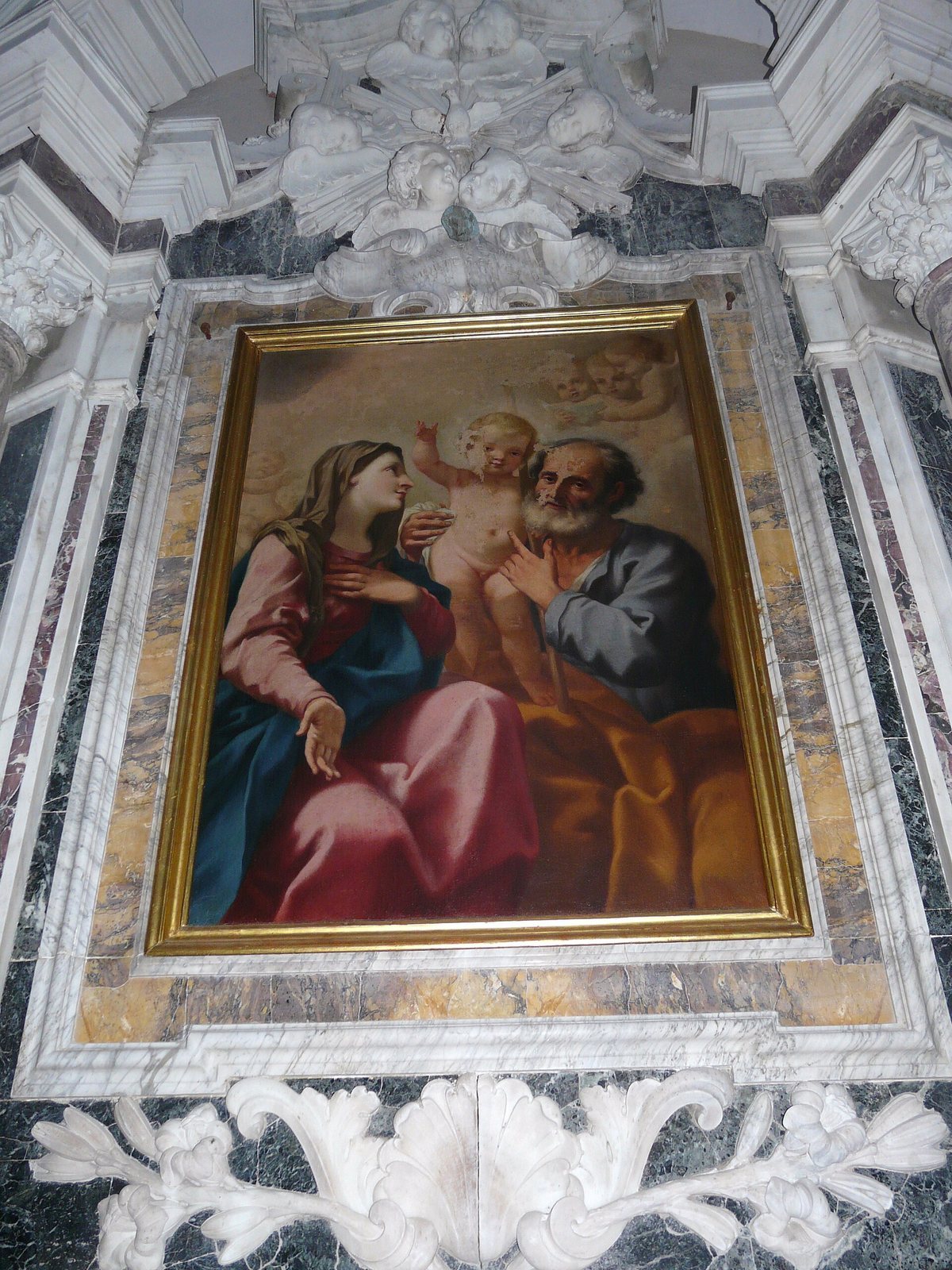
Six marble side altars stand in the church, three along each side, in addition to the marble high altar. The high altar is dedicated to the Annunciation and holds the statue of the Virgin. A balustrade with turned columns surrounds it. Niches beside the altar contain statues of Mary’s parents, St Anne and St Joachim, while four other statues depict Elijah, Jeremiah, David, and Moses. A statue of the Archangel Gabriel stands at the side altar nearest the presbytery, the area around the main altar. The St Joseph altar has an altarpiece of the Holy Family and was made by Valli in 1747. Giuseppe Casoni, a sculptor from Carrara, made the 1810 altarpiece for Our Lady of Sorrows. It shows Mary pierced by a sword, an image referring to the saying that a sword would pierce her heart and to her loss of her child at a young age.
Sculpture and paintings
A life-size wooden sculpture of the dead Jesus was made in 1646 by painter Giovanni Francesco Galeotti. The church also contains a nineteenth-century painting of the Madonna and Child. Seventeenth-century ceiling frescoes depict Christ and God the Father, with the Assumption of the Virgin at the centre.
Choir and organ
The walnut choir has seven folding seats along each side and a central bench at the back. Above the entrance, a wooden choir gallery rests on two white Carrara-marble columns, which probably came from the earlier oratory. A marble staircase, partly set into the wall, leads up to it. The Serassi-family organ in the gallery probably dates to the early nineteenth century; its first payment was made in 1820, and it remains operational.
Sacristy
The sacristy area comprises two rooms linked by a corridor that runs from the end of the church toward the bell tower and an outside door. One marble plaque above the door and another in the apse commemorate the oratory’s consecration. The room now used as the sacristy is approximately square, with a twentieth-century frescoed vault and a checkerboard floor of white marble.