Malaspina Castle: A Medieval Fortress and Renaissance Court in Italy


Site at a Glance
- Rating
- 4.6
- Popularity
- Medium
- Country
- Italy
- Primary era
- Early Modern
- External website
- Open
- Eras represented
- Medieval, Early Modern
- Civilizations
- Holy Roman Empire
- Site type
- Military
- Remains
- Castle
On this page10 sections
History
Malaspina Castle is a medieval fortress in Fosdinovo, Italy, whose present construction began in the second half of the twelfth century. Built to dominate and defend the early settlement, it became the court of the Malaspina marquises and the principal residence of the Spino Fiorito branch from the fourteenth through the eighteenth century.
Early Fortress and Malaspina Rule
Fosdinovo was already known as the Castrum Fosdinovense in a document issued at Lucca in 1084. The fortified settlement was initially administered by local inhabitants on behalf of the counts-bishops of Luni, medieval bishops who also exercised territorial and feudal authority around the former see of Luni. Their struggle with emerging communes and noble families continued into the early fourteenth century.
In 1221, the Malaspina family divided its extensive Apennine territories between the Spino Secco and Spino Fiorito branches. Fosdinovo was assigned to Spino Fiorito, although the Malaspina and the counts-bishops of Luni continued to dispute control of the territory for several decades.
In 1340, the Nobles of Fosdinovo transferred or restored the territory and its jurisdictions to Spinetta Malaspina, a condottiero, or professional military commander serving under contract. He had recovered Fosdinovo from the Republic of Lucca and established the Marquisate of Fosdinovo, a territory governed by a marquis, making the castle his court.
Spinetta died without children in 1352. Three years later, Emperor Charles IV ratified the marquisate and granted it to Spinetta’s nephews Gabriele, Galeotto I, and Guglielmo, the sons of his brother Azzolino. Gabriele initially held power, but the title and fortress later passed to Galeotto I. A jurist, Galeotto was the first member of the family explicitly associated with embellishing the fortress.
Dynastic disputes continued among the Malaspina branches until Spinetta II, Galeotto’s son, regularized the succession in 1393. He distinguished the Fosdinovo branch of Spino Fiorito from the branch based at Castel dell’Aquila, clarifying the family’s division of power.
Renaissance Transformation
At the end of the fifteenth century, Gabriele II Malaspina, the sixth Marquis of Fosdinovo, restored the castle according to Renaissance principles of military fortification. During the sixteenth century, further work by Gabriele II and his successor Lorenzo transformed the fortress into an aristocratic residence and Renaissance court.
The settlement expanded during the seventeenth-century marquisate of Giacomo II Malaspina. In 1636, Fosdinovo was recorded as having 800 households, reflecting the continuing importance of the marquisate and its seat.
From the Revolutionary Era to the Kingdom of Italy
Malaspina rule ended during the upheavals associated with the French Revolution, when Fosdinovo was annexed to the Cisalpine Republic, a French-backed state in northern Italy during the Revolutionary and Napoleonic period. After Carlo Emanuele Malaspina died without heirs in 1808, the castle passed to Marquis Giuseppe Azzolino.
Following the Congress of Vienna in 1815, the former Malaspina territories were incorporated into the Duchy of Modena and Reggio. The Austria-Este, a branch of the Habsburg-Lorraine dynasty, acquired the castle from Azzolino and made it the capital of their Lunigiana territories.
When the revolutions of 1848 forced Duke Francis V of Austria-Este to flee to Fosdinovo, a provisional government was established there. Austrian forces restored the Este government in 1849, and it lasted until 1859. A second provisional government then operated at Fosdinovo until the proclamation of the Kingdom of Italy in 1861.
Ownership, War, and Restoration
The Austria-Este rulers later sold the castle to the administration of Fosdinovo Hospital. Marquis Carlo Maurizio Malaspina subsequently reacquired it for the family. After his death, ownership passed to his brother Alfonso Malaspina and then to their nephew Alessandro Malaspina, the son of Cristina Malaspina and the Florentine Marquis Filippo Torrigiani. Alessandro added Malaspina to his surname and thereafter bore the name Torrigiani-Malaspina.
The castle remains owned by the Torrigiani-Malaspina family, which descends from the Malaspina through the female line. German forces occupied it from autumn 1944 until 23 April 1945, when Allied bombardment and the German evacuation caused severe wartime devastation. Carlo Filippo Torrigiani-Malaspina promoted a major restoration campaign from 1960 to 1965, repairing the damage caused by the Second World War. The castle is protected as a historic residence by the Italian authority responsible for artistic and architectural heritage and is regarded as the largest and best-preserved castle in Lunigiana.
Traditions Connected with the Castle
Tradition holds that Dante Alighieri stayed at Malaspina Castle during his exile. Dante, the medieval Italian poet and author of the Divine Comedy, was associated with the Malaspina through friendship, a relationship also recalled by Giovanni Boccaccio, the fourteenth-century writer and scholar who wrote about Dante and his circle. The castle’s frescoes preserve this association.
Local tradition also tells of Bianca Maria Aloisia Malaspina, who was supposedly walled up alive by her father after a relationship with a stable hand. One version places her death in 1690, while another assigns the story to the thirteenth century and identifies her as the daughter of an earlier ancestor of Spinetta Malaspina rather than of Giacomo II. A separate legend concerns Marchioness Cristina Adelaide Pallavicino, who is said to have killed numerous lovers with a trapdoor. Alleged paranormal phenomena, including sightings of Bianca Malaspina’s ghost, are also associated with the castle.
Remains
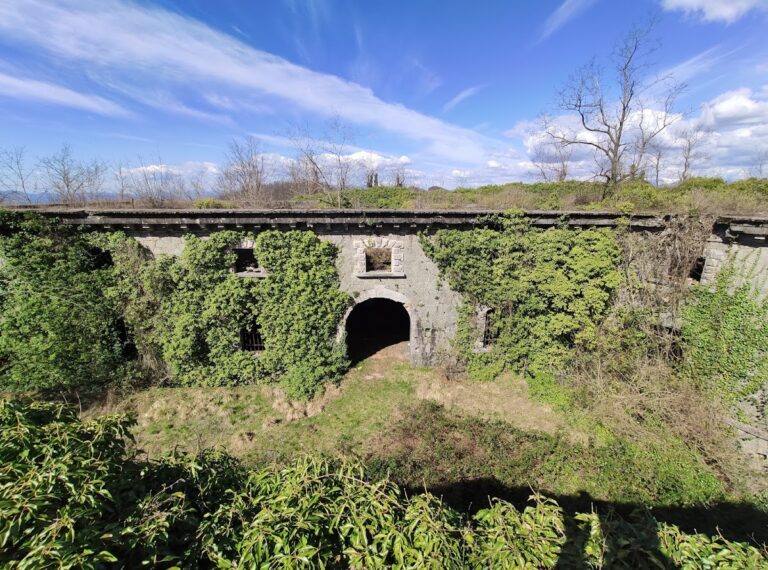
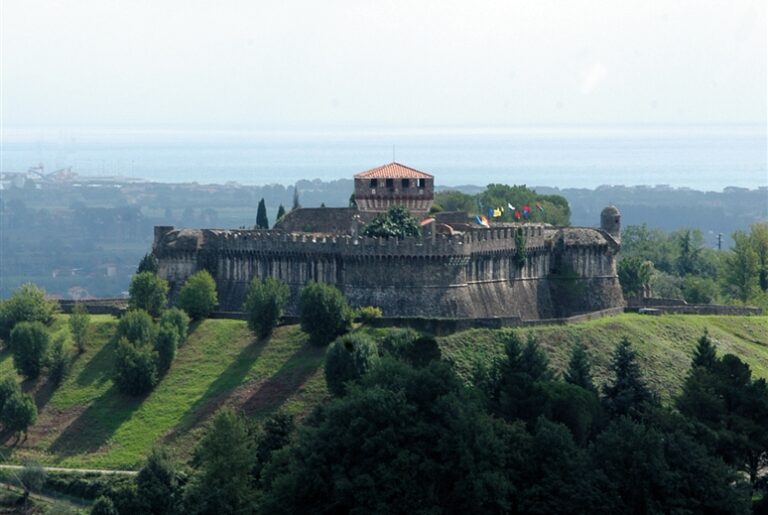
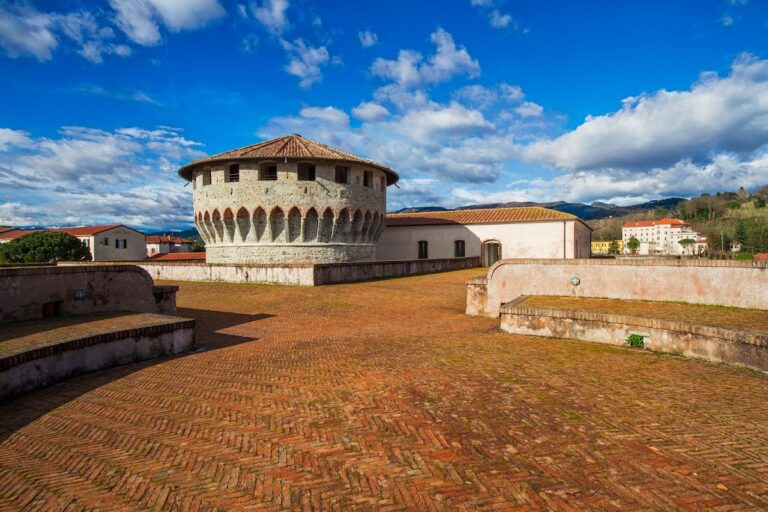
Malaspina Castle has a quadrangular plan integrated with a sandstone rocky outcrop. Four round towers, a semicircular bastion, two internal courtyards, roof-level wall walks, hanging gardens, and loggias form a complex defensive and residential arrangement. A projecting defensive work facing the settlement, formerly called the Spuntone, protects the approach. The original system also included a drawbridge.
Entrance and Courtyards
The thirteenth-century entrance gate opens into a small Romanesque courtyard. A marble column from the same century supports the loggias above it. During the Renaissance, cannon were positioned in this entrance court, while broad stair ramps led to the larger central courtyard. Their width allowed horses to use the ascent.
The central courtyard contains a Renaissance portico supported by stone columns, together with a well and a sixteenth-century marble portal. The portal marks the route into the castle rooms, linking the courtyard’s defensive setting with the residential spaces developed during the Renaissance.
Furnished Rooms and Frescoes
The castle remains furnished throughout, including its historic rooms and upper-level chambers. The rooms were furnished and decorated with frescoes at the end of the nineteenth century under the last Malaspina owners. They include an entrance hall, a dining room with a large eighteenth-century fireplace and seventeenth-century pharmacy ceramics, a throne room, and a large hall with adjoining drawing rooms.
The oldest eastern tower contains the room traditionally identified as Dante’s room. Frescoes in the large central hall depict Dante’s friendship with the Malaspina, giving physical form to the tradition of his association with the castle.
Trapdoors and Torture Installations
The trapdoor room has a torture chamber below it. Three other openings were traditionally associated with the castle’s trapdoor stories: two lay in the loggia overlooking the garden and one in a corner tower. They were said to operate by springs and to lead to bases fitted with upward-pointing knives.
Another alleged torture installation consisted of an iron arm projecting from a tower wall, a pulley, and a ring fixed into the ground. A rope connected these elements and was used, according to the tradition, to suspend a victim.
Nearby sites