Fortezza di Sarzanello: A Renaissance Fortress Above Sarzana


Site at a Glance
- Rating
- 4.3
- Popularity
- Medium
- Country
- Italy
- Primary era
- Early Modern
- External website
- Open
- Eras represented
- Medieval, Early Modern
- Civilizations
- Genoese, Republic of Florence
- Site type
- Military
- Remains
- Fort
On this page12 sections
History
Fortezza di Sarzanello is a military fortress above Sarzana in Italy, overlooking the Val di Magra. Its history began with a medieval stronghold associated with the Bishops of Luni and culminated in the complete rebuilding of the site for the military needs of the late fifteenth century.
From Luni to the medieval stronghold
The decline of Luni, an ancient settlement and ecclesiastical center in the lower Magra valley, began in the fourth century. As insecurity increased, inhabitants moved toward defensible hills, including Sarzanello, where exiles settled around an important residence of the Bishop of Luni.
A military structure on the hill is first mentioned in 963, when Emperor Otto I granted the Bishop of Luni possession of six castra, or fortified settlements, including de Sarzano. By the end of the tenth century, Sarzanello had become one of the bishop’s residences in the valley. The castrum, meaning a fortified stronghold, appears again in 1076, 1078, and 1080 as a curtis, an estate or administrative domain, of Emperor Frederick I. In 1191 it was listed as a curtis of Henry VI.
Imperial and Genoese phases
From 1314 to 1328, the imperial vicar Castruccio Castracani held plenipotentiary authority in the area and probably used Sarzanello as his residence. He may have altered the earlier fortress, although that structure was later entirely destroyed or incorporated into the present one, leaving no identifiable trace.
In 1421, the Genoese ruler Tomaso Fregoso ordered alterations and repairs. Work continued until Florence took control of the area, and in 1447 the fortress was governed by Iacopo Biassa. These interventions preceded the much more extensive rebuilding carried out under the Medici.
Medici rebuilding and completion
After fortifying Sarzana and constructing Fortezza Firmafede on the site of an earlier citadel, the Medici transformed Sarzanello to meet the demands of contemporary warfare. Francesco di Giovanni, known as Francione, and Luca del Caprina designed the new fortress, which completely replaced its predecessor.
The work was still unfinished in 1494, when Piero de’ Medici handed Sarzana and Sarzanello to King Charles VIII of France. Construction resumed after Charles returned to France, when the two sites passed to Genoa’s Banco di San Giorgio. Pietro Biancardo and Matteo Civitali completed the fortress in 1502, following the Florentine design.
Once the main fortress had been completed, an outlying triangular fortification called a ravelin was added to protect the entrance and block artillery fire from the southeastern hill known as the Fortino. A basic defensive line was also established on that hill. Together, these additions completed the fortress’s formal defensive arrangement.
Modernization, attack, and changing purpose
At the beginning of the eighteenth century, Genoa modernized the defenses by installing gun ports in two central towers. Several rooms were also converted into accommodation and barracks. In 1747, during the War of the Austrian Succession, troops serving Maria Theresa of Austria and commanded by the German general Wocter unsuccessfully tried to capture the fortress.
After the failed attack, the Genoese government ordered the nearby village of Sarzanello to be demolished because it assisted enemy assaults. The operation destroyed 120 houses and the ancient church. In 1748, the inhabitants were compelled to move southward to the area that became the new Sarzanello.
During the period of French rule, the fortress was threatened with demolition but survived because the operation had to be completed within three months. In 1814, after the territory passed to the Kingdom of Sardinia, restoration was ordered. King Charles Albert visited the fortress in 1837. Its strategic military function ended during the nineteenth century.
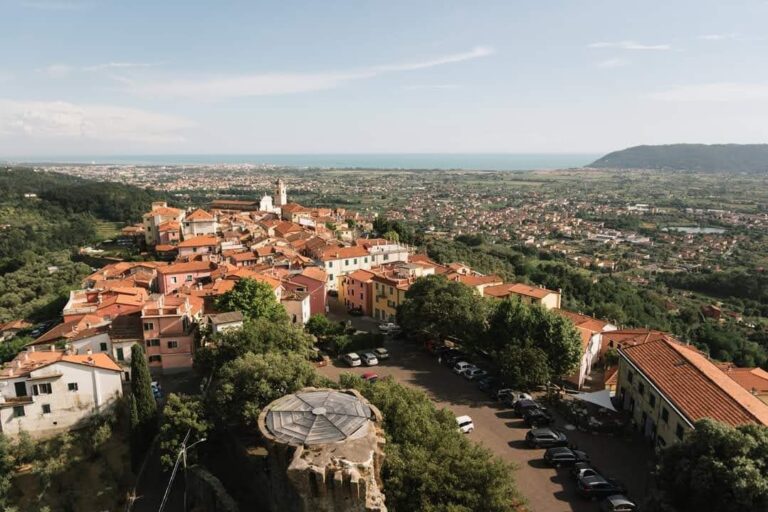
Fortezza di Sarzanello is now owned by the Municipality of Sarzana and has been managed by Italy’s Ministry of Culture since December 2014. Management initially belonged to the Liguria Museum Pole and, from December 2019, to the Regional Museums Directorate. The well-preserved fortress remains one of Sarzana’s symbols because of its position above the Val di Magra.
Remains
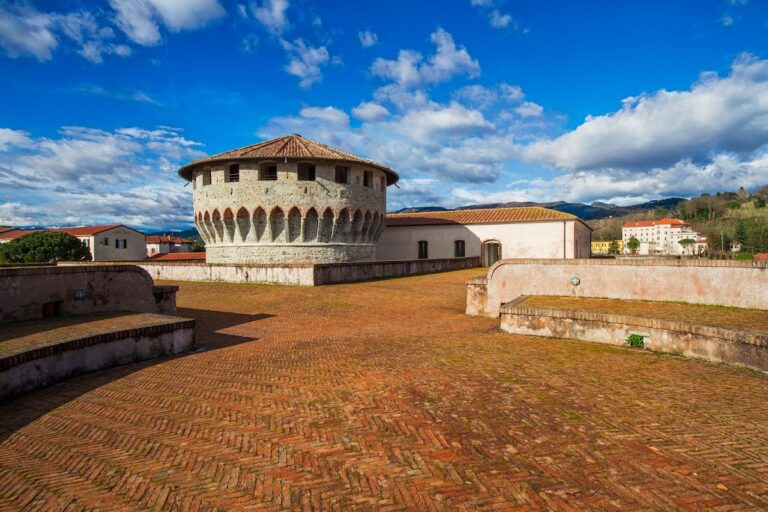
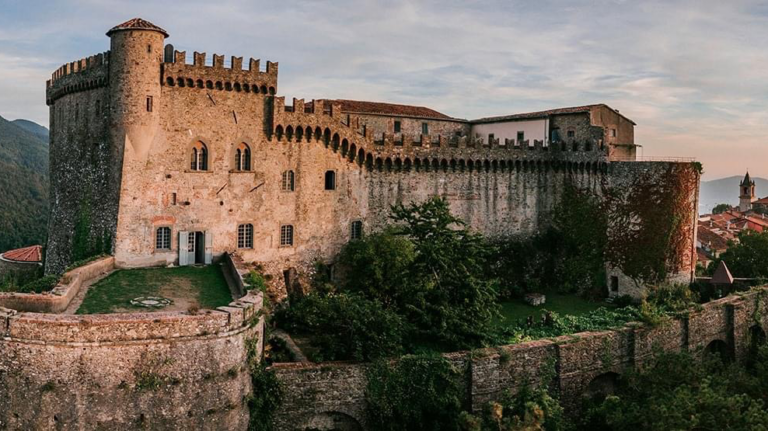
Fortezza di Sarzanello occupies Sarzanello hill above the Val di Magra. Its surviving layout consists of a principal triangular castle and a separate triangular ravelin opposite it. A bridge links the two elements, whose combined forms create an approximately diamond-shaped composition. The entrance is reached across a stone bridge spanning a wide and deep fortified moat.
The principal castle
Triangular fortress and towers
The main castle has a triangular plan with a bastion at each vertex. A bastion is a projecting fortification designed to allow defensive fire along the walls. Three low, circular towers remain within the design, rising no higher than the surrounding walls. The castle also contains a central square tower and a triangular proto-bastion, an early form of the projecting defensive structure.
Interior military spaces
The early eighteenth-century modernization altered the castle’s military arrangements. Gun ports were installed in two central towers, while some interior rooms were adapted for accommodation and barracks. These changes remain part of the fortress’s later defensive and practical history.
The ravelin and outer defenses
Triangular entrance defense
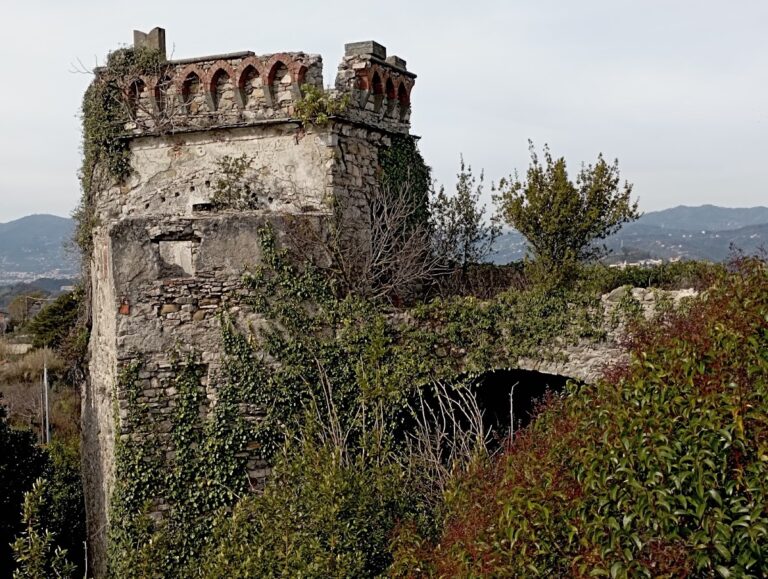
Opposite the main castle stands the large ravelin, an outlying triangular fortification placed beyond the main ditch to protect the entrance and disrupt attacks. It is formed as a fortified embankment and is connected to the castle by the bridge over the moat. The ravelin probably incorporates the ancient tower of the earlier medieval stronghold.
The Fortino side
The southeastern side faces the hill called the Fortino. From this position, artillery could otherwise have fired on the entrance. A rudimentary defensive line was therefore established on the hill as part of the fortress’s completed defensive configuration.
Nearby sites